

Today’s post comes from Rakesh Agrawal, a product executive and writer focused on autonomous vehicles and their real-world impact. He’s a regular contributor to PCMag, where he’s written about robotaxis, including Waymo and Zoox, drawing on firsthand ride experiences and a product-builder’s perspective shaped by leadership roles at Amazon and Microsoft.
Safety is the first priority for autonomous vehicles, and in my experience, especially after riding extensively in Waymo and Zoox vehicles, it has effectively become table stakes. These vehicles are already safer than human drivers and I barely think about the novelty of getting into a Waymo anymore.
At this point, the more interesting question is no longer whether autonomous vehicles can drive safely, but how they should behave once the driver disappears. From a passenger’s perspective, safety may be assumed, but comfort, control, and overall experience are still up for debate.
Putting on my product leader hat, what follows is a set of passenger-facing features that should be inevitable in a mature autonomous ride service.
Convenience
Share from my phone’s map app to Waymo app
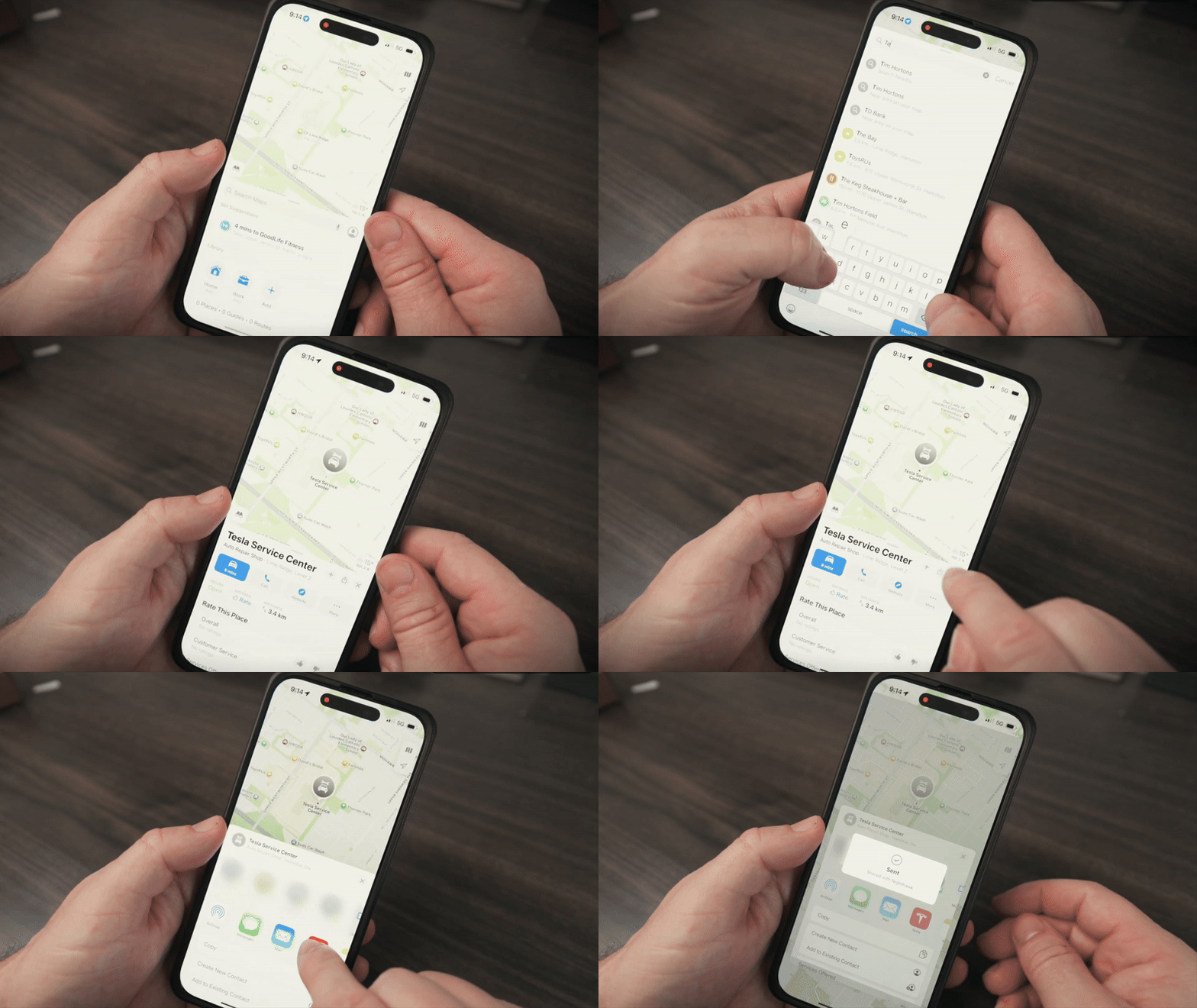
If I’ve already searched for a destination in Apple Maps or Google Maps, I shouldn’t have to re-type it inside the vehicle’s app. A system-level share sheet—tap once, send destination to the AV provider—removes friction at exactly the moment a user is making a transportation decision. My Tesla already has a share sheet: in Maps, I can send the place directly to my Tesla. When I get in, it’s ready to go.
Retractable charging cables
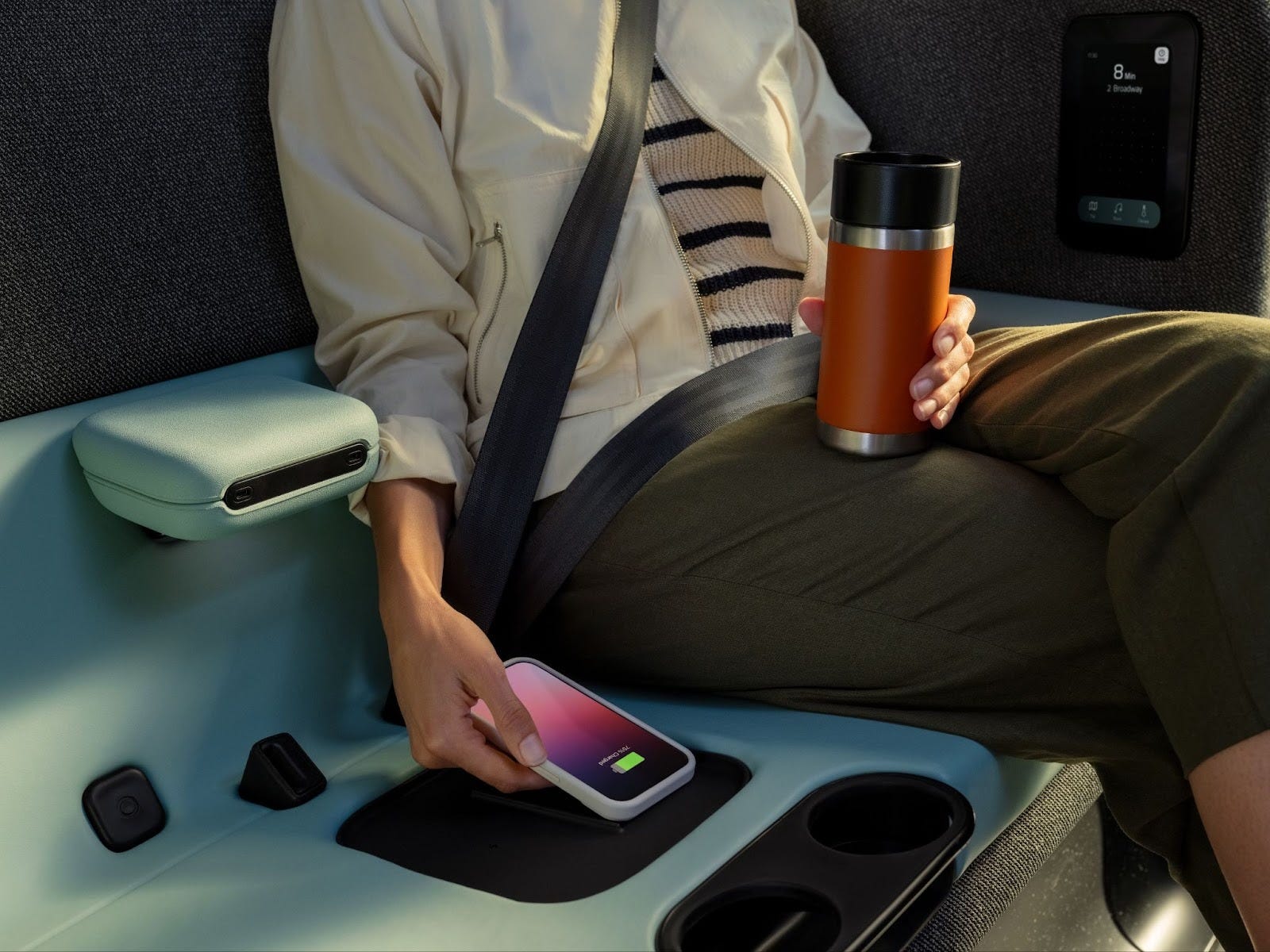
Most people do not carry charging cables. Vehicles should assume charge-hungry passengers and embed retractable, durable cables. The cars already have ports, but that isn’t enough. The difference is huge. Ports assume planning. Cables assume reality.
Making them retractable makes sure that they’re available for future passengers.
Zoox has Qi chargers already, but that’s not good enough. Qi, and even Qi2, doesn’t deliver enough juice fast enough for today’s phones. You need fast charging for phones since rides typically only last 15-20 minutes. Cable theft is a problem for Uber and Lyft drivers, but it shouldn’t be for AV fleets. Secure the cables and charge passengers who steal them. Problem solved.
Don’t take me there: destination-closed alerts
Navigation systems already know when destinations are closed. If I ask to be dropped off at La Taqueria in San Francisco on a Tuesday afternoon (like Harry did on his last trip to SF 😂), the vehicle should flag that immediately.
Apple and Google Maps already do this. Waymo will still take you there. An autonomous vehicle should surface this before departure: “This destination appears closed. Proceed anyway?” It avoids wasted trips and builds trust. You may even keep the ride: “La Taqueria is closed. Would you like to go to El Farolito nearby?”
Calendar integration
If my next meeting is in my calendar, the car should know that, opt in of course, and offer to route me there automatically with departure time suggestions based on traffic. Over time, it should learn patterns like weekday office commutes, weekly dinners, or recurring medical appointments. At that point, the vehicle stops being just transportation and starts functioning like a lightweight logistics assistant.
Uber and Lyft used to offer a similar calendar integration but stopped offering this feature a few years ago; I have no idea why.
Comfort and Personalization
Preference to turn off blinkers
Some passengers find repetitive turn signal clicking distracting or anxiety inducing, especially when sitting in silence while the vehicle drives itself. A rider level setting to mute interior turn signal sounds, clearly optional and easy to toggle on or off, does not affect safety since external indicators still operate, but it meaningfully improves cabin comfort. AV user experience is not just visual. It is auditory.
I had been thinking about this for a while, and it was a pleasant surprise when I did not hear the clicking during a ride with Zoox.
This is a good example of designing for both one time and frequent riders. For a first ride, the sound can be reassuring. For frequent users, it quickly becomes annoying.
Preference to turn off wipers
Like turn signals, windshield wipers create unnecessary noise for some riders. Passengers should have the option to suppress interior wiper sounds or motion, with a clear on or off control. The vehicle does not rely on wipers to see. It has a full sensor stack for that.
Some riders may want a clear windshield. Others may prefer a quieter cabin for conversation or phone calls. This is another case where simple rider choice improves comfort without affecting safety.
There is also a small operational benefit. Wipers are a wear and tear item, and using them less reduces maintenance over time.
Access and Throughput
Sliding or carriage-style doors
Concert venues. Stadiums. Airports. Dense downtown curbs. Traditional hinged doors are terrible for high-volume loading and unloading. Sliding or wide-swing carriage doors speed ingress and egress, reduce curb occupancy time and dramatically improve accessibility for wheelchairs and strollers. This isn’t a styling flourish—it’s infrastructure for scale.
It also reduces the need for Waymo to pay people to close doors. Not only does it save Waymo the $20 to get someone to close the door, it keeps the vehicle in service.
(Zoox already has sliding doors.)
Customer Delight
Selfie camera
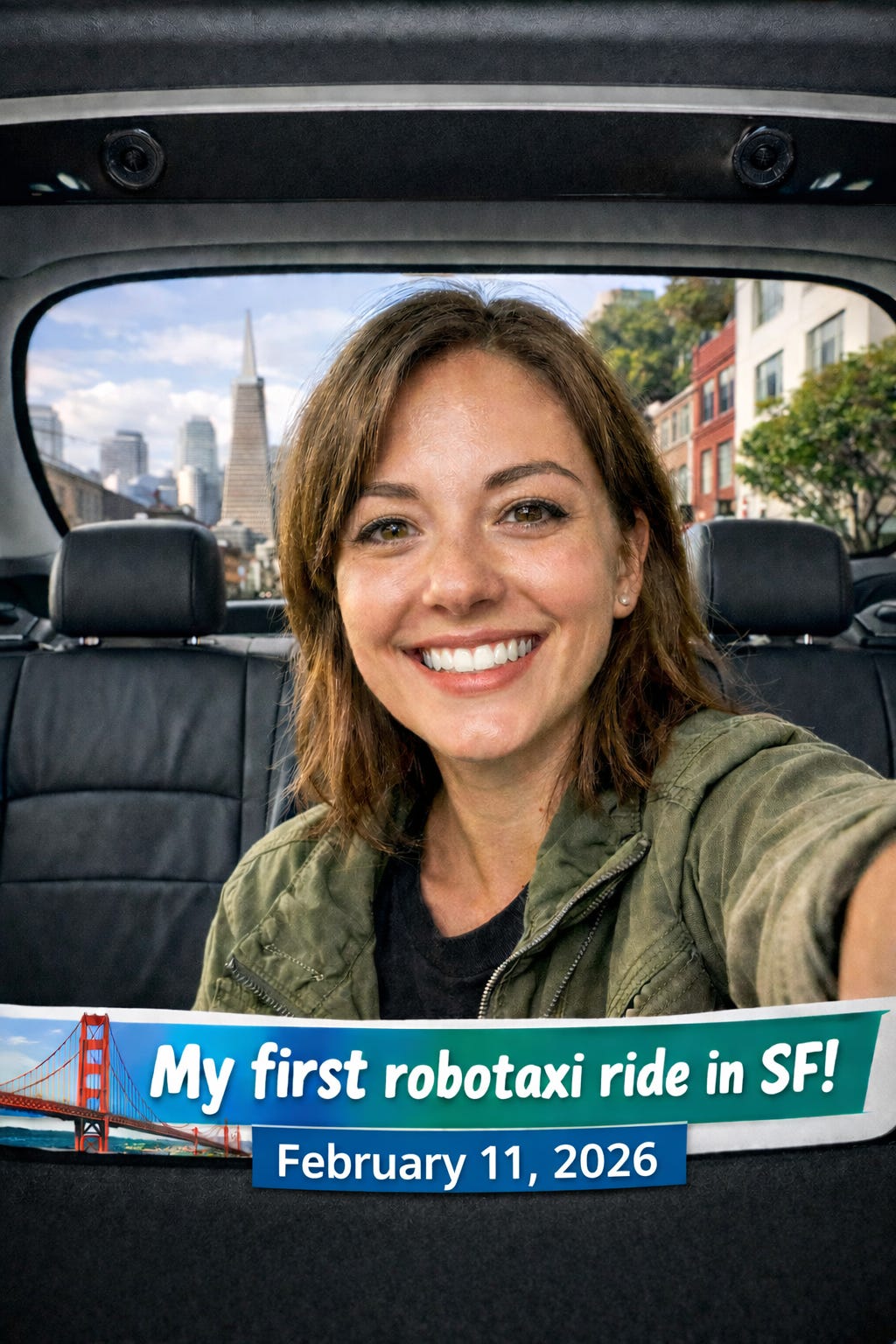
People document experiences. A built-in interior camera—clearly marked, privacy-controlled and rider-initiated—lets groups snap photos on the way to events, tourists record their first driverless ride or commuters grab a quick shot like in a photo booth.
Tourists already do it, but the shots are generally bad given the tightness of the interior. On the screen, show a countdown and take the picture. Give people the option to pick frames: “I rode my first robotaxi in San Francisco!” “A robot got me here.”
It’s not about vanity; it’s about turning the ride into a shareable moment. Marketing that passengers opt into is always better than marketing that interrupts them.
Bonus: It serves as social proof. “My friends had a great time in their Waymo, I should try it.” You could also add a referral code, but this post is about me wearing my product hat... I haven’t put on my marketing hat.
Trust and Transparency
Passenger-facing cameras with tally lights
Any camera pointed at riders—whether for safety, monitoring or optional features—should have a visible tally light indicating when it’s active. On or off. No ambiguity. This is borrowed from broadcast studios for a reason: people deserve immediate, ambient feedback about when they’re being recorded. Even if the feature is benign, invisible sensors erode trust.
Secure light home
For nighttime drop offs, it’s a common social courtesy to wait until someone is inside to drive off. AVs could do something similar: light the pathway to the exit side for a minute or until it’s obvious the passenger has entered the building.
Bonus feature: listen for “Call 911” or “help.” It triggers a call to 911 and starts recording video. It might cost a minute or two of utilization, but it can be safety gold.
It’s also an “a-ha!” moment. Something you didn’t expect, something that triggers delight.
Environmental Awareness
Olfactory sensors (electronic nose)
Now this will smell off from the rest of the post, but it’s also something I consider a huge win.
Smell is an underrated part of the transportation experience. Cigarette smoke from a prior rider. Spilled alcohol. Strong perfume. Food residue. Bodily fluids. Even mild mold.
An onboard olfactory sensor could detect abnormal odors, flag the vehicle for cleaning, or route it out of service automatically. For things like smoking, you can notify the operations center and someone can politely advise passengers that smoking is not allowed and they are subject to a cleaning fee. Some odors can be resolved immediately. You can fix two minutes of cigarette smoke by turning on the blowers and opening the windows. If it settles for hours, you have to do a deep clean. That could take the car out of service for 8-12 hours and requires additional staff.
If you’ve been in as many hotel rooms as I have, you know that deep cleaning often isn’t good enough.
Like with hotel minibars, you can also charge the right person the cleaning fees. There’s less dispute over “I didn’t do that,” when the start and nature of the odor is timestamped.
Longer term, it becomes part of safety—detecting smoke, chemical fumes or battery issues before humans notice.
It’s also a competitive differentiator to Uber and Lyft, where sometimes the odor makes you want to immediately jump out.
The Throughline
What ties these features together is not novelty. It’s the assumption that autonomous vehicles must graduate from “technically impressive” to thoughtfully domestic. They should understand calendars, sensory preferences, crowded sidewalks and the subtle ways people judge whether a system feels respectful. Thoughtfulness about details will imbue a broader sense of confidence in the experience.
AVs won’t win because they drive well. That’s necessary.
They’ll win because they make getting somewhere feel oddly frictionless—like the car was paying attention before you even realized you needed something.
And once that becomes the baseline, everything else becomes a commodity.
Readers, what new features would you like to see Waymo implement? Let us know in the comments.
- Rakesh
You can learn more about Rakesh and check out his articles on PCMag here.

I know the blinkers / wiper thing sounds silly, but look at it from the other direction. If were designing the car from scratch, would we have those sounds?
Once you can nap in the cars, it will become more important.
We often talk about Lidar and algorithms, but Rakesh Agrawal’s latest piece shifts the focus to where it matters most: the passenger.
If Waymo or Tesla want to win, they need to stop thinking like car manufacturers and start thinking like hospitality experts. Some of my favorite takeaways from his 11 proposals:
Sensory Comfort: Letting passengers silence turn signals or wipers (since the car "sees" via sensors anyway).
Proactive Safety: "Escort lighting" that stays on until you safely enter your building.
The "Sniff Test": Using electronic noses to ensure the cabin doesn't smell like the previous rider's takeout.
The goal isn't just a car that drives itself; it's a "frictionless sanctuary." Which of these features would make you switch to autonomous ride-hailing for good? 👇