

Texas has proven to be a pioneering state for autonomous vehicles, and Austin is where that’s most visible, with Waymo, Tesla, Zoox and Avride all actively operating or testing autonomous vehicles on its streets. That made it a natural home for our Urban Autonomy Summit, presented by Empiric Earth, which took place on October 14, 2026 and brought together more than 200 leaders from across autonomous vehicles, mobility policy and transportation technology.
Across three panels, our speakers traded lessons on what it takes to move autonomy from pilots to everyday operations. They tackled everything from charging and depot infrastructure, permitting, and insurance to edge cases, labor, regulation and the economics of falling vehicle costs.
Panel 1: Building the AV Ecosystem

Deploying autonomous vehicles at scale depends on a wider ecosystem of fleet operators, infrastructure providers, insurers, customer support teams and policymakers. Guided by moderator Julia Pickar of NPR/Marketplace, the first panel looked at what it takes to build that ecosystem.
Why Texas?
Julia opened by asking why Texas has become the proving ground for AV deployment. Panelists pointed to consistent statewide rules, a deep talent base, lower costs and stable weather. But Ben Seidl, CEO and Co-founder of Autolane, offered the most vivid answer:
I think Austin is the only place on planet Earth where you can see all of these companies operating fully driverless, paid commercial activities in one place. So this, in my opinion, is absolutely the heartbeat of autonomy, and that’s why we’re here.
What is the biggest missing piece of the puzzle?
Several panelists named the physical layer: parking, charging and energy. Nick Allen, Head of AV Mobility at TaskUs, went a step further:
I do think the real estate and the charging is going to be a huge roadblock to get through, especially because you’re going to need multiple depots per city and per market. But as you look at it from a scale perspective, the ability to bring on partners that have the human infrastructure built in, with experience, safety management systems, protocols that follow compliance based on state regulations, is really going to be something needed as you see more and more companies scaling their product.
At what point do edge cases stop being edge cases?
Daniel Severin, Head of Global Mobility Insurance at The Ride Platform, brought the insurer's perspective. His argument was that unpredictability comes largely from people, and since people will be sharing the road with AVs for a long time, edge cases won’t disappear soon.
Don't take this the wrong way, because I love driving, but all the time there's us behind the steering wheel, there are always going to be those edge cases, because the autonomous vehicle is never going to be able to predict what we do. There'll be a day you get up in the morning and you're stressed. There'll be a day you rush into work and you take a different risk or a different chance. Whereas the autonomous vehicle is not programmed to take those risks or those chances, right?...Some of us in this room might be a bit crazy behind the wheel.
What are the biggest business opportunities as fleets scale?
Julia pointed out that what’s manageable at 100 vehicles becomes much harder at 10,000, and asked where the opportunities lie.
Ben was bullish, arguing that autonomy is deflationary and that vehicle costs will follow the path of phones and computers, ending up
So cheap, so ubiquitous, so high quality that delivery, I believe, is essentially going to be free.
Yulia Shveyko, Head of Public Affairs at Avride, agreed that costs will fall, and focused on what that means for unit economics. As vehicles and delivery robots trend toward the cost of their components, the main expense becomes the human labor needed to operate them. Avride's response is a three-word playbook, applied to everything from charging to tire changes, with the aim of automating as much as possible so costs keep dropping.
The main goals for us at Avride, when we operate our cars and robots, can be put into three words: automate, delegate, and innovate. Automate as much as you can: charging, cleaning, basic maintenance, software updates, log uploading. Then delegate what cannot be automated, for example changing the tires, some basic maintenance for the vehicles. And then keep innovating to automate more things, because this will significantly drop the cost.
Panel takeaways
Texas wins on consistent rules, talent, cost, weather and the sheer concentration of AV activity
Depots, charging and energy are emerging as the real constraint on scale, along with the people to run them
Edge cases won’t go away, and human unpredictability will outlast the transition
As vehicle costs fall, operations become the bottleneck: automate what you can, delegate the rest
You can find a recording of this panel here.
Panel 2: Hub City, Robotaxis’ Electric Infrastructure
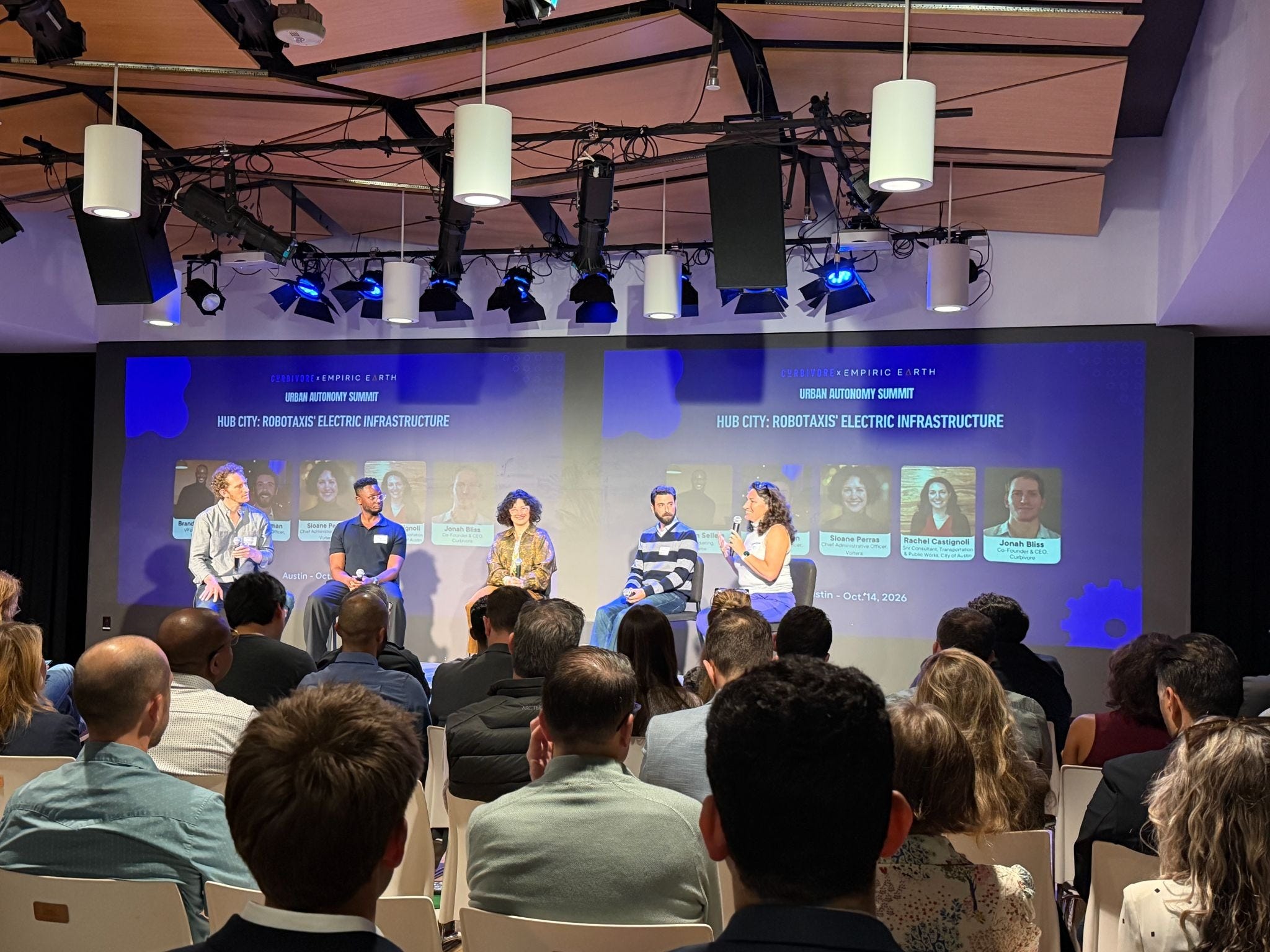
As robotaxi fleets grow, the question is shifting from whether AVs can operate safely to whether cities have the charging, depots and grid capacity to support them at scale. Moderator Jonah Bliss, Co-founder of Curbivore, guided a discussion on what it takes to build that infrastructure, and how cities like Austin can prepare.
What does an AV charging hub look like?
Sloane Perras, Chief Administrative Officer at Voltera, which has four sites in Austin, set the scene by saying what they’re not:
Well, it does not look like the Walmart parking lot with 20 chargers in a row. It's a private, secured site where the AVs can safely come in and out. They can charge, on average, about 40 stalls...It can be anywhere from around an acre to two acres. It can have operational facilities. It can have maintenance and repair facilities...It will have a data offload system so that data can be pulled off the cars, and of course, very importantly, the power coming onto the site from the upstream infrastructure.
How do you permit and locate these sites?
Rachel Castignoli, Senior Consultant for Transportation and Public Works at the City of Austin, who runs the city's automated vehicle program, said the challenge is power:
We want them to be located in places that work for the AV companies. They have the best maps of where they're located and where they need to be. Access to freeways is increasingly important as all our rideshare gets on the freeway. It's actually very hard to get that much electricity to a site. We need to upgrade our infrastructure to make it work.
Sloane explained that they are trying to locate sites that hit the sweet spot of demand nearby, fewer deadhead miles and power that already exists.
Ted Silverman, Chief Operating Officer, at LAZ Parking Reality Investors (LPRI), echoed this by sharing that the industry is overlooking dormant power.
One of the things the industry does not do as much of as we could is figure out how to use existing power that is not being utilized. We manage a hundred venues, for example. That's a huge opportunity in this country: to take power that is sitting dormant for the vast majority of the time and use it for fleets.
Brandon Sellers, VP of Marketing at Gridwise, added that demand clusters around airports and going-out districts, and that sites far from those centers mean empty miles and weaker profitability.
How are robotaxis changing the rideshare market?
Brandon said the clearest effect so far is fewer trips for human drivers, and platforms are paying more to attract reliable, highly rated drivers. Asked how a driver can compete with a robotaxi, he said drivers are already adapting:
They're changing the shape of how they drive. They're repositioning so they get longer rides that are more profitable. That could be a lot of airport rides, or rides in suburbs where it makes less sense for AVs to be out there. You definitely see more premium rides: Uber Black, comfort rides to get a more premium experience. And where I think AVs are going to do very well is as the base layer of demand.
What is the city's north star?
Rachel’s answer was safety. With almost 100 deaths a year on Austin's roads, the city sees AVs as a tool to bring that number down. She said they are focused on the basics, repainting road markings and improving signage where AVs struggle, which she said makes a huge difference.
If you could snap your fingers and change one thing...
Jonah closed by asking each panelist to name the one change that would unlock the next level of AV uptake. Brandon wanted better education and care for the 10 to 12 million drivers worried about the impact of AV technology. Sloane would educate city staff, planners and council members, because unlocking land for charging is on the critical path. Ted said the industry needs a targeted, strategic approach, finding power “for the fewest dollars possible” while satisfying the tenant. Rachel chose accessibility: she wants AV companies to support the disabled community, which has already embraced the technology.
Panel takeaways
Charging hubs are not your average car park; they are secured, purpose-built sites
Power is the bottleneck
Sites work best close to demand centers like airports and nightlife districts, where deadhead miles are lowest
Humans are repositioning themselves as the more premium ride
You can find a recording of this panel here.
Panel 3: From Long Haul to Last Mile: AVs Take on New Form Factors
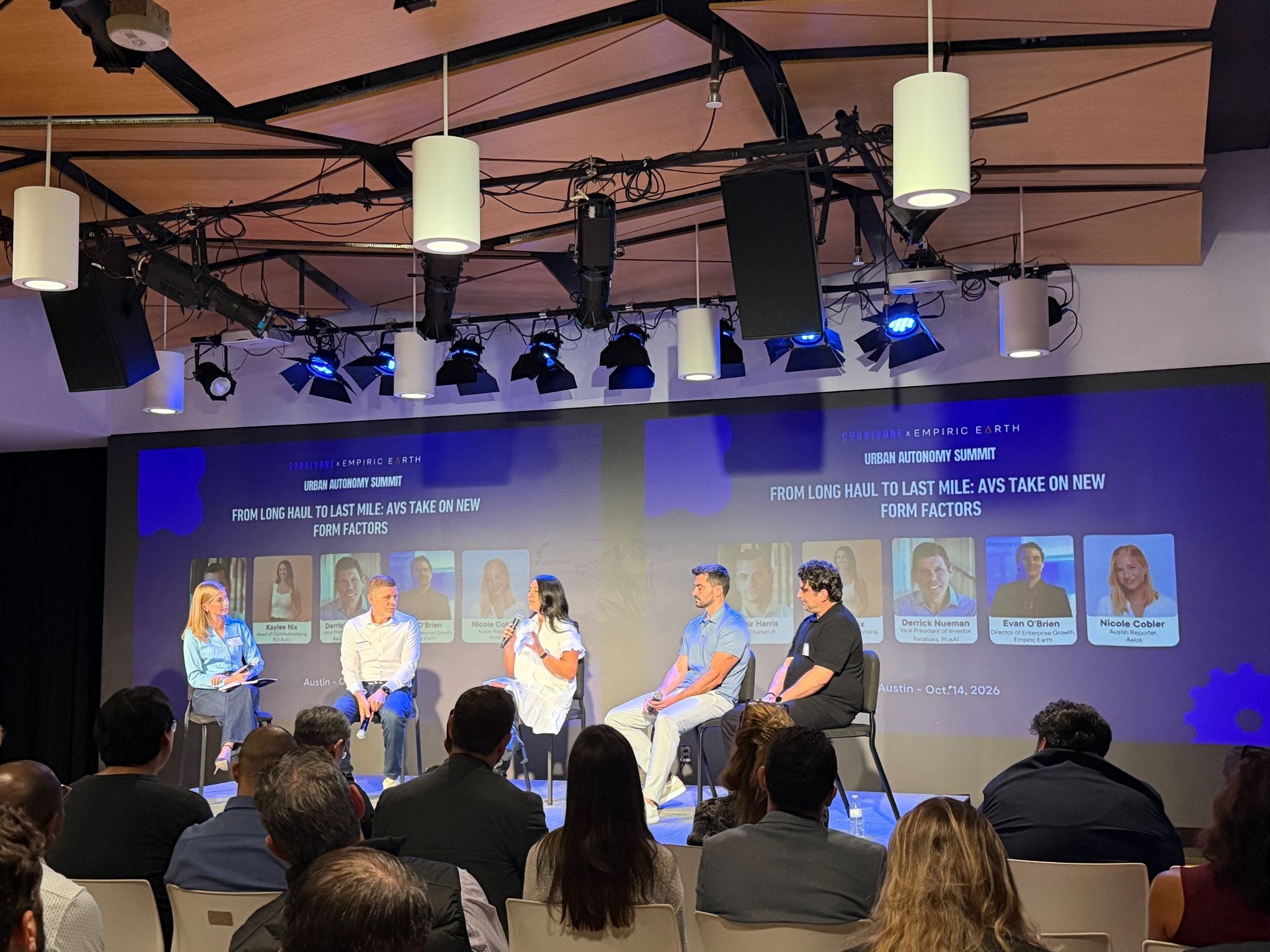
Autonomous vehicles are moving beyond robotaxis, with trucking, freight and transit emerging as major opportunities. Moderated by Nicole Cobler of Axios, the panel explored where autonomy can deliver the most value, what investors are looking for and how the industry can make their products safer.
Where do you see the most value in autonomous driving right now?
Derrick Nueman, VP of Investor Relations, at AV trucking company PlusAI, kicked things off by arguing that autonomous trucking offers the greatest value, though admits he’s “pretty biased.” With a US driver shortage of almost 100,000 people, he sees an opportunity to address labor gaps, improve safety and cut costs.
Each mile of long-haul trucking costs about $2.30, of which a dollar is the driver,” he explains. “So when we think about autonomous trucking, there's this opportunity…to take the driver out, solve this driver shortage issue, make things safer and save a ton of money.
Kaylee Nix, Head of Communications at autonomous trucking company Bot Auto, agreed, but pointed to a more specific opportunity: the middle mile, where routes are difficult to staff because of overnight hours and long driving shifts.
People don't want to run those routes. It's not fun. You're away from your family. That’s where we see a very constrained labor problem in trucking.
Nix pointed to a concrete example: in April, Bot Auto completed a fully driverless, 251-mile overnight run from Houston to Dallas. The customer needed pickups between 8 and 10 p.m. and delivery by 4 a.m. but was cycling through a different carrier almost every load because the shift was so difficult to staff.
What are investors looking for?
Derrick took this one by sharing that investor focus has shifted from the technology itself to the path to commercial success.
A couple of years ago, investors were asking, does your technology work?…Now everyone assumes your technology works, and the question really is, what is your go-to-market strategy? Do you have deployments? Can you scale? What is your financial model?
Armir Harris, CEO of CharterUP, offered a broader view of why the sector is attracting investor attention. After two decades in which software dominated Silicon Valley, he argued, the focus is shifting back toward hardware, specifically, physical AI.
The hottest space right now is physical AI. Billions of venture dollars are being deployed towards this sector, Harris said.
He pointed to the scale of the opportunity: labor is a $30 trillion market, and intelligent machines are beginning to offer a new model for delivering it.
What are the key data points you’re thinking about when it comes to making your products safe?
Moderator Nicole Cobler noted that companies often lead with the number of miles their autonomous vehicles have driven, comparing their safety records with human drivers. But she asked the panel what other data points matter when it comes to proving safety, inviting Evan O’Brien, Director of Enterprise Growth, at Empiric Earth to speak.
“I think exposure is certainly important, but an odometer never really saved a life,” O’Brien said.
The real measure, he argued, is what companies capture from those miles and how effectively they use that data to identify risks and improve performance. No single company can gather every insight it needs on its own. Sharing real-world learnings across the industry can help AV developers spot hazards earlier, strengthen safety where they already operate, and anticipate risks before expanding into new environments. Nueman of PlusAI added that they have a safety framework built around extensive testing and validation, including edge cases, and are currently at 93% of its target. Ultimately, he said, the goal is to prove through real-world miles that autonomous trucks are not just safer than human drivers, but meaningfully safer.
Autonomous trucking can ease driver shortages, improve safety and cut costs
The middle mile offers a major opportunity for hard-to-staff overnight routes
Investors want proven deployments, scalable business models and a clear route to market
Proving safety takes more than miles: rigorous testing and meaningful data matter
You can find a recording of this panel here.
The Reactions
Here’s what some of the people who were in the room shared about the summit:
⚡ Voltera
🤝 Bailey Lucius (DVP, Strategic Growth at TaskUS)
👁️ Mobileye
🛡️ Daniel Severin (Head of Global Mobility Insurance at The Ride Platform)
🚘 Autolane
🔌 Steve Kelley (CEO at L-Charge)
🔋 James Kirk (Founder and CEO at Nerava)
👥 Elena Sagunova (Global HR Director at Avride)


Next up on the calendar is our San Francisco Urban Autonomy Summit on January 27th, 2027, bringing together leaders from Waymo, Wayve, Moove, Terawatt, Gridwise and more. Last year's event drew more than 600 RSVPs, so please reach out as soon as possible if you'd like to join them on stage as a partner.