

Today’s post comes from David Zipper, a Senior Fellow at the MIT Mobility Initiative known for his writing on transportation policy, technology, and urban planning. A co-host of Look Both Ways, a transportation podcast, he is also a contributing writer for Vox and Bloomberg, where he often covers autonomous vehicles and their impact on society.
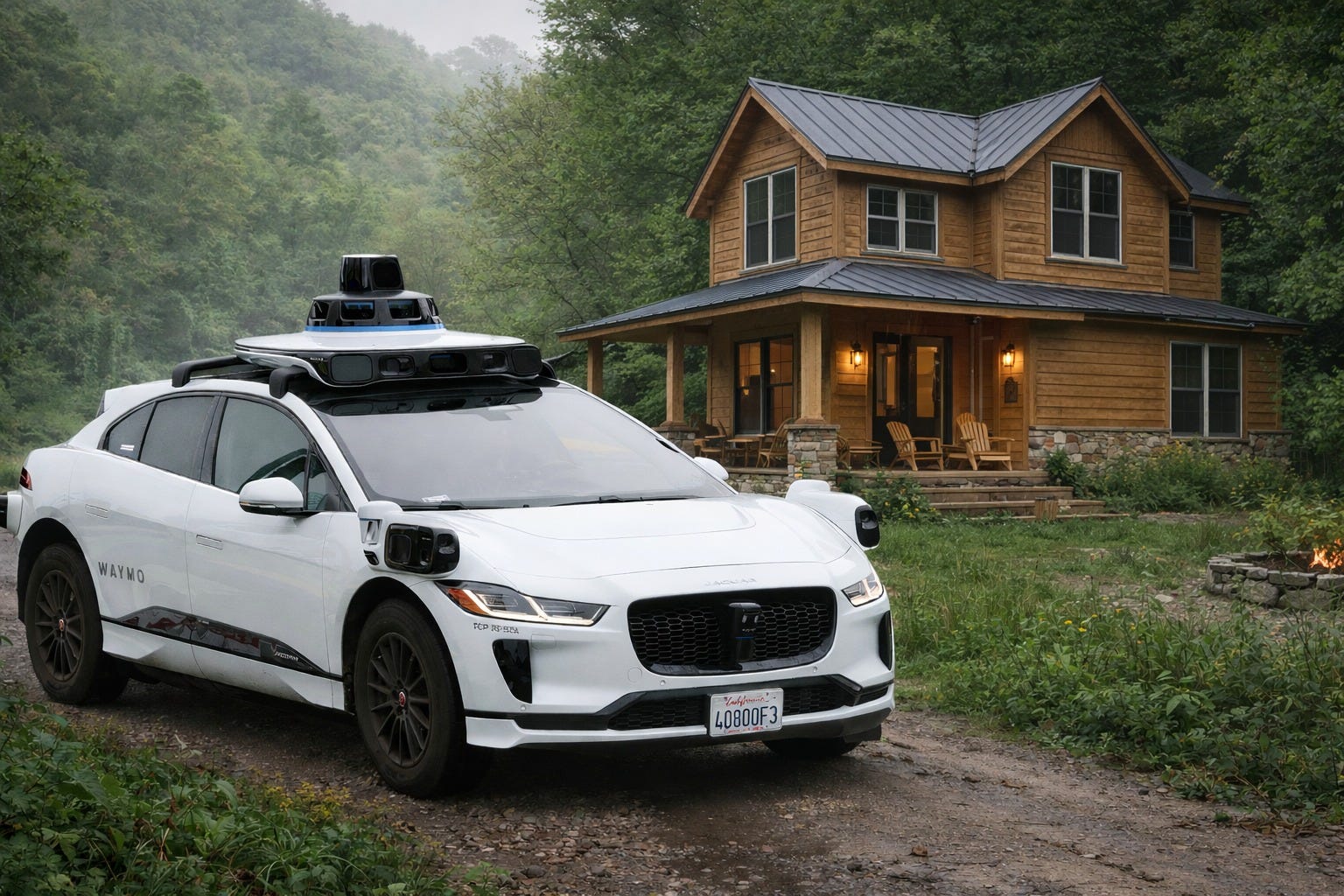
My wife and I recently spent a few days in an old house nestled in a quiet West Virginia holler, the kind of place where human beings are far outnumbered by turtles, geese, and deer. Much as we enjoyed our bucolic surroundings, by Saturday evening we were ready to go out for dinner and sample local libations (West Virginians make some excellent whiskey).
But we couldn’t do it. At least, not legally and safely.
The nearest town was ten miles away, too far to walk or bike even if the roads and weather were accommodating (which they weren’t). Public transportation came nowhere close to our house. According to a neighbor, the entire county had just one taxi driver who did ridehail on the side.
Our remaining options were to drink and drive—a nonstarter—or have one of us serve as designated driver, which meant we wouldn’t enjoy tipples together. Realizing we were stuck, we gave up and stayed home.
If robotaxis had been available, we would have ordered one without hesitation. But none was on offer, and they likely won’t be anytime soon.
Even as robotaxis from Waymo, Zoox, and Tesla mushroom across the country, rural America is being left out. That’s a shame, because autonomous vehicles have tremendous potential to improve lives outside of urbanized areas, where—unlike in cities—they would pose minimal risks as they scale. Indeed, AVs’ upsides might be greatest in the sparsely populated communities that the industry has largely ignored.
To appreciate AVs’ tantalizing possibilities in rural places, consider the myriad transportation challenges that residents currently face. Because populations are sparse and destinations distant, automobiles are a near-necessity. But as a recent academic study observed, securing and maintaining a car can be difficult due to the rising cost of vehicle ownership as well as a shortage of local mechanics.
Some 4.3 million rural residents do not possess a motor vehicle, and they often find themselves stuck, with sharply limited employment opportunities. Transit service, if present at all, is infrequent and restricted to primary corridors. (Those with disabilities may be able to request paratransit rides if they schedule them well in advance.) Facing a dearth of options, rural residents without cars are twice as likely as those in cities to forgo trips, including to healthcare appointments.
Even locals who do have a car might be unable to operate it safely due to medical issues or the use of alcohol or drugs. But with few other ways to get around, some will drive even if they know they shouldn’t, endangering themselves and others on roads that are often faster than urban streets. (Although rural youths are more likely to binge drink, the share of traffic fatalities tied to alcohol is roughly 30 percent in both rural and urban areas.) Less than a fifth of all Americans live outside metro areas,but fully 45 percent of crash deaths occurred there between 2016 and 2020. In particular, single-driver and head-on collisions were much more frequent.
If they become widely available, autonomous taxis and shuttles could be a godsend in the countryside, improving safety as they expand mobility. Unlike a human, reliable AVs will not drive high or veer into oncoming traffic. And the enhanced mobility they offer could be a lifeline for carless residents needing to reach a jobsite or nocturnal revelers wanting to avoid operating a three-ton machine.
Better yet, AVs outside of cities pose far fewer societal costs (known to economists as externalities). The convenience of robot-driven rides could induce a surge in total car use that grinds urban traffic to a halt, but most roadways running through forests or farmland have capacity to spare. AV-induced sprawl, too, is much less of a concern in the countryside, as are obstructions to public transit.
So far, so good. But AV companies do not craft their deployment plans based on community need; their objective is to make money. It’s currently much harder for them to do so in rural areas, regardless of how much their presence would benefit residents.
For robotaxi providers, urban density begets profitability. Denser places have more potential customers within a given area (and city residents are wealthier, making self-driven trips more affordable). Destinations also tend to be closer, enabling an electric AV to fulfill more trip requests before needing a recharge. To get a sense of the scale of rural America’s disadvantage, consider that rustic Allen County, Kentucky has just 64 residents per square mile, while the equivalent figure for California’s suburban San Mateo County is 1,700. (The city of San Francisco is ten times greater still.)
Complicating matters further, country roads pose technical challenges. Self-driving vehicles would need to reliably recognize and respond to regular situations – like a combine spilling into an adjacent lane or a recalcitrant moose plopped on the asphalt – that are hard to imagine in Phoenix or San Jose. Curbs, sidewalks, and lane markings are also less common outside of cities, compromising AVs’ ability to pinpoint their precise location.
Xiaopeng Li, a professor of engineering at the University of Wisconsin-Madison, noted that spotty cellular service is an issue, too. “Companies need to have remote drivers to watch what’s going on in real time and be ready to take over,” he said. Connection interruptions make that difficult. And country road networks may not accommodate learning curves. “In rural areas there are plenty of 55, 65 or even 70 MPH corridors that you have to drive on,” Li said. Unlike in cities, “you cannot avoid them if you want to connect different communities.”
Rather than try to surmount these rural hurdles, AV companies have given big cities their myopic attention. Waymo, the industry’s standard bearer, has touted future service from Seattle to Boston, but the only non-urban areas on its deployment map are places like Marin County that lie within the conurbation of Northern California. (Waymo did not respond to a request for comment.) If individuals could purchase AVs for themselves, rural owners might dispatch them to fulfill trip requests when they aren’t using them. But such a scenario seems to be years away.
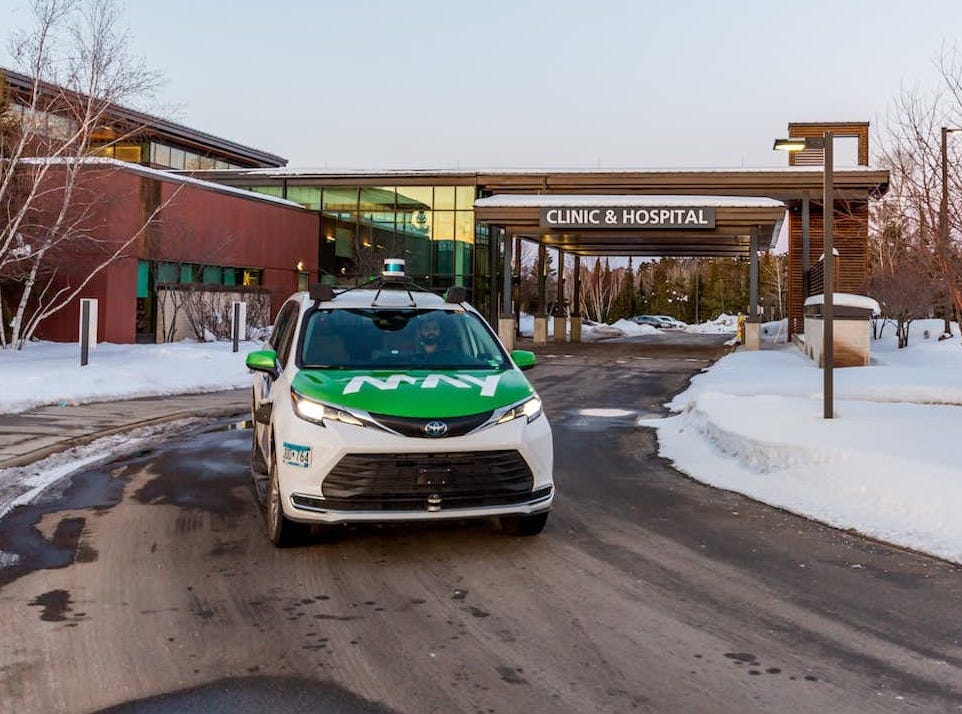
For now, at least, it has fallen on the government and academia to explore and refine AV applications outside urban settings. Tapping federal funding, Minnesota’s transportation department currently partners with May Mobility to offer goMARTI, an on-demand service operating in and around the small town of Grand Rapids, MN. A few years ago, Ohio ran an AV pilot in Athens and Vinton Counties in the Appalachian foothills. (That project also received federal support.) Researchers at universities in Iowa, Oklahoma, and Wisconsin are among those exploring use cases.
Despite the AV industry’s current disinterest, Li is optimistic that companies will come around to serving rural residents without the enticement of government largesse. The key, he said, will be cheaper vehicles and more efficient operations. “Let’s say that I need just two or three teleoperators for 10 vehicles,” he said. “When that happens, you’re going to see sustained, non-subsidized deployment.”
If so, the 81 million Americans living in the countryside could benefit enormously. It might take a while, but perhaps my wife and I will yet summon a robotaxi to go out for drinks when we’re staying in the woods.
- David
I wrote something similar to this a long time ago (2017!). Small towns would be a nice middle ground. Small towns are full of poor people and older people who either can't afford cars or are nervous to use them under certain conditions (such as night time).
They also have unbelievably easy roads with far fewer variables. I think AVs will get there but if they went to some now it would help build good will
In particular, little college towns, for drunk college students.
https://observer.com/2017/04/pittsburg-kansas-autonomous-vehicles-navya-olli-local-motors-navigant-easy-mile/
Robotaxi companies and supporters claim a lot of *potential* benefits. Which of those benefits become reality will depend on economics and incentives. A good place to start with critical thinking is to ask how well ride hail serves the proposed need, and why robotaxis will be different (or when they will be more than slightly cheaper). In rural areas too sparse to support robust ride hail, don't expect robotaxis to appear anytime soon.