

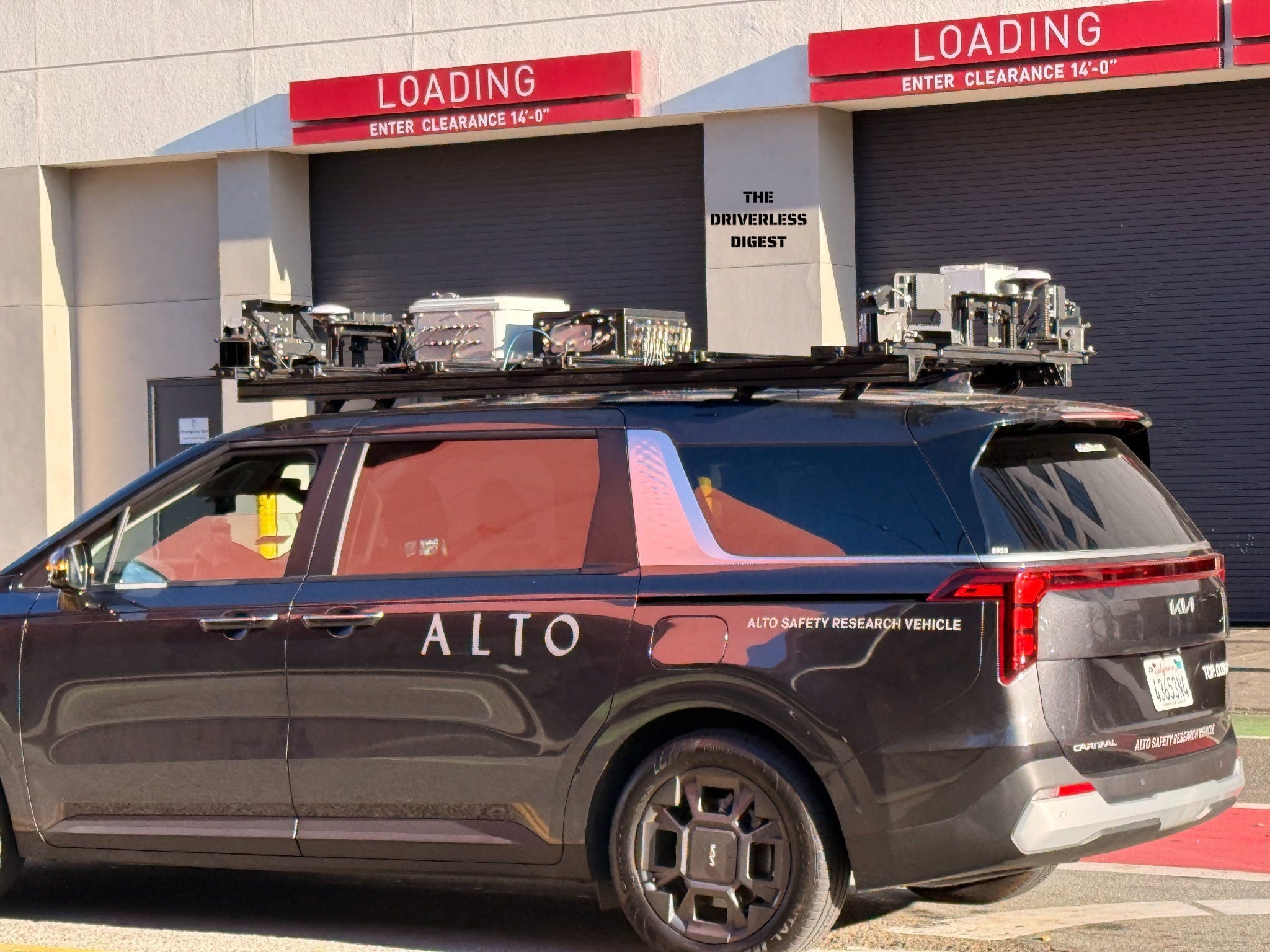
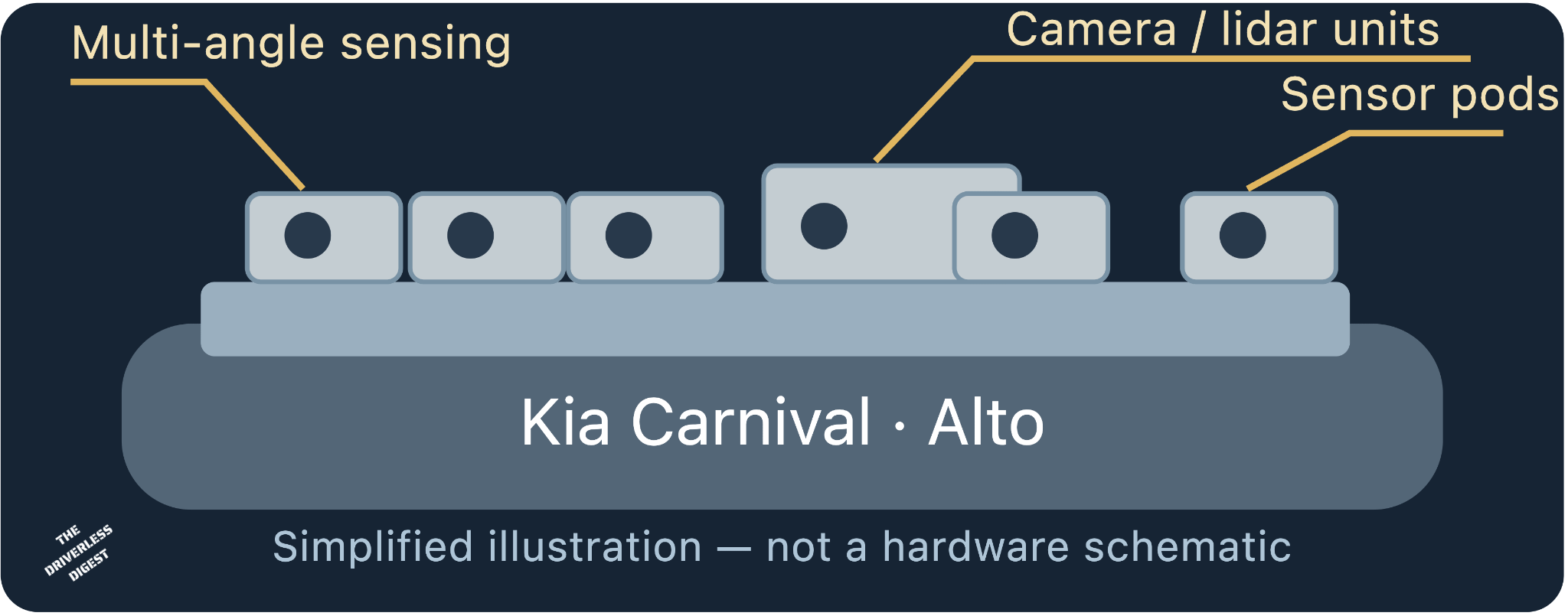
A Driverless Digest reader recently spotted an unusual sight on the streets of San Francisco, an Alto-branded, Kia Carnival topped with a rooftop array of LiDAR, radar and cameras.
Alto is best known for its premium ride hailing service and fleet partnership with Uber, but what was it doing with a vehicle that looked more like an autonomous driving test car?
We reached out to Alto CEO Will Coleman to find out. According to Coleman, Alto now has a number of sensor equipped vehicles operating in San Francisco, and they’re not just out collecting data. They’re carrying paying Uber passengers. And although the vehicles are human driven, their sensor suites capture real-world driving data that could help train and improve autonomous vehicle systems, and that’s where things get interesting.
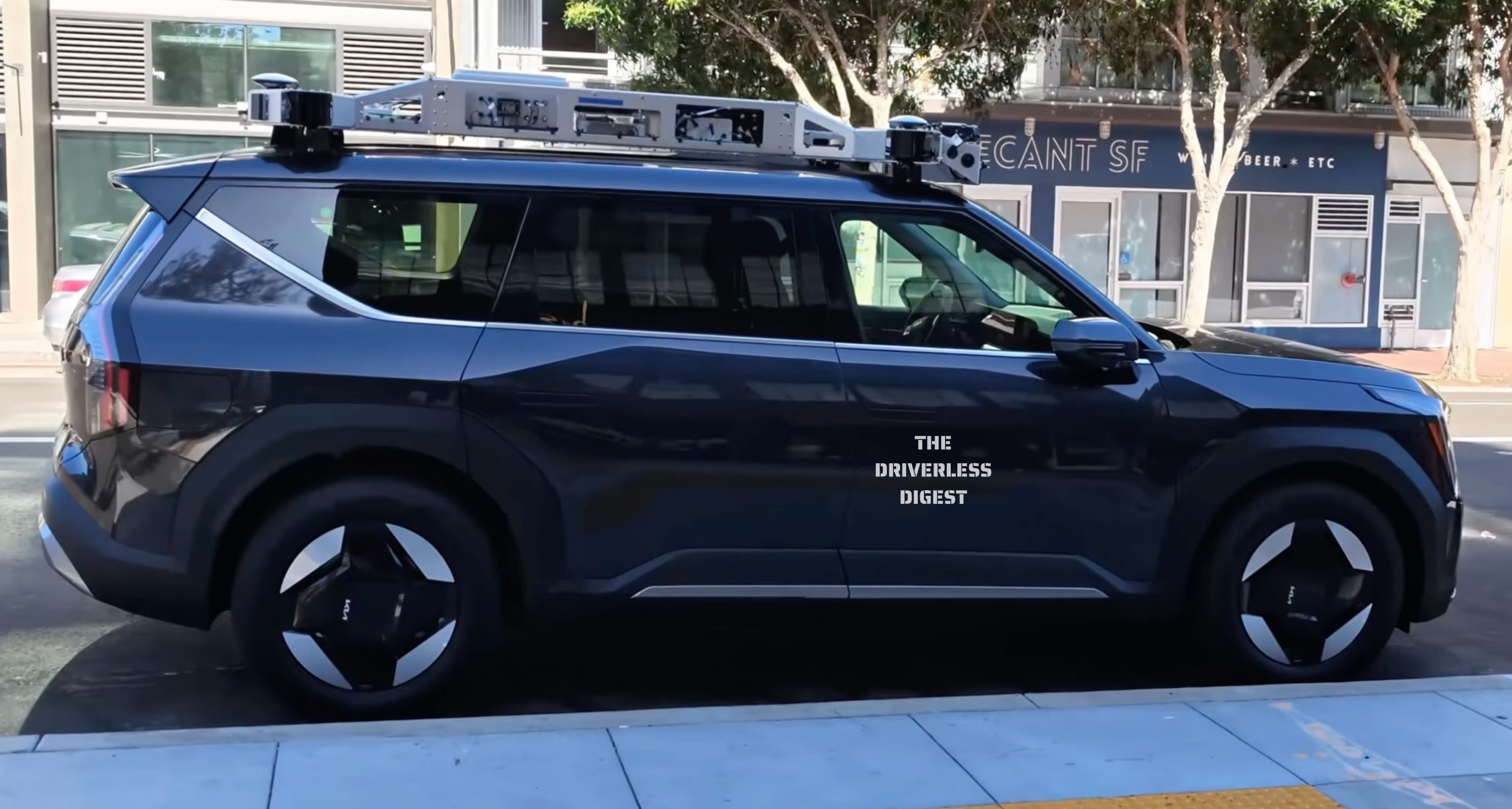
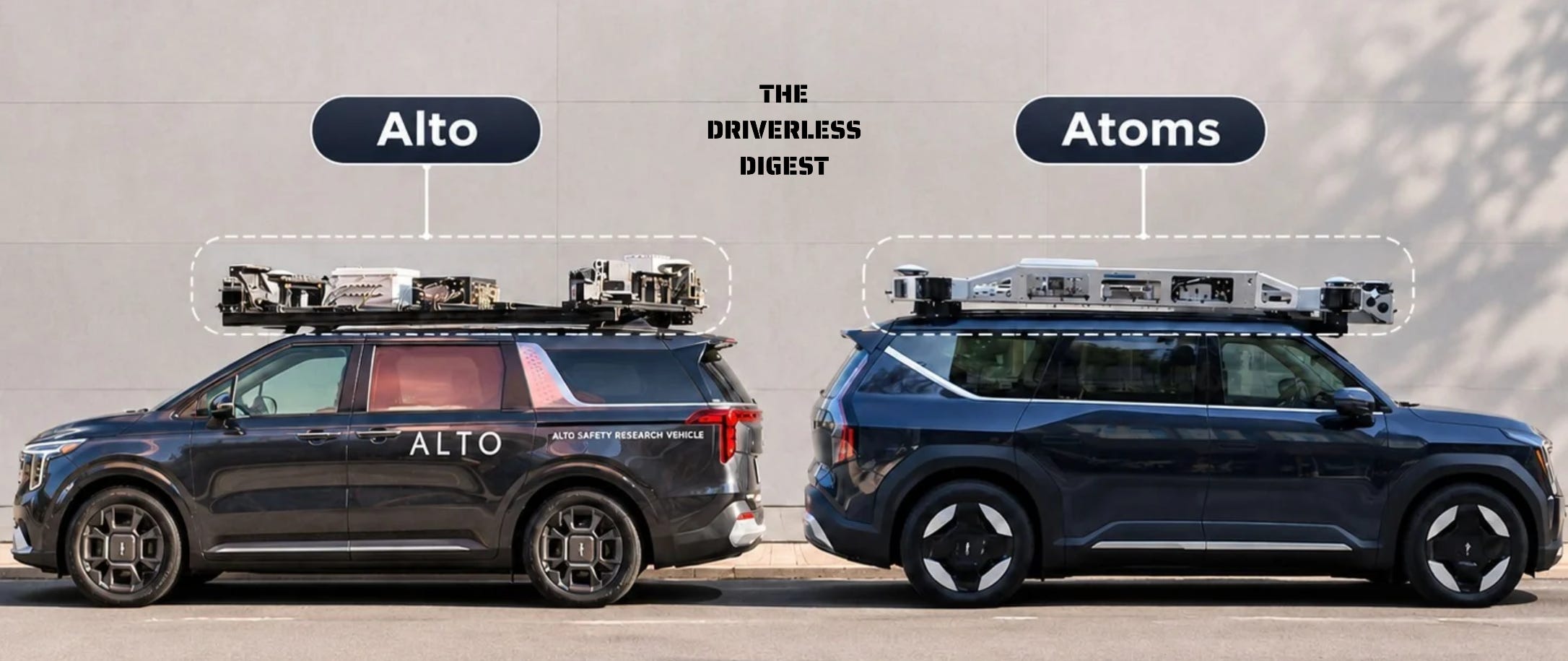
The sensor setup resembles equipment seen on Kia vehicles believed to be operated by Atoms, Travis Kalanick’s autonomous vehicle venture. A recent Reddit post showed a similarly equipped vehicle driving around San Francisco, with commenters identifying it as a possible Atoms test vehicle. The Driverless Digest has not been able to confirm whether Alto’s vehicles have any connection to Atoms, but the sensor setups certainly look similar.
Here’s an AI generated side by side view so you can easily compare/contrast:
Turning Passenger Trips Into AV Training Data
Alto operates a fleet of more than 1,000 company-owned electric vehicles driven by over 4,000 W-2 employees, giving it more direct control over its fleet than conventional ride-hailing platforms. And unlike independent rideshare drivers, Alto’s trained drivers return their vehicles to company-operated depots at the end of each shift, making it easier to maintain the vehicles, manage the sensor equipment, and collect and transfer data.
The company has also developed a close relationship with Uber, which is both an investor and distribution partner. Alto currently operates vehicles on Uber Black, Uber XL, and UberTeen in Los Angeles, Miami and San Francisco. More recently, Alto has relaunched its own direct to consumer ridehailing service in Los Angeles, allowing customers to book rides through the Alto app.
Alto’s mapping vehicles can thus accomplish two things at once: generating revenue by transporting passengers and collecting valuable sensor data for autonomous vehicle development. This makes for an intriguing business model, especially given that Alto has already driven more than 200 million miles. By spreading the cost of data collection across an existing commercial ride-hailing operation, Alto avoids funding an entirely separate fleet of mapping vehicles.
Ride-hailing vehicles naturally gravitate toward areas with the highest passenger demand, so they collect data in many of the same neighborhoods and corridors where robotaxis are likely to operate. They also encounter the unpredictable conditions that autonomous vehicles will eventually need to navigate, including passenger pickups and drop-offs, construction zones, pedestrians, cyclists, and challenging intersections. This makes the data particularly valuable while reducing the need for dedicated data-collection trips.
One potential downside is the passenger experience. Alto positions itself as a premium ride-hailing service, and customers paying for an Uber Black ride might not be thrilled to see a vehicle with a massive rooftop sensor array pull up. I know I wouldn’t be. This may be less of an issue for more affordable services like UberX, but it’s an interesting trade-off as Alto looks to balance its ride-hailing and data-collection businesses.
The AV Industry Has A Data Problem
Access to quality driving data from the real world has become an increasingly important competitive advantage in autonomous driving. Companies such as Tesla and Waymo have spent years building enormous proprietary datasets. Tesla has access to camera footage from millions of customer vehicles, giving it an extensive source of driving scenarios. Waymo, meanwhile, has accumulated hundreds of millions of autonomous miles using vehicles equipped with cameras, LiDAR and radar. But there’s a catch: neither company has much incentive to share its proprietary driving data with competitors.
“Data is the bottleneck,” Coleman told The Driverless Digest. That’s particularly true for smaller AV developers trying to compete with established players. Collecting large volumes of geographically diverse, quality sensor data can be expensive, time consuming and operationally complex. Still, there’s not necessarily a strong technological moat around collecting the raw data itself. It’s largely a matter of time, money and getting enough vehicles on the road. And while simulation and synthetic data can help bridge the gap, data collected from actual driving remains essential for training and validating autonomous systems.
This is where an operation like Alto’s could have an advantage. Instead of requiring every AV developer to deploy its own data collection fleet, companies could potentially access information gathered by vehicles that are already on the road. The same dataset could even support multiple AV developers, assuming the appropriate licensing arrangements and technical compatibility.
Of course, collecting raw sensor data is only part of the challenge. Developers also need to process, label, organize and validate that information before it becomes useful for training autonomous driving models.


Uber Is Already Building A Data Business
Alto’s sensor-equipped vehicles are particularly interesting given Uber’s broader ambitions in autonomous driving. Earlier this year, Uber launched Uber Autonomous Solutions, a suite of services designed to help AV developers commercialize their technology. One component is AV training data. Uber said its data collection network includes thousands of specially equipped vehicles across dozens of cities, gathering millions of miles of multi-sensor data.
In June, Uber also announced plans to deploy 500 specially equipped Hyundai Ioniq 5 vehicles outfitted with cameras, LiDAR and radar to collect high-fidelity driving data for its AV partners.
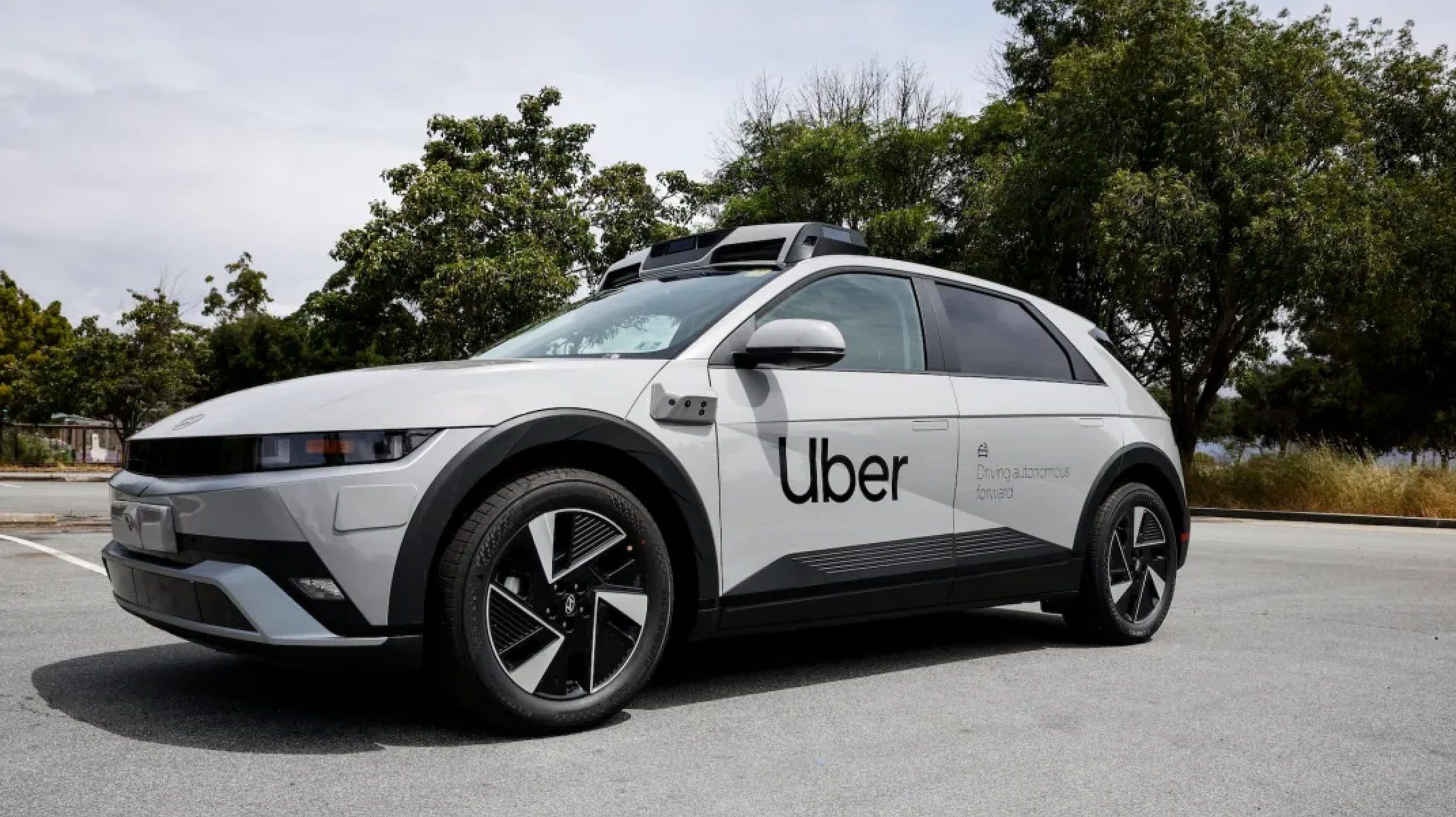
The strategy is straightforward. Uber has access to a massive network of vehicles operating in cities around the world. By equipping some of those vehicles with sensors, it can help AV developers collect the real-world data they need without requiring them to build their own fleets from scratch. Uber has also confirmed that it shares certain collected roadway data with selected autonomous driving technology partners to support training and validation.
Alto’s sensor-equipped vehicles could be a natural fit for Uber’s broader data collection strategy. Uber wouldn’t need to hire its own drivers or manage a dedicated fleet, since it could potentially work with fleet partners like Alto that already employ drivers, own vehicles and operate depots. This could also help Uber avoid some of the employment classification complexities associated with directly hiring drivers. The Driverless Digest has not confirmed whether Alto is collecting data for Uber or other AV developers, but the potential synergies are clear.
A New Role For Ride-Hailing Fleets?
For Alto, collecting driving data could become another revenue stream on top of its existing ride hailing business. And with vehicles already operating in Los Angeles, Miami and San Francisco, there’s an opportunity to expand the model beyond the existing fleet of vehicles in SF.
The model could also benefit AV developers that don’t have the resources of Waymo or Tesla. Rather than investing in their own mapping fleets, they could potentially purchase data from companies like Alto, which are already collecting it as part of their daily operations.
How valuable this data will be and whether Alto can turn it into a meaningful business, is still an open question. Even so, the basic idea makes a lot of sense. Why send out dedicated mapping vehicles when you can collect much of the same data while transporting paying passengers?
Readers, what do you think about Alto’s new mapping vehicles and its approach to combining ride-hailing with AV data collection?
-Harry