

Today’s post comes from Jackson Lester, an experienced mobility product manager who closely tracks AV operations and deployment data on AV Map.
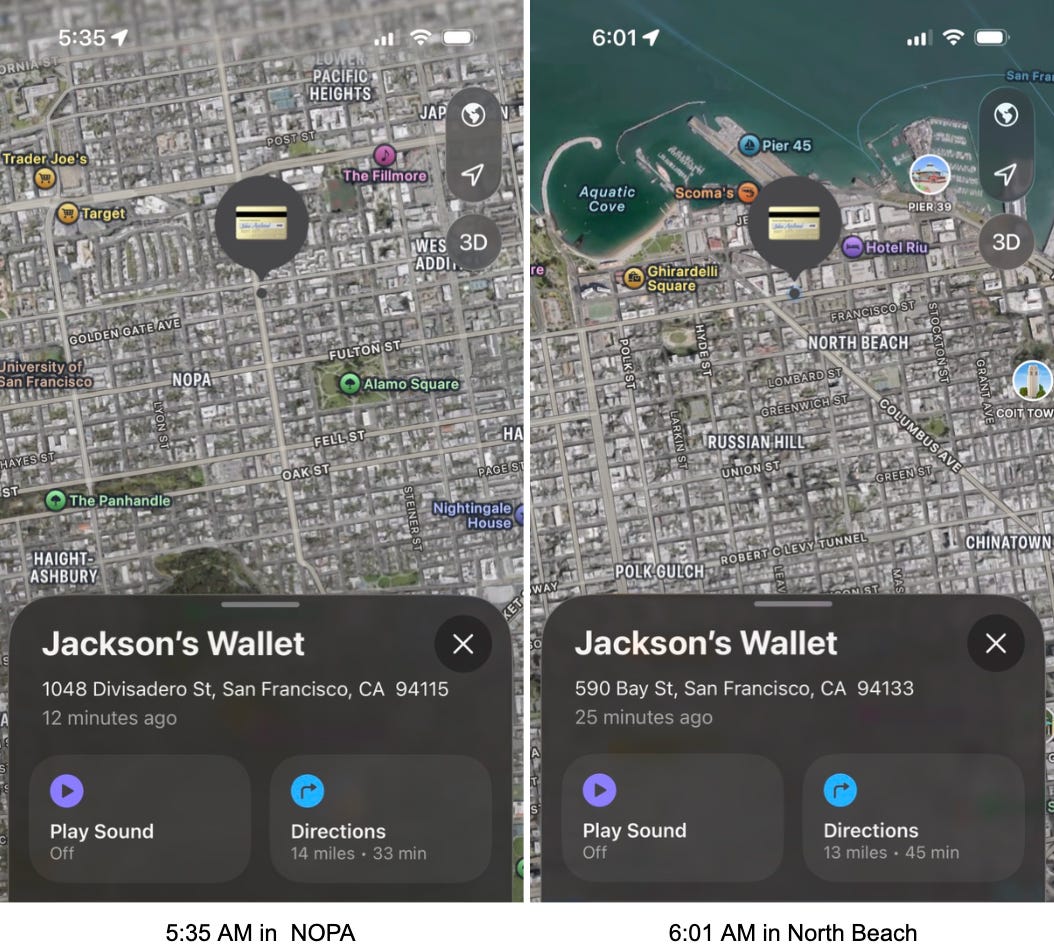
On Monday, November 3rd at 7:20 PM, I left my wallet in a Waymo at Costco in San Francisco. By Tuesday at 8:14 AM, I got an email from Waymo saying they found it. Luckily, I had an AirTag in my wallet, so I could see that it actually traveled to at least eight different San Francisco neighborhoods during the night. Here’s what happened:
After I reported the missing wallet, the vehicle went back to Waymo’s Bayview depot around 9 PM, then headed right back out to pick up passengers. I guess they weren’t able to find my wallet. For someone who spends all day mapping AV deployments, this was fascinating. I got to see exactly how Waymo handles problems when they’re running 250,000 trips per week, and how that may change as they work their way toward 1 million trips per week and beyond.
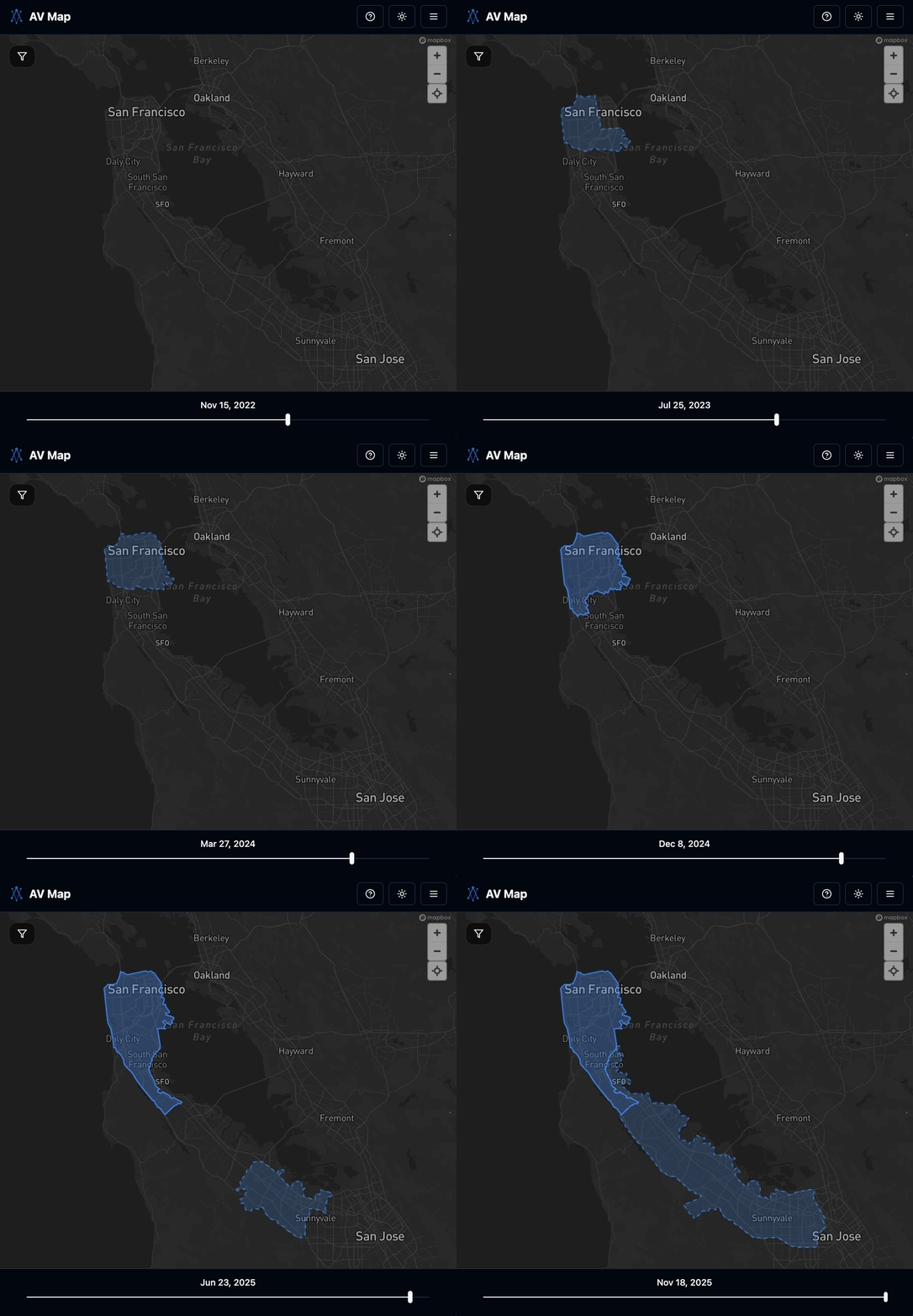
Waymo’s Lost Item System in Action
At 7:55 PM, I started a support chat through the Waymo app. Ter, the agent, was professional and asked all the right questions. What did it look like? A navy blue Dakine wallet. Where might it be? On the floor behind the passenger seat. Then they said something interesting: “I have logged the description you provided and escalated the car to return to base so our team can check.”
That was great news for my wallet, and for me, but it also meant that this Waymo vehicle was going to lose out on some rides and revenue in the meantime.
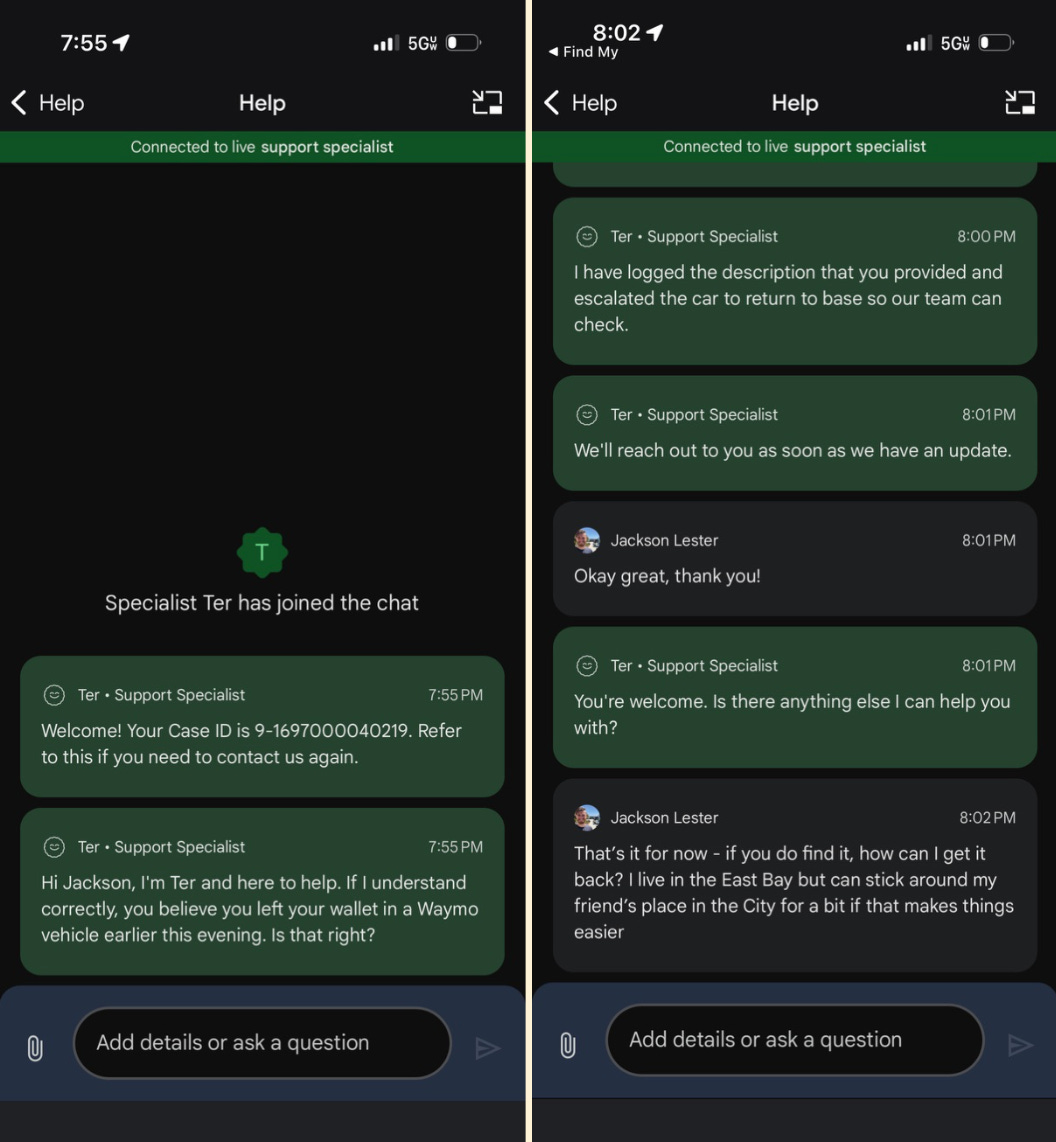
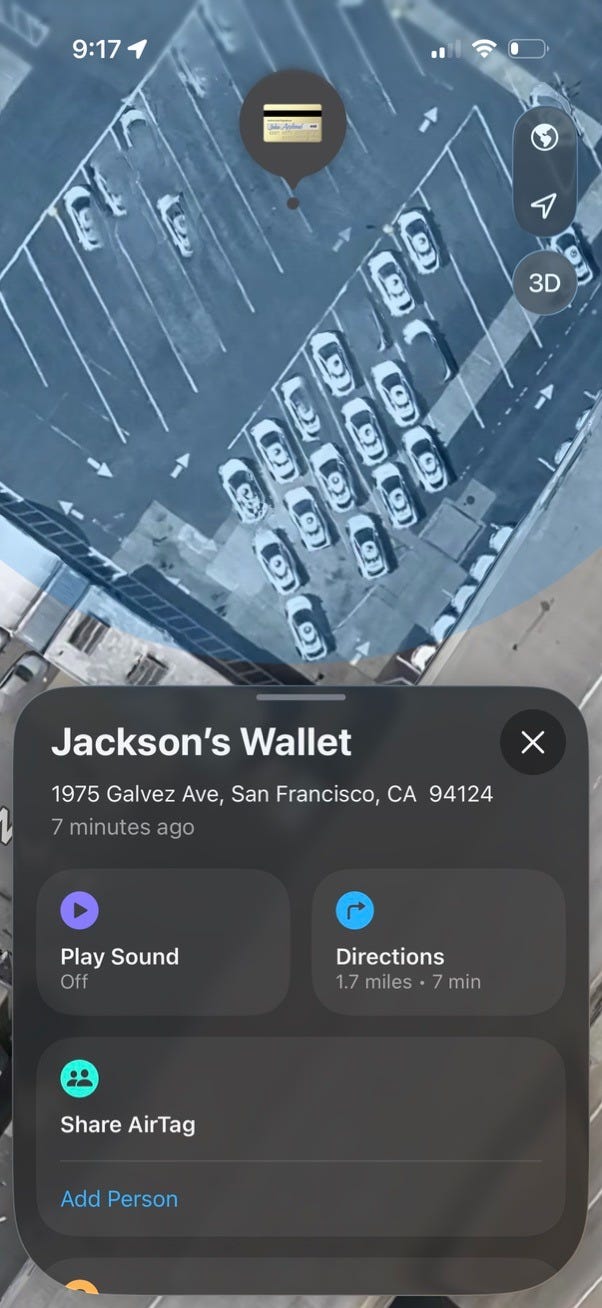
After the chat, Waymo sent me an email saying they’d search the car and get back to me within eight hours, but in reality I didn’t hear back for a little over 12 hours. By 8:50 PM, ‘Find My’ showed my wallet at the Bayview depot. I could literally see it on satellite view, sitting in a lot full of Waymos. Great, I thought, they’ll grab it and I might even be able to pick it up tonight.
I called support at 9:34 PM to let them know it was there. The agent was helpful but limited. They could file another support ticket but couldn’t call the depot directly to say “check this car now, his AirTag says it’s there.” By 9:45 PM, I gave up for the night and headed back to Berkeley on BART. I’d deal with it tomorrow.
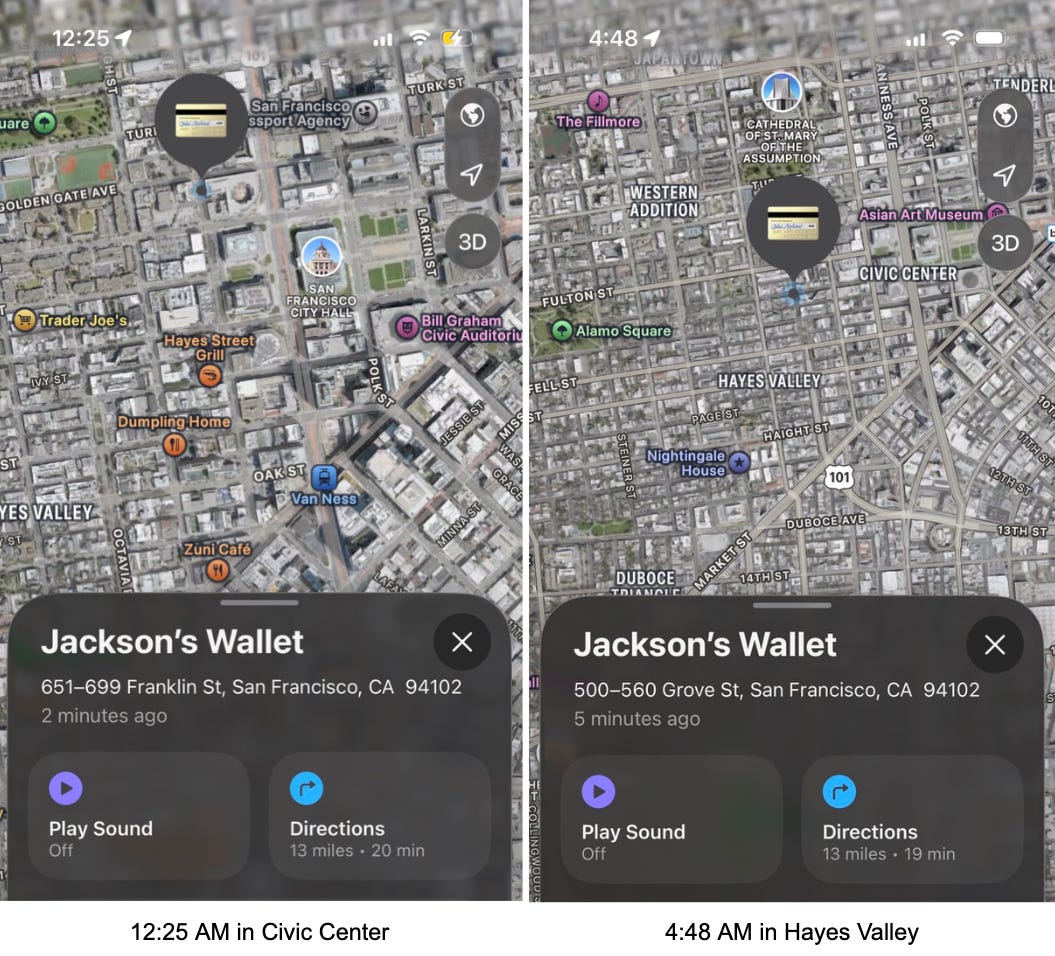
Even though the Waymo came back to the depot just like they told me, nobody apparently found the wallet during the search, because at 12:25 AM my wallet was at Franklin and Golden Gate. At 4:48 AM it was at Grove and Octavia. By 5:21 AM, Geary and Divisadero. I kept waking up and checking Find My. I couldn’t help it.
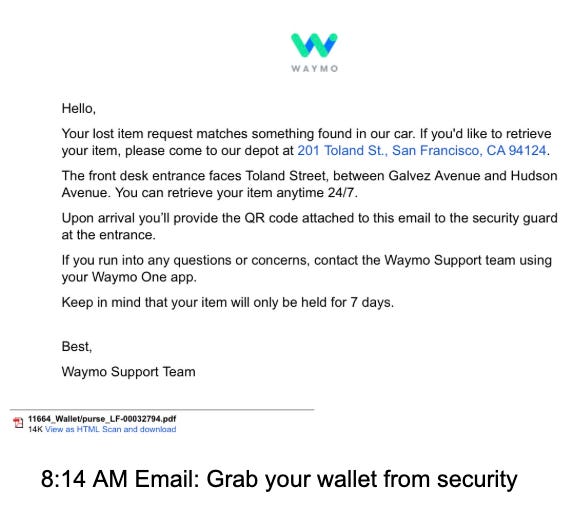
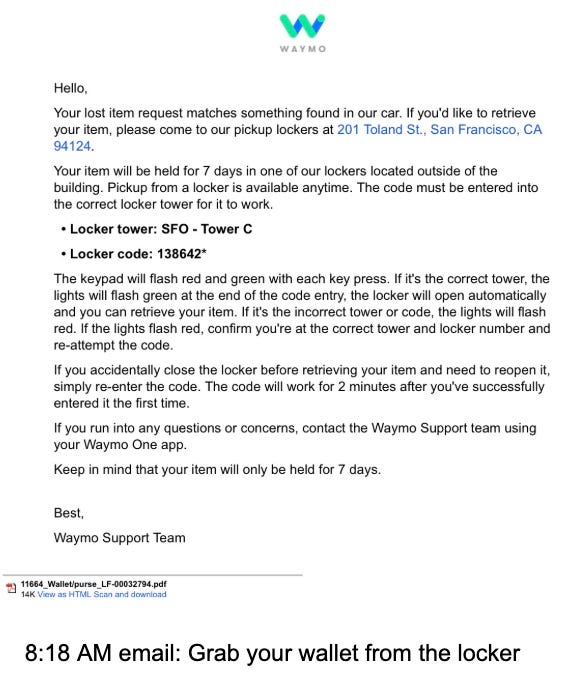
At 8:14 AM Tuesday morning, I got an email telling me to come to 201 Toland Street and show a QR code to security. Then at 8:18 AM, a completely different email with instructions to get my wallet from a locker using a code, Amazon Locker style.
Getting My Wallet Back
Tuesday evening I biked to the depot in Bayview. It’s in an industrial part of the city surrounded by other logistics companies, which makes sense. You need space for all those cars, chargers, and maintenance equipment. The whole place is run by Transdev, the same company that operates many transit systems. It feels like a public transit yard, with people working on vehicles 24/7, security guards at the gates, the whole operation humming along.
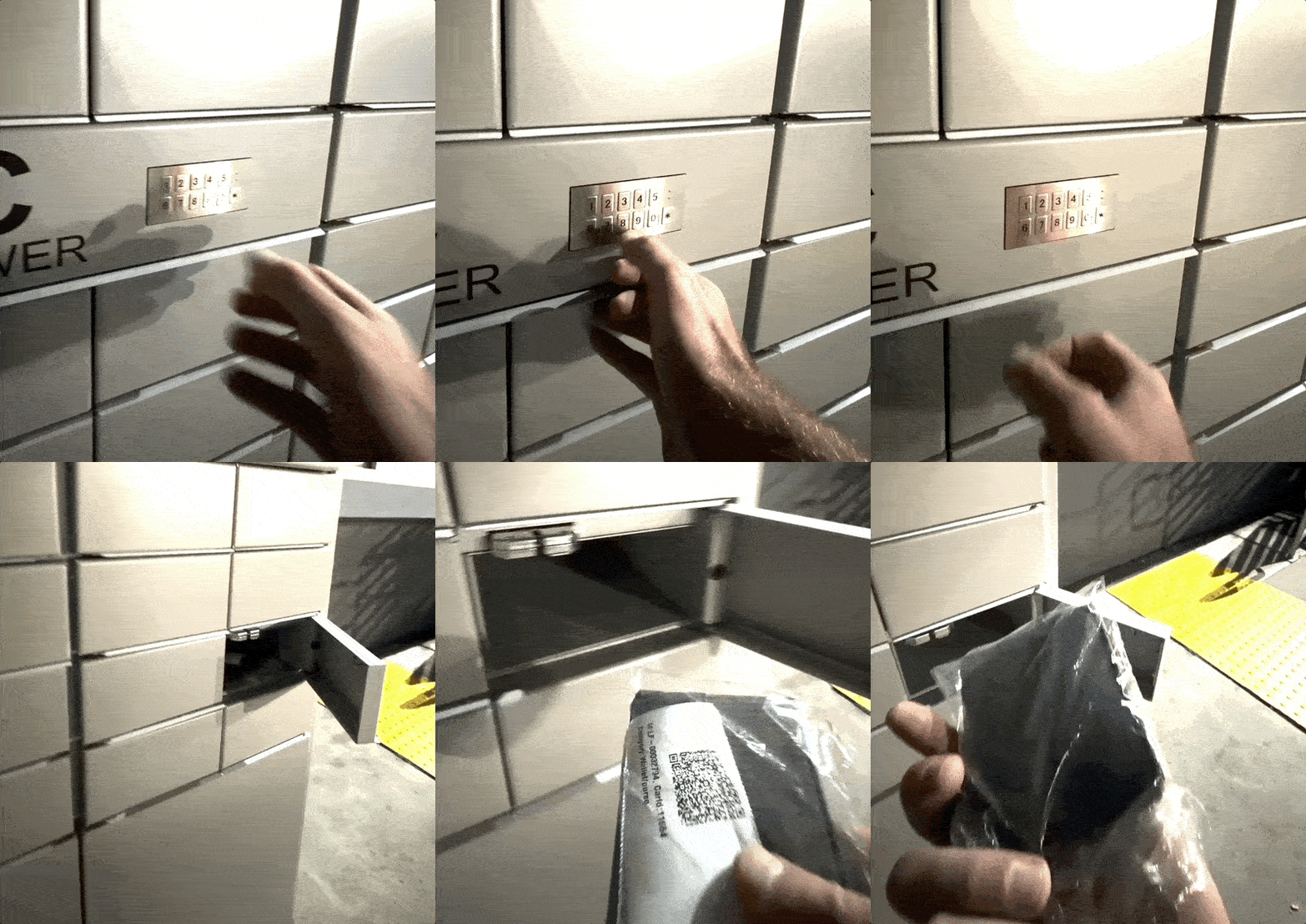
I learned that the locker system is powered by Harbor by Luxer One and in my experience, it worked perfectly. I found Tower C, punched in 138642, the green lights flashed, and the door popped open. My wallet was sitting there in a plastic bag with a reference number. While I was there, another person showed up to retrieve their phone. With Waymo doing 250,000+ rides per week nationally, I definitely wasn’t the only one who left something behind that day.
The whole retrieval took maybe 30 seconds once I got there. Getting to Bayview from Berkeley and back? That’s a different story: two hours round trip if you’re fast on a bike and lucky with transit timing.
What Happens Next
Waymo’s cameras can already spot items left on seats and alert passengers through the external speaker. My wallet, tucked on the floor, was invisible to the cameras, and that’s the gap they’re working on.
Look closely at any part of running robotaxis and it explodes into complexity. Lost items alone involve detection systems, retrieval logistics, depot operations, customer authentication, storage limits, delivery economics, and sensitive communication with stressed-out riders missing something important. Every solution creates new edge cases. What if someone’s phone is dead? What if the phone itself is the lost item? What if they’re from out of town? What if it’s medication they need immediately?
As they scale toward a million weekly rides, the possibilities multiply. Better detection systems could catch items on the floor. They might partner with stores for pickup locations. And the infrastructure they’re building could support packages, food delivery, and all kinds of logistics beyond just lost items.
What impressed me most is how fast Waymo iterates. Two years ago this was a tiny pilot. Now they’re running hundreds of thousands of rides per week with functioning lost-item systems, 24/7 depots, and automated lockers. They’re solving problems that don’t even exist yet at most AV companies in the U.S.
My wallet’s overnight tour showed me something important. The obvious hard part is getting cars to drive themselves safely. But the other hard part is everything else — and these boring operational problems are what determine whether robotaxis work as a business.
Readers, have you ever left an item behind in a Waymo? How do you think they handled this situation and what would you recommend?
-Jackson
You can learn more about Jackson and his work at AV Map here.