

Waymo’s growth in its most mature market, California, appears to be flattening as momentum slows sharply over the last quarter.
The mobility company now operates in 11 US cities, covering more than 1,400 square miles of autonomous robotaxi service area. Across its network, Waymo has completed over 20 million trips, operates a fleet of roughly 3,000 robotaxis, and is targeting one million trips per week by the end of 2026. According to recent reporting from TechCrunch, Waymo is currently delivering around 500,000 paid robotaxi rides per week.
But while overall growth continues, new data from the California Public Utilities Commission (CPUC) suggests a clear slowdown in Waymo’s most established market.
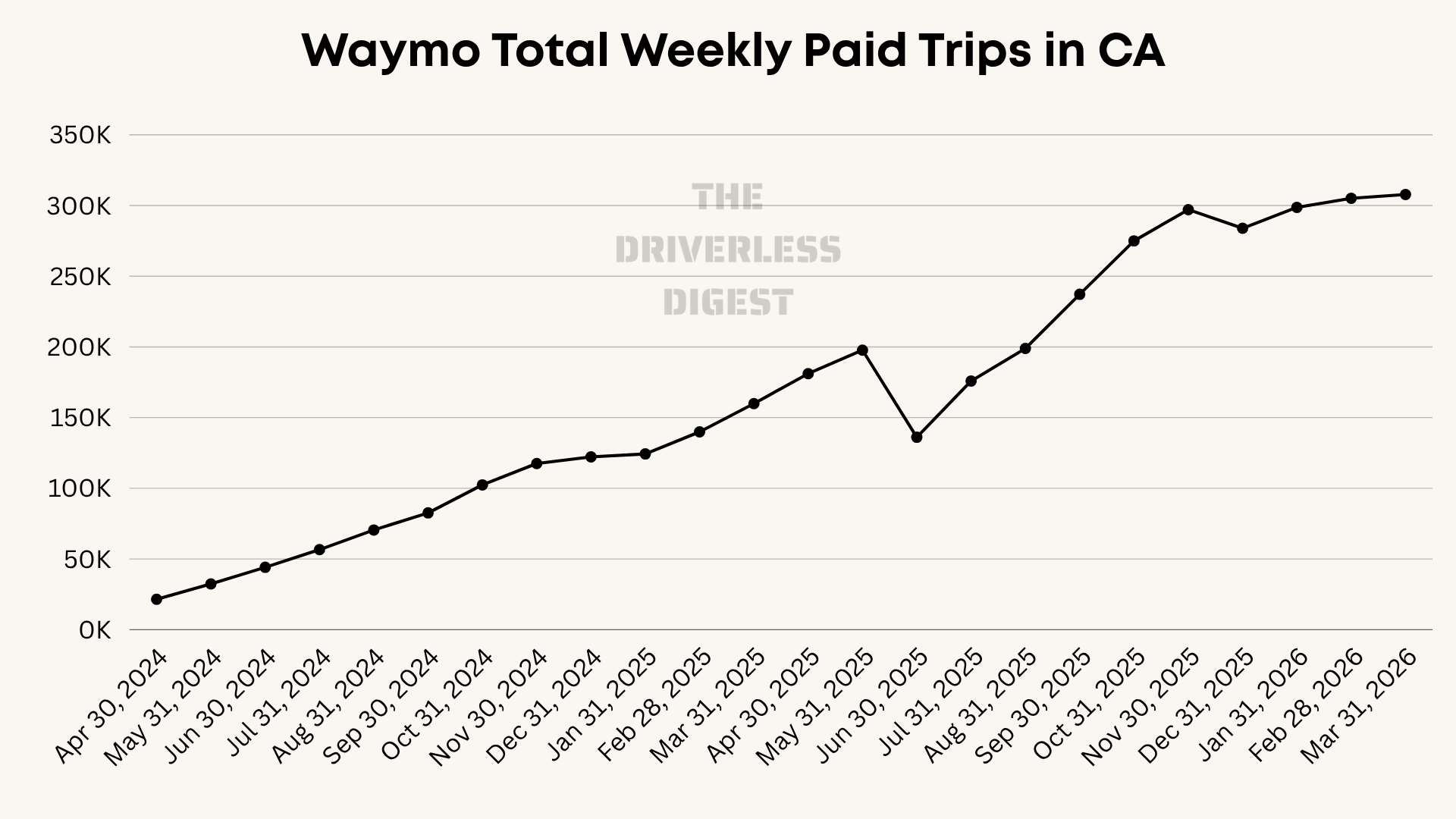
California growth is slowing sharply
CPUC ride data indicates that trip growth in California decelerated significantly between December 2025 and March 2026. While total rides continue to rise, the pace of growth is weakening.
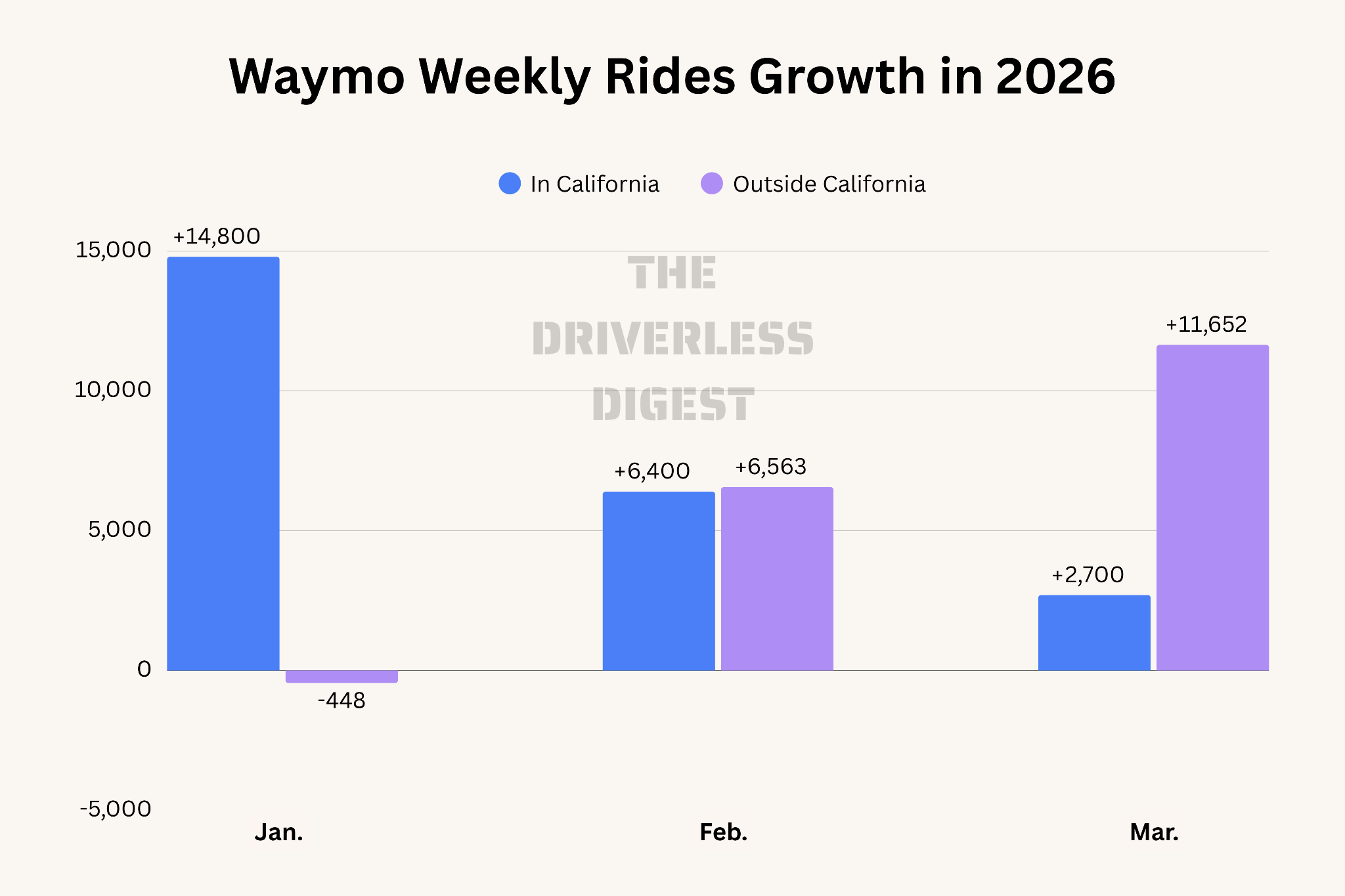
Monthly incremental gains in California weekly rides show a clear decline:
January: +14,800 rides/week
February: +6,400 rides/week
March: +2,700 rides/week
This represents an 82% deceleration1 in the pace of growth from January to March.
Growth is shifting outside California
At the same time, Waymo’s expansion outside California is showing stronger momentum, suggesting that newer markets are contributing an increasing share of overall growth.
Non-California weekly rides2 moved as follows:
January: -448
February: +6,563
March: +11,652
This marks a sharp acceleration in growth outside California, with monthly ride additions rising 78% from February to March.
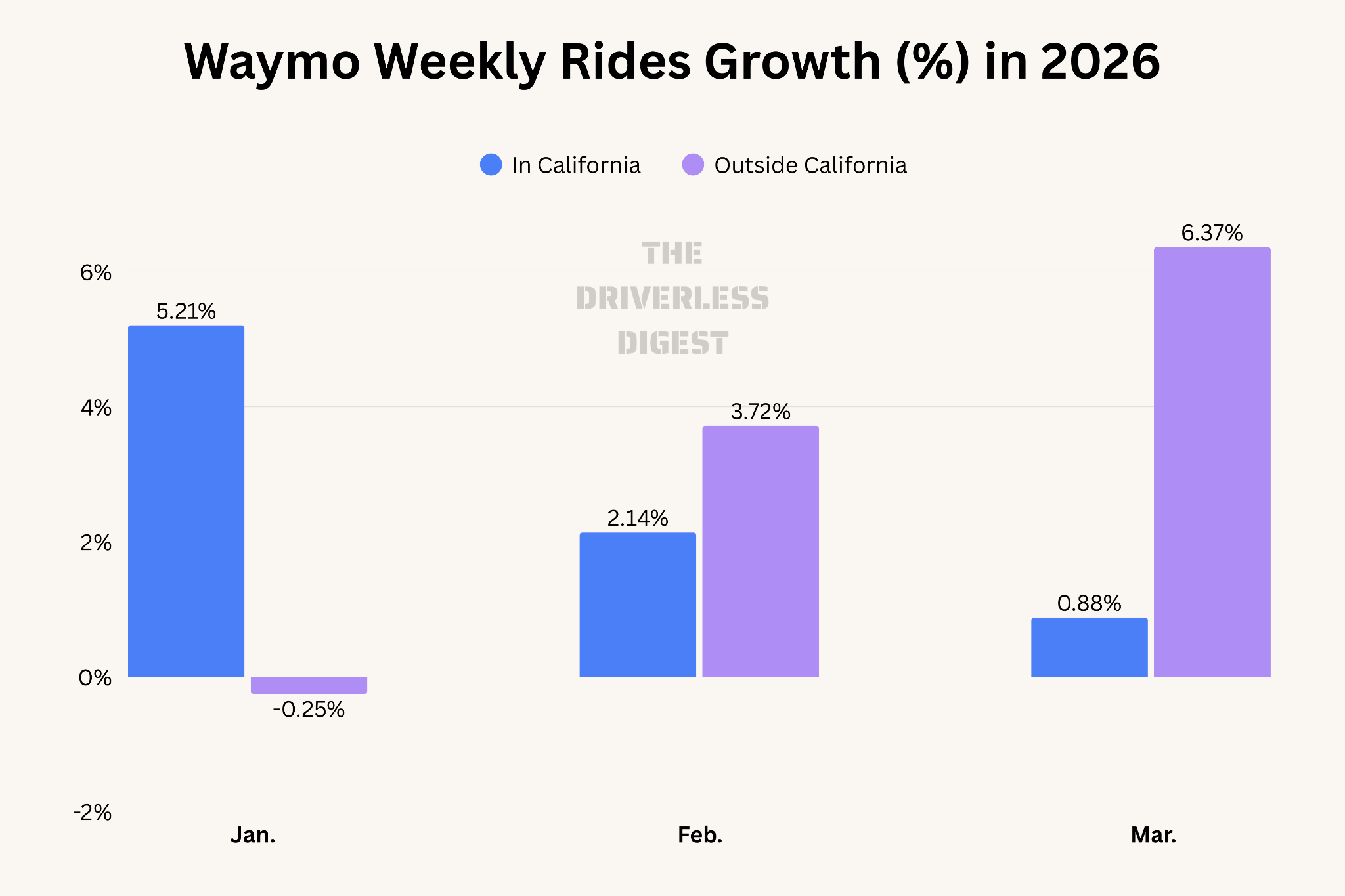
Taken together, the data suggests Waymo’s expansion story may increasingly depend on scaling newer markets rather than deepening growth in its most mature ones.
Why is California slowing?
The slowdown raises several possible explanations, none of which are mutually exclusive.
Weakening demand
Waymo has made substantial market share strides in California, but it is possible that the company is facing challenges growing beyond the early adopter stage. As it shifts from a niche market to a broader audience, it may be struggling to sustain growth with the more price-sensitive and time-conscious average rideshare customer.
Fleet constraints
Robotaxi growth is ultimately limited by vehicle supply. If Waymo’s fleet of roughly 3,000 vehicles is being distributed across an expanding number of cities, capacity in mature markets like California could be stretched more thinly.
In this scenario, slower California growth would reflect supply constraints rather than weakening demand.
Expansion trade-offs
Every new city launch requires operational resources, vehicles and support infrastructure. As Waymo expands into more markets, it may be reallocating capacity away from maximising ride volume in existing cities.
Strategic focus shift
A further possibility is a deliberate shift toward geographic expansion, prioritising presence across more cities rather than maximising density in California alone.
However, this interpretation is not universally supported. Recent reporting from Electrek suggests a more nuanced picture, noting that Waymo appears to be “expanding within its existing cities rather than just rushing to plant flags in new ones.”
What is clear is that California’s role in Waymo’s overall growth picture may be changing. Rather than driving rapid expansion, it may now be entering a more mature phase where gains come incrementally rather than explosively.
The 82% deceleration is calculated by comparing the growth from January (14,800 rides/week) to March (2,700 rides/week). The formula used is: {(Initial Growth−Final Growth)/Initial Growth}×100, resulting in an 81.76% decline in growth.
In order to come up with these data points, we used Waymo’s publicly available ride numbers of 450,000 trips per week (as of 12/8/25) and 500,000 trips per week (as of 3/26/26) and did a linear extrapolation to the corresponding dates for CPUC’s data release (1/31, 2/28, 3/31) and then subtracted the CA rides figure at that date.
Interesting, to say the least. One way to test the "running out of cars" hypothesis is to see if wait times are climbing in LA and SF? The robotaxi tracker website shows the Waymo LA fleet at about 700 cars and SF at about 1000, with wait times at 6 minutes and 19 (!) respectively, right now, 4 PM Eastern. But we'd have to see if wait times are climbing over X weeks or months, and I do not know how to look back in time to see the trend.
For me its 100% related with them being car constraint.