

Today’s post comes from Josie-Dee Li, a product manager working on charging electric & autonomous trucks and writing about EV & AV mobility trends in a personal capacity at Electrons & Asphalt.
Autonomous vehicles have shifted from pilots and novelty rides to an integral layer of daily urban mobility in AV-forward US cities. This transition set the tone at Curbivore’s San Francisco Urban Autonomy Summit on January 28, 2026, where AV tech players, fleet and rideshare operators, infrastructure providers, technologists, city leaders, and reporters compared notes on what autonomy looks like once it starts scaling across city streets.
Across three panels focused on city-scale deployment, fleet and charging operations, and AV safety and system design, a clearer picture of urban autonomy emerged. Panelists tackled systems-level urban mobility questions around congestion, curb space, energy, safety, labor, regulation, and incentives. What emerged was a grounded view of autonomy in cities today, shaped less by hype and technology moat and more by operational reality and bottlenecks.
Panel 1: Responsibly Scaling AVs in America's Mega-Cities
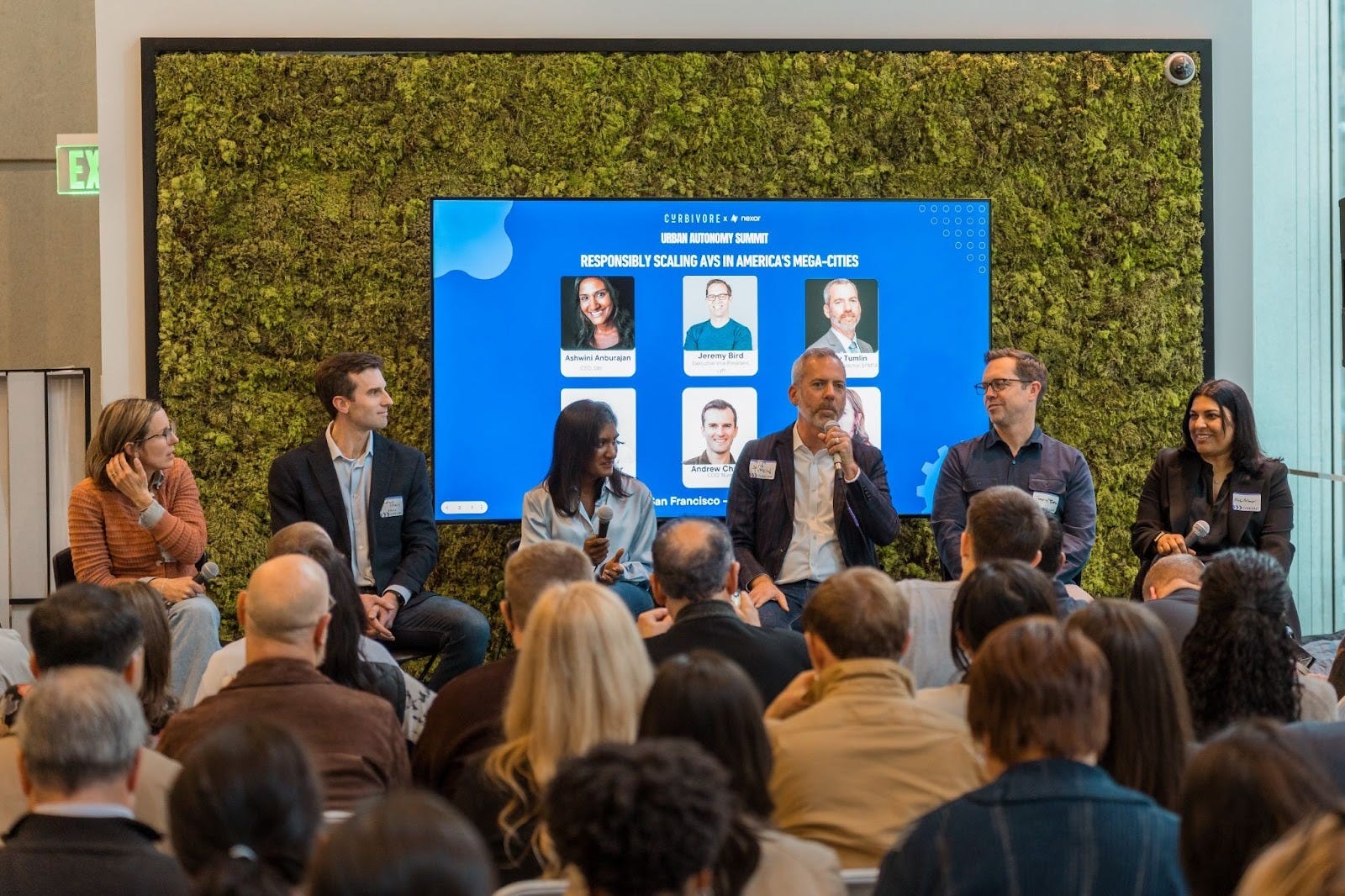
The clearest systems-level perspective came from Jeffrey Tumlin, former Director of Transportation at SFMTA. Jeff was the only panelist whose perspective was rooted in city and societal outcomes, rather than company performance. He spoke candidly about congestion, curb management, and pricing as policy decisions that cities either make deliberately or inherit by default. Ridehail already disrupted city systems by prioritizing convenience over mobility efficiency, and AVs are following the same path. Jeff went further, arguing they can become a drain on city economies by reducing overall people throughput, especially when AVs are not integrated with transit systems. He emphasized that balancing supply and demand through time-based mechanisms like congestion pricing is most effective. AV fleets are uniquely capable of responding to these signals, but they will not do so on their own. Coordination at city scale requires federal and state regulation. Public good outcomes do not naturally align with profit driven incentives, even as cities actively seek partnership with tech companies. Here’s a quote that stood out during the panel:
One of the reasons why I love the Curbivore team is they point out a current regulatory failure, which is our inability to manage the curb for the highest public good, and to get autonomous vehicle companies to be able to partner with cities, in order to direct them to the most efficient places to do pickup and drop off as well as the most efficient or least impactful place to store the vehicle while it’s waiting for its next trip.
Jeremy Bird from Lyft reinforced the idea that the broader mobility marketplace must ultimately become more affordable and work together with cities to align on goals. Jeremy spoke about Lyft’s experiments with fleet operations and partnerships as ways to integrate autonomy without recreating earlier ridehail tensions.
The issue of ridehail contributing to urban congestion remained unresolved. Andrew Chapin, COO of Nuro, framed short-term AV congestion as a societal tradeoff for overall increases in safety. From Nuro’s perspective, safer streets represent a net gain, even if utilization patterns take time to stabilize.
Neha Palmer, CEO of Terawatt, noted that AVs are at least electric, making them more sustainable than riding or driving gas vehicles. She emphasized that AV deployments cannot be separated from power availability, reliability, and land use planning. Terawatt works closely with utilities to determine where charging infrastructure should go across both urban robotaxi depots and more remote electric truck charging hubs. Her point was simple but critical: vehicles do not scale without energy systems that scale with them.
Ashwini Anburajan, CEO of Obi, grounded the discussion of scaling in affordability with data. Ashwini shared recent insights showing how robotaxi pricing in San Francisco has shifted over the past year. Six months earlier, Waymo rides carried a 30-40% price premium over Uber and Lyft. That price gap has narrowed substantially to roughly 17%, as wait times dropped and riders became less novelty driven. Obi’s latest rideshare pricing report also includes comparison to Tesla robotaxi’s lower pricing and demonstrates that AV prices are converging toward traditional ridehail levels, with specific use cases increasingly driving rider choice. One example is travel behavior, where people increasingly choose to rely on rideshare instead of renting and driving themselves.
Curb space and car ownership became a flashpoint, especially as Curbivore’s research has shown repeated failures in curb management to serve the greatest public good. Rachel Swan, transportation reporter at the San Francisco Chronicle and moderator of the panel, citing public frustration with Waymo vehicles occupying parking spaces.
The discussion surfaced a key contradiction: cities want AVs to behave as part of a shared mobility system, while companies want efficiency and scale. Without clear rules, both sides default to their own incentives.
You can find a partial recording of this panel here.
Panel 2: Charged Up Cities: Operating Affordable & Sustainable Urban Fleets

The second panel turned attention to the physical and digital systems that determine whether autonomy can operate at scale.
Erin Galiger, Director of North American Markets at Rocsys, described charging as the tempo setter of fleet operations. To maximize robotaxi depot throughput, charging must be optimized. But reliance on high-cost human labor to plug and unplug vehicles quickly becomes a bottleneck. Rocsys’ hands-free, automated charging solutions aim to alleviate this bottleneck in robotaxi depots, port operations, and heavy-duty logistics.
Erin introduced the idea of “invisible infrastructure.” These are systems designed to blend into cities while doing most of the operational heavy lifting. Automated charging enables a future vision for dark depots: smaller, quieter sites automated and optimized for efficiency. This in turn drives higher throughput and infrastructure utilization, which is more cost-effective and sustainable.
Claire Eagan, Global Head of Legal at Vay, agreed that automation is a prerequisite for scale and pointed to the cost and efficiency challenges of managing on-the ground labor to manage charging for Vay’s remotely driven electric fleet in Las Vegas. While Vay’s vehicles are not classified as autonomous and therefore operate under a more flexible regulatory framework, that flexibility only accelerates market entry, it does not eliminate the physical constraints of ensuring a high-uptime fleet. The takeaway resonated across the room: removing drivers from vehicles does not remove the need to solve physical-world problems.
Jonathan Colbert, VP of Marketing and Business Development at Voltera, reinforced that physical infrastructure decisions unfold over years, and that electric robotaxi fleets often consider their energy needs too late. Siting, permitting, constructing, and energizing robotaxi depots often takes 18 to 36 months. Voltera approaches charging depot development with 30 year horizons, treating them as long-lived urban land assets. Here’s a quote that stood out from the panel:
I would say, the number one bottleneck to scaling electric and autonomous fleets is infrastructure. Everything inside the property line matters, maintenance facilities, access controls, even things like bathrooms. Charging is the big, sexy thing everyone likes to talk about, but for a lot of fleets it’s actually one of the last things they think about.
Rya Jetha, tech culture reporter at the San Francisco Standard and moderator of the panel, closed by asking speakers what they were most excited about and most worried about. The answers clustered around collaboration and urgency. Panelists expressed optimism about shared infrastructure and coordination, alongside concern that regulation and permitting timelines are not moving fast enough to match deployment reality.
You can find a recording of this panel here.
Panel 3: Inside AVs: Safety, System Design, Data, and Training
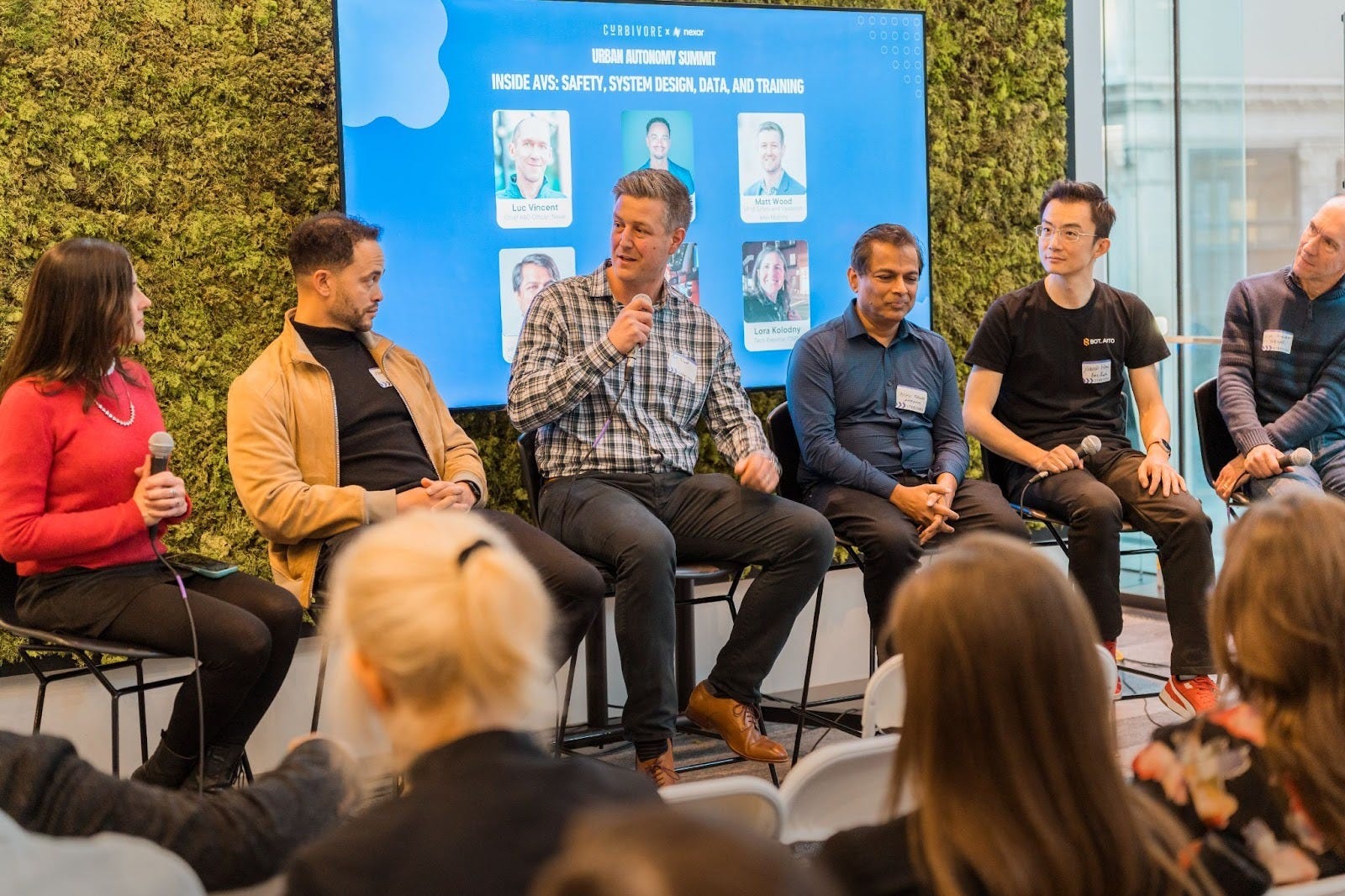
The final panel focused on safety, validation, and what it takes to earn public trust.
Matt Wood, VP of Safety and Validation at May Mobility, spoke about the cost and complexity of proving safety. Validation requires storing enormous volumes of data, running simulations at scale, and testing systems against rare but consequential edge cases.
Luc Vincent, Chief R&D Officer at Nexar, emphasized the importance of real world physical data. Simulations are necessary but not sufficient. Nexar’s network of over 350,000 in-vehicle dash cameras captures rare events, translating chaotic real-world behavior into structured insights AV systems can learn from.
Most driving is actually easy. You’re following the car in front of you most of the time. What’s not solved is the long tail. The rare events that might happen once every tens or hundreds of millions of miles. Those are exactly the scenarios that matter most for safety, and they’re the hardest ones to capture and validate. That’s where large-scale real-world data becomes critical. At Nexar, we operate a network of hundreds of thousands of dash cams, which allows us to capture rare events at a scale that AV fleets alone simply can’t. Those rare events are what developers need to train, validate, and ultimately prove the safety of autonomous systems.
Xiaodi Hou, CEO of Bot Auto, delivered some of the panel’s sharpest product insights. He contrasted autonomy efforts that solve real market needs with those that do not. Autonomous trucks, he argued, address a three-trillion-dollar market where cost per mile matters most, while consumer robotics experiments like laundry-folding robots showcase immature intelligence without meaningful demand or impact.
Xiaodi also highlighted incentive differences. Companies that sell vehicles or autonomy technology optimize differently than fleet operators who must prove autonomy lowers total cost of ownership. He likened Tesla’s goal of selling cars to a chef whose primary objective is filling tables, regardless of broader claims about robotaxis or humanoid robots, or a chef’s self-image as an artist, creator, or influencer. Those incentives shape everything from safety validation to deployment strategy. He closed with a bold promise: Bot Auto will be driverless on public roads this year.
When I started my last company, I truly believed that if you just built the best technology, everything else would take care of itself. That was naïve. Technology is only one part of the problem. Once you’re the CEO, you realize product, operations, and regulation matter just as much.
Ashu Rege, VP of Autonomy and Head of DoorDash Labs, built on this idea by tying autonomy to physical world understanding. Ashu emphasized that AI systems deployed in the real world must understand how objects move, interact, and fail. He echoed Yann LeCun’s view that intelligence without a grounding in physics is incomplete. (Notably, Yann recently joined Nexar’s board as physical AI scales beyond the lab.) Ashu also noted that delivery autonomy faces different constraints and a continued reliance on human tasks compared to autonomous ridehailing. DoorDash deploys autonomy, whether via sidewalk robots or aerial drones, only when it is the best delivery modality based on route, distance, and type of food or goods being delivered. I found this quote from Ashu during the panel to be eye opening:
We’re not just moving people, we’re moving food and goods, and that fundamentally changes the size of the opportunity. Deliveries aren’t constrained the same way ridehail trips are. There’s effectively no ceiling on how many deliveries you can enable when autonomy lowers costs and expands capacity.
Ryan Green, CEO of Gridwise Analytics, added labor context with data showing how increased autonomy use cases are already affecting human gig workers, including rideshare drivers and delivery couriers. In AV active cities, Gridwise found trips per hour for traditional rideshare drivers declined by 5.3%, compared to 2.6% nationally. The data points to measurable shifts in labor dynamics, though panelists agreed it is still too early to know how these changes will ultimately play out, particularly as autonomy could also create new job and gig opportunities.
Lora Kolodny of CNBC played a critical role translating technical debates into public facing questions. She pressed panelists on whether self driving is solved, whether concepts like a digital drivers license make sense, and what 2026 has in store for autonomy. When asked for predictions, panelists largely agreed that the long standing claim that self driving is always five years away no longer holds. AVs are here, and 2026 is shaping up to be a consequential year for expansion.
You can find a partial recording of this panel here.
Urban Autonomy Takeaways in 2026
A few themes cut across every panel:
Cities and companies operate under different incentives, and autonomy exposes that gap.
Charging and physical infrastructure shape scale more than self-driving vehicle technology alone.
Safety depends on real world data, validation discipline, and transparency.
Urban autonomy in 2026 feels like an urgent system-level responsibility as it reaches scale. The work now is about shaping regulations, public/private partnerships, automating operations, and scaling infrastructure to integrate autonomy into evolving mobility systems.


You can view more photos from the event here and next up on the calendar is our flagship Curbivore event— returning to Downtown LA on April 16 & 17. Bringing together leaders from Uber, Zoox, DoorDash, Starship Robotics and many more - it’s a can’t miss gathering about the future of autonomy, delivery and mobility. Register with code Autonomy25 to save an extra 25%.
- Josie-Dee
