

Today’s post comes from Chessin Gertler, a creative strategist and founder focused on the future of mobility. He is also the Founder & Editor in Chief of Freedom Machine, a post-algorithmic publication exploring human movement, and runs a multidisciplinary creative strategy practice of the same name.
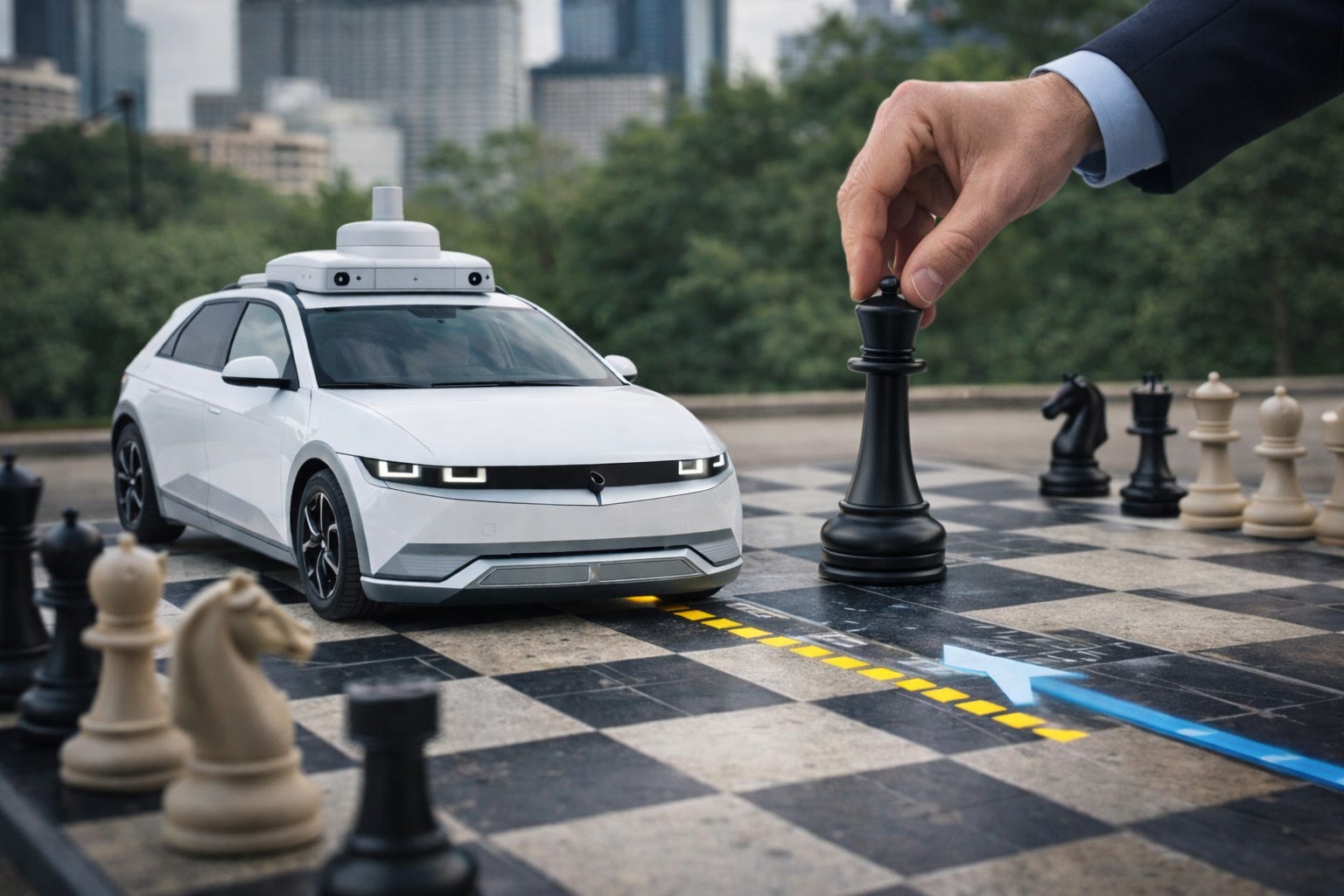
Every year, roughly 40,000 people die in traffic accidents in the United States. Globally, the number exceeds one million deaths annually. Autonomous vehicles will save lives. Early deployment data indicates that the safety potential is real. But between here and that future, there is an unavoidable reality: incidents will happen in perpetuity.
Not because the technology is fundamentally flawed, but because autonomous systems operate in one of the most complex environments imaginable: dense, unpredictable human systems operating at scale. AV incidents uniquely pose the risk of becoming defining events that shape public perception, trigger regulatory action, and, in some cases, alter the trajectory of entire companies.
Which leads to a simple but underdeveloped idea: the AV companies that succeed will not just have the best technology, but the best crisis playbook.
Incidents Don’t Kill Companies. Responses Do.
In 2018, Uber’s autonomous test vehicle struck and killed a pedestrian in Tempe. The contributing factors are well documented: perception challenges, disabled emergency braking, and a distracted safety driver. Uber suspended testing, faced intense scrutiny, and ultimately exited direct AV development, selling its AV division to Aurora.
Cruise’s 2023 incident followed a different pattern. The underlying event was complex: a pedestrian was first hit by a human-driven car and then struck by a Cruise vehicle. The robotaxi attempted a pullover maneuver and dragged the pedestrian. The defining issue was not the collision alone, but how Cruise communicated it. Regulators later accused the company of failing to fully disclose key details. The California DMV suspended Cruise’s permits. Operations halted, leadership turned over, and the program was fundamentally reset.
Now consider Waymo. As the most mature and widely deployed AV system in the United States by a substantial margin, it is now experiencing scrutiny at scale: interactions with buses in Austin, a cyclist incident in Santa Monica, viral clips of awkward vehicle behavior, and more. None of these are existential events individually, but collectively they reinforce that every moment is increasingly observable, recordable, and interpretable, and that interpretation, not just performance, drives perception. Waymo may be beyond the point where a single minor incident can derail the company, but it is not beyond the consequences of cumulative perception. More importantly, it is still early in its growth trajectory. The long-term opportunity remains far larger than its current footprint, and how trust is built or eroded at this stage will shape how far that expansion can go.
The Core Problem
Autonomous vehicle companies operate in a uniquely exposed environment. Every system decision happens in public, on camera, under regulatory oversight, and within an already skeptical narrative. This means crisis response is not a downstream function, but an integral part of the product.
Yet many AV companies still treat crisis response as reactive, legal-driven, siloed from engineering, and disconnected from brand positioning. This approach does not hold up under real-world conditions.
What Goes Wrong
Across these incidents, patterns emerge.
1. Delay creates narrative loss
In both Uber and Cruise’s cases, the gap between the incident and a clear explanation allowed others to define the narrative. Media, regulators, and social platforms will always fill a vacuum. If an AV company does not explain what happened quickly and clearly, someone else will. Cruise is particularly instructive here: the company knew early that its vehicle had dragged the pedestrian, but that detail was not clearly surfaced in initial communications, creating a perception of withheld information. The lesson is simple: in autonomous mobility, partial transparency is often interpreted as concealment.
2. Over-optimization for legal risk
There is a natural instinct to limit exposure, for example by withholding information or deferring to investigation. With autonomous vehicles, that strategy often backfires. What may reduce legal risk in the long term can increase regulatory scrutiny and erode public trust. In a category still building legitimacy, responses that appear legally driven rather than responsibility-driven are often interpreted as avoidance, amplifying the consequences companies are trying to contain.
3. Misalignment with stated values
Most prominent AV companies position themselves as safety-first, transparent, and human-centered, but in moments of crisis, responses often shift toward opacity, defensiveness, and minimal disclosure. This gap is where trust breaks.
The Playbook
If incidents are inevitable, then crisis response must be designed in advance. Here is what that looks like in practice.
1. Pre-defined incident response
Every AV company should have a clear, rehearsed playbook for scenarios such as pedestrian collisions, emergency vehicle interactions, viral incidents, and regulatory inquiries. This strategy should cover not only operational response, but narrative response: what to say, how quickly to say it, through which channels, and in what format. If these decisions are being made in real time, the response is already behind.
By example, consider a pedestrian crosswalk incident. Preplanned analysis and response should activate immediately. Within hours, the company should issue an initial statement acknowledging the event, confirming known facts, and outlining next steps. This should be followed by a structured update including a clear timeline, relevant context (e.g., right-of-way, visibility conditions, actions of other actors), and, where possible, annotated video or visual reconstruction showing what the system perceived and how it responded. Simultaneously, regulators should receive a complete and proactive briefing.
Public communication should be consistent across channels, updated as new information becomes available, and framed in a way that is both technically accurate and understandable to non-experts. Critically, the tone, clarity, and level of transparency should not shift under pressure. The same communication principles that define the company’s brand in normal operation must carry through in moments of crisis. Trust is built through continuity, and any break between brand values and actual behavior in these moments is immediately visible.
2. Default to structured transparency
Speed matters, but clarity matters more. This means early acknowledgment, a clear timeline of events, visual explanation when possible, and consistent updates. Releasing raw information is not enough and is often misleading. AV companies need to explain what happened in a way that non-experts can understand.
3. Make the system legible
Autonomous systems are complex, but explanations of them cannot be. The public does not need to understand the software stack, but it does need to understand what the vehicle saw, what it decided, and why it behaved the way it did. This must be explained simply, otherwise the narrative will be lost.
Without that clarity, even technically correct behavior can be misinterpreted as failure. In many cases, the more relevant question is how a human driver would have responded under the same conditions. If an AV behaves conservatively, hesitates, or yields in a way that appears awkward but avoids risk, that context needs to be made explicit. Making system behavior legible in real time is not just an explanatory exercise; it is how companies ensure that performance translates into trust.
4. Build regulatory trust before it is needed
AV companies cannot improvise trust during a crisis. Regulators should already understand how the system works, how incidents are reviewed, and how findings are communicated. Companies that treat regulators as partners, not obstacles, navigate crises differently.
5. Stay on-brand under pressure
This principle should be evident across all of the above. Crisis response is where an AV company’s brand is most visibly tested. If a company positions itself as safety-first, transparent, and responsible, its actions in moments of failure must reflect those values in practice, not just in messaging. Companies that maintain alignment between their brand principles and their behavior during incidents will be best positioned to preserve trust and sustain long-term success.
A crisis is the moment a brand becomes real, and from that, an opportunity.
Incident Reflections
With Waymo, the gap between operational excellence and narrative control has become most visible. Based on real-world examples and the framework above, there are several areas where Waymo can refine its approach:
More consistent use of visual incident explanation. In a media environment driven by short-form video, releasing clear, annotated footage early can help anchor interpretation before it fragments across social platforms.
Tighter narrative timing. Even minor delays between an incident and a clear, authoritative explanation create space for speculation to take hold.
Greater system legibility in public communications. Not just what happened, but why the system behaved as it did, in plain language.
These are strategic decisions that shape how the technology is understood. As deployments scale, the ability to guide interpretation in real time will become as important as the ability to operate safely.
The Long Game
AV companies have the potential to save millions of lives, but the transition to autonomy will continue to be messy. Incidents will continue to happen, public reactions will follow, and trust will be tested repeatedly.
Trust is built through principled brand behavior, not performance alone. It is reinforced through proactive clarity, consistency, and transparency in moments of pressure.
In the long run, the companies that succeed in autonomous mobility will not simply engineer autonomy. They will engineer trust.
- Chessin
It would be incorrect to presume these companies don't have detailed playbooks already, and haven't had them for a long time. I know at Google Chauffeur, before it was Waymo, we had a detailed series of plans over what to do in a crash, over 15 years ago. Their playbook is much more involved today, and I don't think other companies are that different.
The problem is that just as vehicles will make mistakes, so will reaction teams. No battle plan survives first contact with the enemy. No matter how much you write "don't panic" in large, friendly letters on the cover of the playbook, there will be panic.
That doesn't mean they can't get better, and I suspect they want to. But it's not for lack of realization of the need, I would say.
This 'Crisis Playbook' perfectly mirrors the shift we saw in healthcare 20 years ago. For decades, hospitals relied on a 'Deny and Defend' model that only served to fuel public distrust and lead to 'nuclear verdicts.' The tide didn't turn until pioneers like the University of Michigan adopted radical transparency—proving that proactive disclosure actually reduces liability.
In the AV space, the legal risk of silence is now far greater than the risk of transparency, provided the industry has the objective data and video to back that honesty up. Excellent analysis.