

In a new study, Associate Professor Michael Hyland at UC Irvine explains why giving robotaxis somewhere to wait between rides could be crucial to avoiding unnecessary miles on city streets.
Where should a robotaxi go after dropping off a passenger?
It could wait at the curb, head back to a depot or it could simply keep moving.
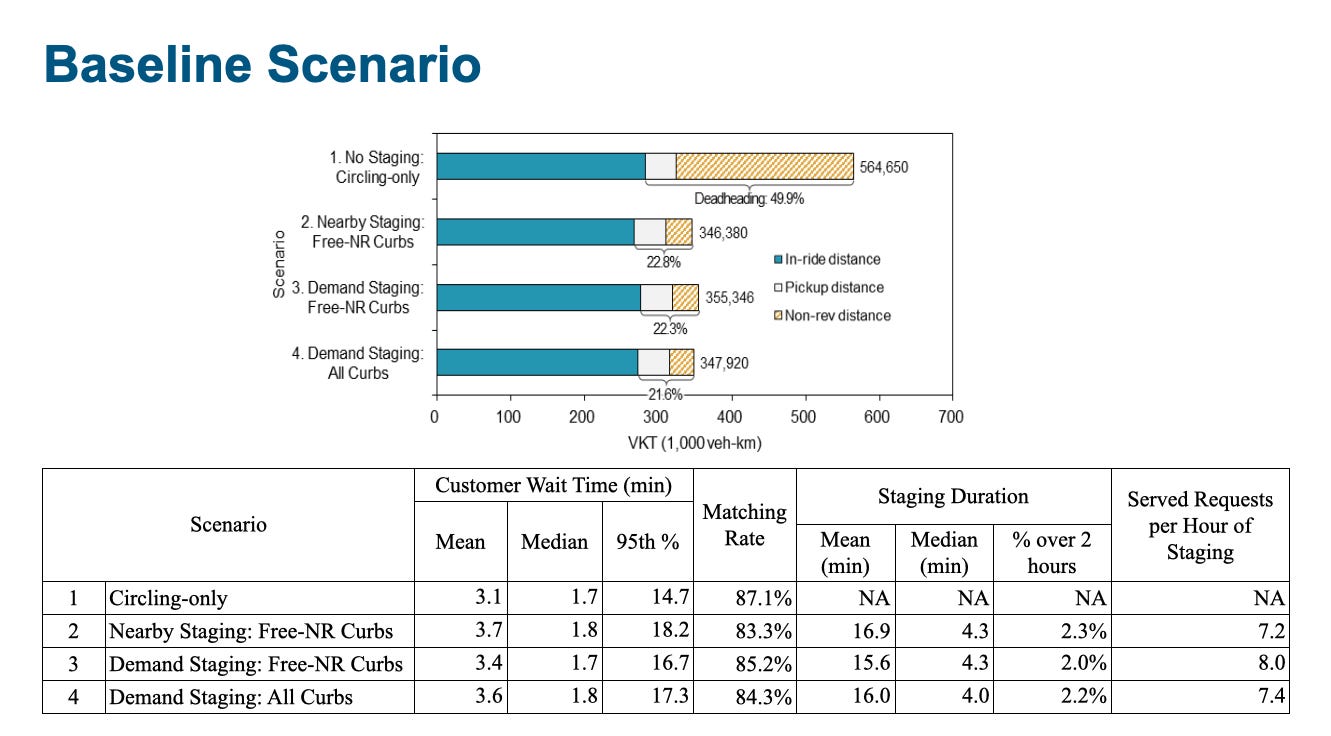
A new study from researchers at UC Irvine and UC Berkeley examines what happens when shared autonomous vehicles are prevented from resting (otherwise known as staging) at the curb in San Francisco. The researchers simulated a fleet of 1,700 robotaxis serving 68,000 daily trips. In the no-staging scenario, the fleet traveled 564,650 kilometers per day. Allowing the vehicles to stage at the curb reduced daily vehicle miles traveled (VMT) by nearly 60%.
Michael Hyland, Associate Professor of Civil and Environmental Engineering at UC Irvine and one of the researchers behind the study, spoke to The Driverless Digest Editor Ben Hubbard about why curb access matters for robotaxis, how cities should manage valuable curb space, and what the rise of personally owned driverless vehicles could mean for congestion.
The Driverless Digest: Tell us about your role?
Michael Hyland: My research is broadly on modeling and analyzing transportation systems. I tend to focus on innovations in the transportation space, such as driverless vehicles, both in terms of shared fleets and personally owned, but also technologies like e-scooters, e-bikes, ride-hailing and micro-transit. My work involves how to operate these systems efficiently, how to design them effectively, and then I also try to understand their impact on people living in cities.
You’ve recently conducted a pretty comprehensive study on managing curb usage. Can you explain the experiment and what you set out to understand?
The idea was to test the impact of banning shared automated vehicles from using the curb. So this is not when they pick up and drop off passengers, but for what we call staging or parking between one drop-off and the next pickup. Essentially, the time when the vehicle doesn’t have anything to do.
The main result, of course, is that it has pretty big implications on what these vehicles do with their time. When they can’t stage, they just circle around the transportation network. In this case, they dramatically increased vehicle miles traveled on the roadway network in San Francisco. We don’t model congestion in our study, but the implications for congestion, I think, are somewhat obvious directionally. It would make congestion worse, most likely in some of the most congested parts in San Francisco.
We ran some other scenarios related to weekends versus weekdays, preventing vehicles from staging at night versus only during the day. Most of the results were pretty similar. If you’re strategic with where you ban the robotaxis from using the curb, the size of the VMT impact is much smaller, but there still is an adverse impact.
Plenty of people have probably wondered where an AV goes after it has dropped off a passenger. Do they just drive around in circles? Do they wait? Could you explain how this study came about because I can imagine this is going to become a really important topic when AVs take off.
Yeah, that’s right. As there are more fleets, the impact will be much larger. The study actually came from Waymo reaching out to us here at UC Irvine via Susan Shaheen’s group at UC Berkeley. They knew we did modeling and they asked us to interview stakeholders in cities to understand how they’re thinking about regulating the curb and using the curb for not just robotaxis but also Uber and Lyft-type vehicles, and micromobility too.
They came to us and said, “Hey, we think it’s mutually beneficial for us at Waymo and for cities for our vehicles to be able to use the curb when we’re not serving passengers,” as opposed to just driving around or even going a long distance back to an off-street parking lot. We co-designed the experiments. We made the final choices, of course. That’s the backstory of how the study came to be.
So is it entirely independent? When a company like Waymo approaches a university to produce a study, there’s always a feeling that the results might be tailored in their favor.
I can see that’s the impression. The main thing Waymo was pushing back on when we were writing up the report was that they said: “Well, we didn’t give you any data, so don’t make it seem like we did give you any data.” All this data is synthetic. We got the parking data from INRIX. We got the ride-hailing trip data from a company called Replica. Waymo really didn’t give us any data, which was fine with us. They gave us order-of-magnitude information about their fleet size, which is publicly available.
As far as the results, I mean I hate to undercut our study, but the directional impact was kind of obvious going into the study. We knew that by banning these vehicles from using the curb, it was going to increase VMT. It was really the magnitude that was the interesting part. Was it going to be a 10% increase? 30%? We found a pretty large number, which was a 60% increase in total vehicle miles traveled with this policy. And that came directly from the results. We didn’t rerun any scenarios or rerun the experiments with Waymo’s input.
Where do all those extra miles come from?
There are all these peaks and valleys throughout the day in terms of the demand for robotaxis. Everyone knows when the big peaks are for regular travel, right? So the morning peak, and then you have the afternoon peak. But for a service like Uber, Lyft or Waymo, there’s even little peaks and valleys that occur throughout the day, and spatially these occur throughout different parts of the region.
But when you have these vehicles out on the road and you get a little bit of a dip in demand, there’s nowhere for them to go. They’re not serving passengers, so they need to find somewhere to go. And if you don’t allow them to use the curb, what the software we use does is just gives them short “fake” trips to take throughout the network, circling around where they expect the future demand to be. And that, as the results suggest, leads to a lot of cumulative extra miles traveled in the network.
Some observers might believe these vehicles would just go back to a depot. Did you measure that?
Unfortunately, we didn’t create scenarios around the vehicles going back to the depot. I wish we could have but we ran out of budget.
Given that there are relatively few Waymo depots across the entire 49-square-mile San Francisco area, I suspect this would reduce VMT somewhat, but probably not by much. I’m not sure exactly how many depots Waymo has, but let’s say somewhere between two and five. Whenever a vehicle became empty, it would likely have to travel a fairly long distance to reach a depot, perhaps a mile and a half on average. It would then have to travel another mile and a half or so to pick up customers once a new request came in. So I think there’d be a pretty negative impact if the vehicles were always returning to the depot as well. Maybe you could bring that 60% number down to like 40-45%.
To reduce the VMT, you’d need to have depots all over the city then?
Yeah, I don’t think they [Waymo] are really into real estate development. They could partner with other companies, though. One thing we learned throughout the study is that the price of off-street parking is clearly time-dependent. In some parts of the city, such as commercial districts, parking might be very cheap to access at night but very expensive during the day. In residential areas, it’s usually expensive no matter what, and there are rarely large enough areas for a depot to be set up.
Acquiring land is also expensive. I imagine they’re trying to minimize the amount of land they need to acquire and be strategic about where they park their vehicles. They’d have to consider both the location and whether they’d have to pay for parking there.
Were there any other major findings?
The other major finding, which Waymo liked a lot, was related to a metric we used called curb productivity.
We measure curb productivity as the number of passengers who move between the transportation system and their destination per unit of time a robotaxi occupies the curb, including time spent staging and picking up or dropping off travelers.
We found that robotaxis were about eight to ten times more productive than personal vehicles in terms of how they use the curb. A personal vehicle spends about one-and-a-half hours at the curb on average, whereas a robotaxi spends eight to ten times less time there, around eight minutes per ride served on average.
If you’re concerned about one of a city’s most valuable assets, the curb, it seems that robotaxis use that asset much more productively than personal vehicles do. Personal vehicles can simply park at the curb and stay there for a very long time. Obviously, people can get out and walk around and do many things while their vehicle is parked, but you still have a very valuable piece of land being occupied by a vehicle that isn’t actively serving passengers.
And I should say that buses are much more productive than robotaxis, which in turn are much more productive than personal vehicles. A bus is only at the curb for a very short period of time, but it can have many people getting on and off during that time.
What can cities do in terms of regulating the curb?
I’m not sure how many cities were considering banning robotaxis from using the curb, but if they were, I would say don’t do that. They might be increasing congestion a bit, but I think they’re providing valuable mobility to a large number of people in urban environments.
Moving beyond our study, I am generally in favor of having designated pick-up and drop-off zones where it is easy for robotaxi, ridehailing and taxi vehicles to get to the curb quickly, pick up a passenger quickly, and exit very quickly. So individual vehicles are not having to fight for curb space, and the vehicles are not spending much time at the curb at all. They’re just getting the passenger in the vehicle and moving away quickly.
I don’t think I’d be in favor of having designated staging locations for robotaxis or ride-hailing or taxi vehicles in general. But I think just allow these vehicles to use the curb for short-term parking, in the same way that private vehicles can.
What about personally owned driverless vehicles? What impact could they have on VMT?
That’s another area of research for my group. I’m not going to make a forecast as to when Waymo or Toyota or another company is going to be selling these vehicles to individual households. But let’s say in 10 to 15 years they do sell them to households. I think in that scenario, we have a lot of benefits to households in terms of mobility, but we have some very big potential implications for congestion and vehicle miles traveled.
What we’re seeing in our modeling results is that households absolutely will have the vehicle drop off one household member at work, drive home, pick up another household member, take them to an activity, whether that’s school or some after-school activity, and then drive back home empty again. In this case, a household might actually be able to own fewer vehicles because these vehicles can travel empty and deadhead back to the household. But that’s going to significantly increase VMT and congestion, unless of course there are some policies to make it more expensive to drive and make it more expensive to congest the roadways. So I think that’s a particularly important policy question for cities and states going forward.
This is like the Airbnb model for driverless taxis. We’re already sharing our homes, our parking spaces and if I buy an autonomous vehicle why would I let it sit in the car parking space when it could be out making me money, right?
We’re a little bit skeptical that people will be willing to give their $80,000 to $120,000 assets to strangers. But we do think there’s maybe an opportunity to get more use out of these valuable assets.
I’d be willing to lend my vehicle out occasionally or semi-occasionally to friends and family that live nearby, which maybe prevents them from buying a third vehicle or a second vehicle here in California. So I think there’s a nice opportunity there for some sharing of these personally owned driverless vehicles. But we’re a little bit skeptical of the model Tesla has discussed, where a Tesla owner lends their vehicle to a ridehailing fleet operator where anyone could be throwing up or using your vehicle for any type of purpose.
Yeah, you also have issues about cleanliness too. Any final thoughts?
I’ve been asked a number of times about whether cities should be charging robotaxis to use the curb and to drive around in urban areas and my answer is yes, but not just robotaxis. In my opinion, robotaxis should be subject to the same rules as all passenger vehicles in urban areas. If a passenger vehicle has to pay to park, a robotaxi should have to pay to park.
So, as a transportation analyst, I am in favor of congestion pricing. I think it’s worked very well in London. It worked very well in New York City. I think it can work in other large, dense areas, including Los Angeles and San Francisco. But I wouldn’t subject robotaxis to additional fees and additional taxes that you’re not subjecting personal vehicle owners to. If you actually want to reduce congestion, you need to charge all of the personal passenger vehicles for using very valuable space in urban areas.
Michael, it’s been a fascinating conversation. Thanks so much for coming on.
This interview has been edited for clarity and length.


