

Today’s post comes from William (Billy) Riggs, a Professor at the University of San Francisco and Director of the Autonomous Vehicles and the City Initiative. He holds a PhD in City Planning and has over 100 publications exploring the intersection of transportation, technology, and the future of cities, with his work featured in leading media outlets including The Economist, Forbes, The New York Times, and The Washington Post.
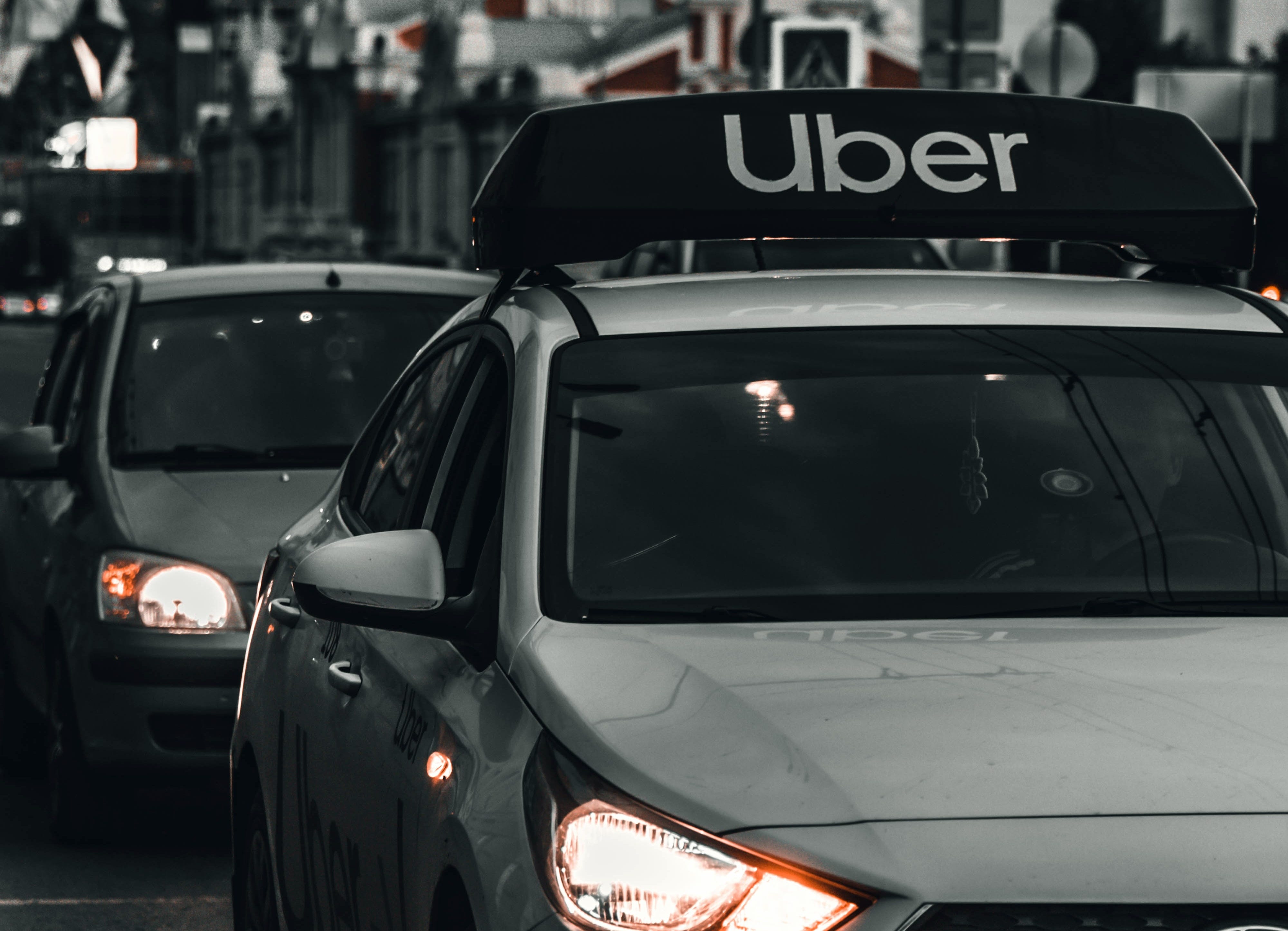
For more than a decade, Uber built one of the most valuable transportation platforms in the world by redefining labor as software-mediated flexibility. Drivers supplied the vehicles, absorbed the depreciation, paid for fuel, maintenance, insurance, financing, downtime, and risk, while the tech platform did the coordination. But now, as autonomous vehicles begin to mature commercially, even as it continues to do business with many AV companies, Uber has repositioned itself as a defender of drivers and equitable mobility, with stated concerns about the impact of automation on workers. This narrative deserves scrutiny.
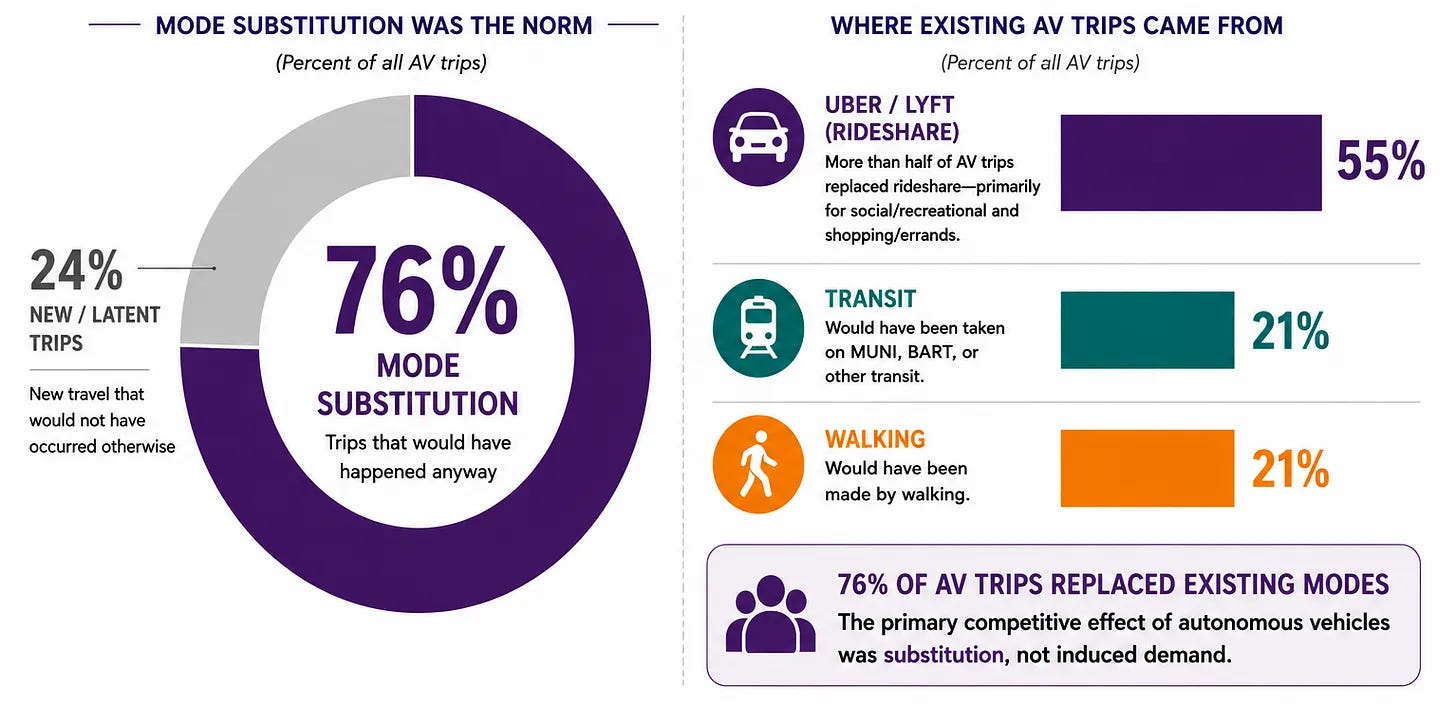
Uber’s recent white paper, “Unlocking the Promise of Autonomy,” presents the company as a pragmatic middle ground between rapid automation and social responsibility. The report argues for a “hybrid” transportation future where human drivers and autonomous vehicles coexist and warns against a future in which robotaxis create unequal systems of mobility. But the argument is difficult to separate from Uber’s own strategic vulnerability and efforts to slow Waymo and Tesla, as signaled by their recent divorce from the company in Phoenix. Research showing that 55% of AV rides come directly from people who otherwise would have taken a rideshare trip indicates that efforts to slow down automation may be more about platform preservation than social good1.
And more importantly, the irony is hard to ignore: the same company that normalized gig work is now not only glamorizing the quality of that work, but framing the preservation of it as a form of worker protection.
The contradiction becomes even more egregious when viewed alongside Uber’s broader strategy to launch its own autonomous vehicles and avoid liability from things like assaults and sexual harassment from its non-employee driver-partners. The company has aggressively expanded partnerships and investments in autonomous mobility while simultaneously signaling caution about displacement and over-automation. It has done things like launching “Uber Autonomous Solutions” (a division specifically designed to accelerate commercialization of autonomous fleets through financing, fleet operations, support infrastructure, and platform integration), and putting more than $10 billion toward autonomous partnerships with Rivian, Nuro and Lucid.
Andrew Macdonald, Uber’s President and COO, recently stated that the technical hurdles for AVs have “largely been solved” and that commercialization is now the central challenge. At the same time, Uber executives have also been publicly criticizing AV-only operators like Waymo as inequitable, less scalable, or disconnected from broader transportation needs.
Given all of these signals, it starts to look like Uber is using the same old strategy they have employed for years to avoid regulation and beat out competition. And in this case they want to occupy both sides of the argument. They say they want to scale automation, but also protect society from it. They say they want to protect labor while exploiting it.
And this labor contradiction is the core issue. The uncomfortable reality is that Uber’s rideshare model is built on a deeply asymmetrical labor structure. Research going back to 2018 suggested that Uber and Lyft drivers only take home $3.37 per hour after taking into account vehicle costs. While these numbers were revised to a median of $8.55 after receiving pressure from the company and a Medium post from Uber’s Chief Economist, the fact remains—the majority of drivers are never compensated for the full operating cost of their vehicles.
Harry Campbell, Founder of The Rideshare Guy, validated this for me in one of our recent discussions, saying:
Uber shifts a lot of the burden of vehicle maintenance and insurance to unsuspecting drivers. For example, drivers can sign up to drive with personal insurance but there’s a coverage gap during Period 1 (driver online, but waiting for a request). If they get into an accident, many are surprised to find out that there’s a $2,500 deductible which is much higher than the average personal insurance deductible.
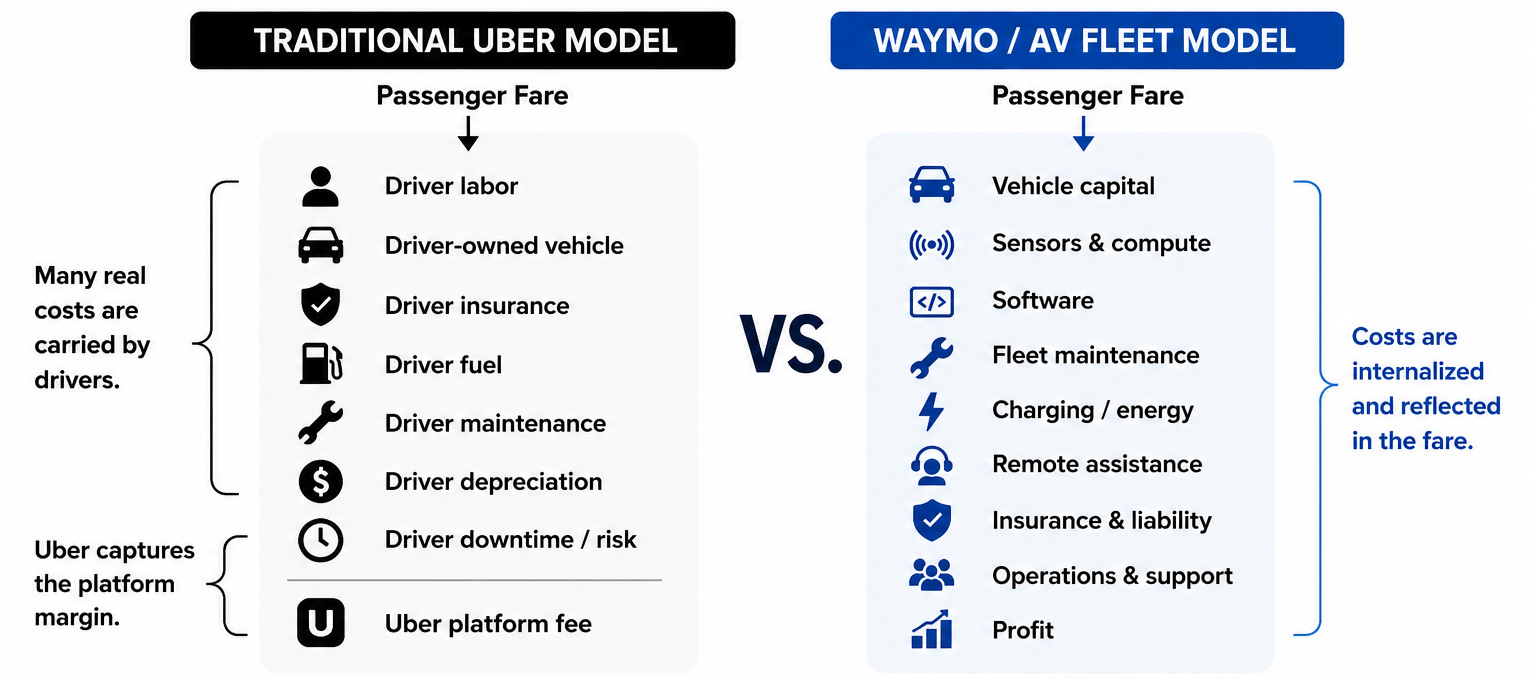
Rideshare platforms externalize large portions of the operational expense of vehicles; placing these costs onto workers themselves. This includes maintenance, insurance, idle time, fuel costs, financing, depreciation, and more… while Uber extracts monetary value from its app, at a fair “take rate” of more than 50%—meaning that the driver often gets less than 50% of what the rider pays. While these figures continue to be disputed by Uber, when factored alongside increases in costs related to vehicle operations in recent years, it is likely that raw take-home wages for drivers is lower than the $30/hour median that Uber claims–and this may be much higher that actual driver earnings because it does not account for down time when drivers are online but waiting for a ride.
Comparing this to Waymo and other vertically integrated AV operators, there are key structural differences. Most importantly, the operational costs are internalized into the service itself. The vehicle, software stack, fleet maintenance, sensors, remote operations, and liability structure are all folded into the economics of the ride. The fares increasingly reflect the real or actual cost of delivering a ride to a customer.
That distinction is important. Rideshare platforms have historically obscured the true economics of transport because the drivers themselves absorbed the substantial share (if not all of) the operational cost and financial burden for the vehicle. The drivers, in essence, subsidize the ride. The low apparent price of many trips is a product of drivers using their own vehicles (assets Uber or Lyft do not own or maintain) and agreement to precarious labor standards. In 2025 Human Rights Watch provided research that showed that 67% and 75% of rideshare drivers struggled to afford food and housing respectively. Many were subject to accidents and exposure to violent crime. In the most simple terms autonomous vehicles threaten to expose the economic exploitation and poor workplace conditions. They reveal the resource that rideshare companies have long exploited—drivers.
For years the growth of the rideshare industry has been subsidized by privately owned vehicles and contingent labor. [Note that in most cases rideshare drivers are independent contractors that receive limited benefits.] I have argued before that the concept of “human dignity” in labor matters, and that gig work is a toxic labor system that perpetuates a “Dickens Economy” that does not value labor fairness, workplace safety or health. The same Human Rights Watch report in 2025 found that 50% of drivers experienced wage instability week-to-week and a shocking 70% were worried about being deactivated or suspended by app algorithms. This is confirmed by medical journal articles identifying occupational health issues related to gig driving and other peer reviewed work that underscores the “lack of social protections, algorithmic control, intense competition, and downward pressure on wages.” This is important in the current context as Uber begins to reposition itself as a defender of drivers, reframing gig work as socially beneficial employment worth preserving against automation and autonomous vehicles.
In evaluating this position (that we should preserve the value of gig labor) however, we should be asking honest questions: what exactly are we preserving? Gig drivers lack long-term wage stability, healthcare, retirement benefits, predictable scheduling, labor protections, or meaningful economic mobility. And Uber has made clear that drivers are independent contractors and not employees so that they could avoid awarding corporate benefits to their large “driver partner” labor pool. Yes, it may be an easy job. Yes, it may be a job that is flexible and easy to access. But that doesn’t mean that gig driving jobs are somehow worth retaining or that the ride-hailing labor model is some kind of social compact we made to preserve low-skilled driving. And this is what Uber is trying to position; that gig jobs are dignified labor that should be protected. But consumers should not be deceived; this is not worker advocacy—it’s self-serving as the company is aggressively pursuing its own self-driving car initiatives.
Given that it’s not clear that companies like Uber have a legitimate claim to push back against automated vehicles when they are ending their partnership-with and looking to compete-with Waymo, and after more than a decade of aggressively restructuring transport jobs into a gig economy that supports precarious and unstable work conditions for drivers. This is not being a principled guardian of jobs or transportation equity; it is simply a ploy to slow down other autonomous vehicle companies, while they scale their own technology, reducing their reliance on gig labor. Put simply, to redefine low-quality, contingent, “gig” labor as socially valuable employment at precisely the moment you are trying to reduce reliance on this form of labor, and at the exact time when automation promises to unlock economic advantages, allowing for upskilling and retraining, is disingenuous.
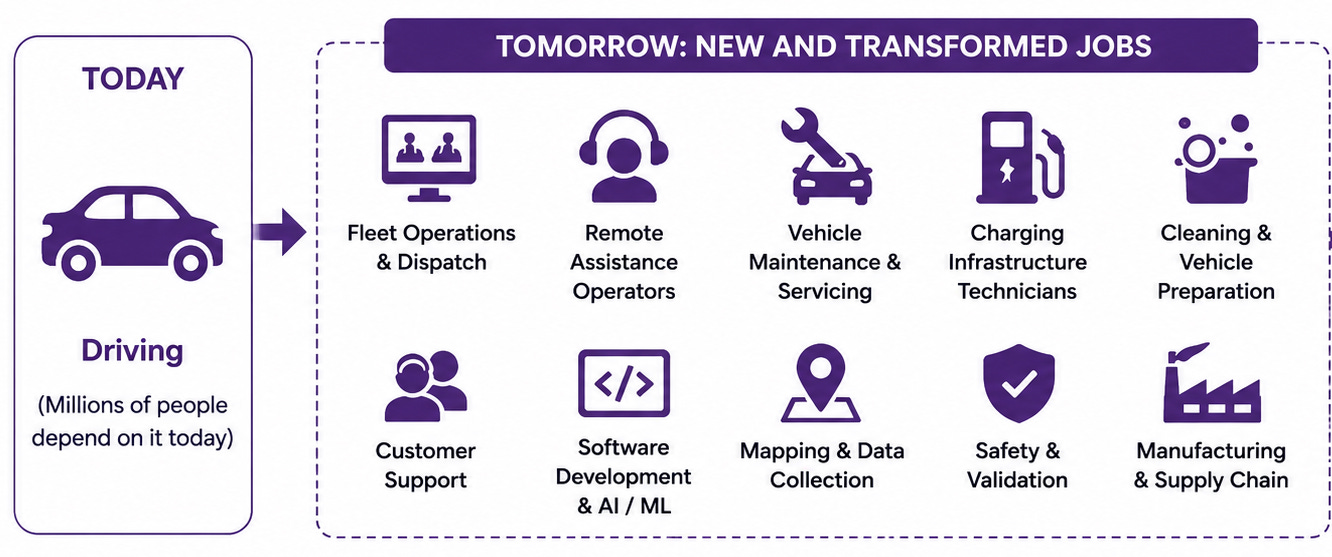
And all this is not to argue that job displacement concerns in an autonomous vehicle future are unimportant. Technological transitions driven by AI and automation will undoubtedly produce disruptions for workers and communities. History suggests as much. But history also suggests these transitions rarely unfold as simple stories of mass unemployment. Most credible research now points toward widespread job transformation, gradual displacement, and the creation of entirely new categories of work alongside productivity gains. For example, The World Economic Forum projects roughly 92 million jobs displaced but 170 million created, for a net gain of about 78 million jobs by 2030. The Chamber of Progress estimates that, “for every 1,000 AVs produced and deployed annually, approximately 190 workers will be needed for manufacturing and servicing these vehicles.”
Yes, some of the concerns Uber highlights are very real government questions that need honest dialogue and decisive policy: from curb management and accessibility, to public transit integration, and equitable deployment. Uber is right that companies and policymakers absolutely should think seriously about workforce transition, retraining, and economic adaptation as well as the build-out. But after years of normalizing the gig economy, arguments about labor feel more self-serving than social responsibility. And the conversation about worker transitions in light of automation deserves more attention than to romanticize today’s gig economy.
If Uber wants to lead the next chapter of mobility, it should do so honestly: not by romanticizing the labor conditions that made its original business model possible, but by acknowledging the economic contradictions that autonomy is beginning to expose. They should be focused on retraining and upskilling, not keeping the same old systems that hold workers back. The future transportation debate should not be framed as humans versus robots. It should be framed around labor transition and how automation helps reshape the dignity of work in mobility.
Figure 1 Source: Riggs, W., Schrage, N., Shukla, S., Mark, S., 2023. The Trip Characteristics of a Pilot Autonomous Vehicle Rider Program: Revealing Late Night Service Needs and Desired Increases in Service Quality, Reliability and Safety, in: Meyer, G., Beiker, S. (Eds.), Road Vehicle Automation 10, Lecture Notes in Mobility. Springer Nature Switzerland, Cham, pp. 93–107 (link).

Amazing perspective and the best AV/ Mobility newsletter.
Wow. Interesting take. 👍