

Today’s post comes from Daniel Abreu Marques, who works in autonomous driving strategy and writes about Waymo and the broader robotaxi space in a personal capacity over at The AV Market Strategist.
Waymo has had an impressive 2025, so today I wanted to look back at the year and review the incredible progress the company has made, from skyrocketing trip numbers to a valuation that is blowing past almost all expectations.
If 2024 was the year autonomous vehicles proved they could work, 2025 was the year they proved they could scale. Waymo has moved from a moonshot to a true multi city utility, effectively doubling its ridership and operational footprint in less than a year.
Weekly rides skyrocketed from 175,000 to 450,000+
The clearest indicator of Waymo’s 2025 momentum is its weekly paid ride progression. The company began the year completing approximately 175,000 weekly rides (reported in November 2024) and ended with 450,000+ weekly rides, representing a 157% increase in roughly 12 months.
On February 27, 2025, Alphabet CEO Sundar Pichai announced on Twitter that Waymo had surpassed 200,000 weekly rides, marking a 20x increase from the 10,000 weekly rides the company provided in May 2023. Just eight weeks later, during Alphabet’s Q1 earnings call on April 24, 2025, the company revealed weekly rides had jumped to 250,000+, representing a 25% increase in under two months. This translated to roughly 1 million rides per month, marking the first time the company crossed the million-monthly milestone.
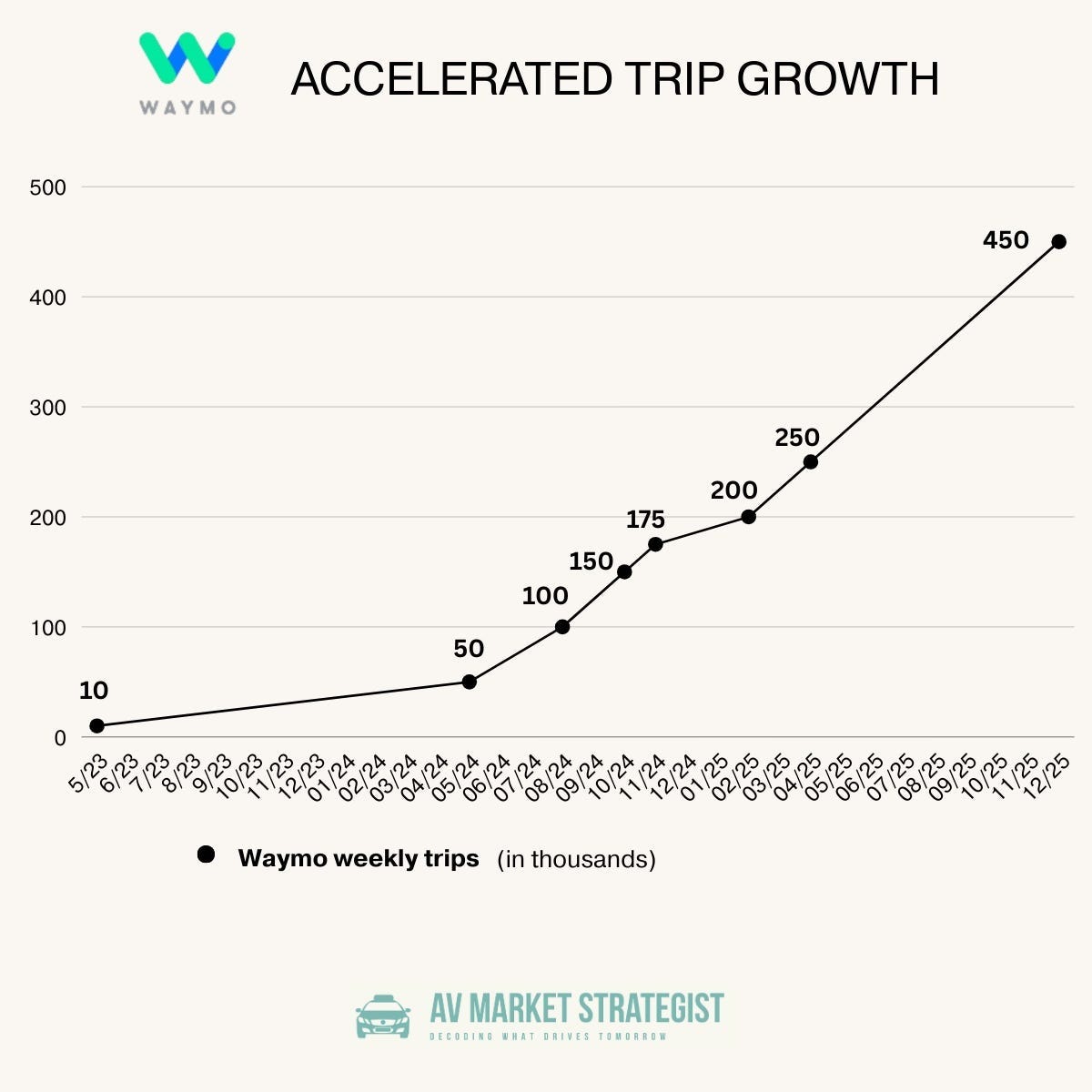
On December 8, 2025, Tiger Global Management revealed in an investor letter that Waymo had surpassed 450,000 weekly paid rides. This represented an 80% increase in approximately seven months and solidified Waymo’s position as “the clear leader in autonomous driving.”
Waymo’s December 10 Year in Review provided even more comprehensive annual totals. The company completed 14 million trips in 2025, three times the approximately 4.5 million rides provided in 2024. Lifetime rides are expected to exceed 20 million by year-end 2025. Riders spent 3.8 million hours in Waymo vehicles throughout the year and collectively avoided 18 million kg of CO2 emissions, also three times 2024 levels.
On July 15, 2025, Waymo announced reaching 100 million fully autonomous miles, doubling from 50 million at the end of 2024 in just six months. The company now drives more than 2 million autonomous miles weekly.
Waymo’s City Launches and Service Expansions
Waymo also aggressively expanded its service footprint in 2025. In March, Waymo launched in Austin, TX (via a partnership with Uber) and began offering public driverless rides. By June, Waymo also opened service in Atlanta, GA through the Uber app. These new markets joined Waymo’s existing cities – Phoenix, San Francisco, and Los Angeles – to bring the active service count to five major urban areas. Waymo also expanded the service area in those existing markets.
Here is an overview of these expansions by market:
Phoenix, Arizona
Phoenix entered 2025 as Waymo’s most mature market at 315 square miles, the largest robotaxi territory in the United States. Unlike other markets, Phoenix saw no geographic expansion in 2025. Instead, the focus shifted to operational capabilities and new service types.
March 2025: Waymo partnered with Moove for fleet operations support in Phoenix.
October 2025: The company launched a multi-year autonomous delivery partnership with DoorDash across Metro Phoenix’s full 315 square miles. DashPass members received a $10 monthly Waymo ride credit through December 31, 2025.
November 2025: Waymo opened freeway operations to paying customers, enabling rides on Loop 101, Loop 202, I-10, I-17, and US-60 at posted speed limits up to 65 mph. This followed over a year of employee testing that began in January 2024.
December 2025: DoorDash delivery operations went live, beginning with DashMart convenience and grocery orders.
Phoenix Sky Harbor continues to offer 24/7 curbside robotaxi service, a capability first introduced in November 2022 that makes it the first U.S. airport with fully autonomous ride access. The airport handles approximately 1,000-1,200 daily trips.
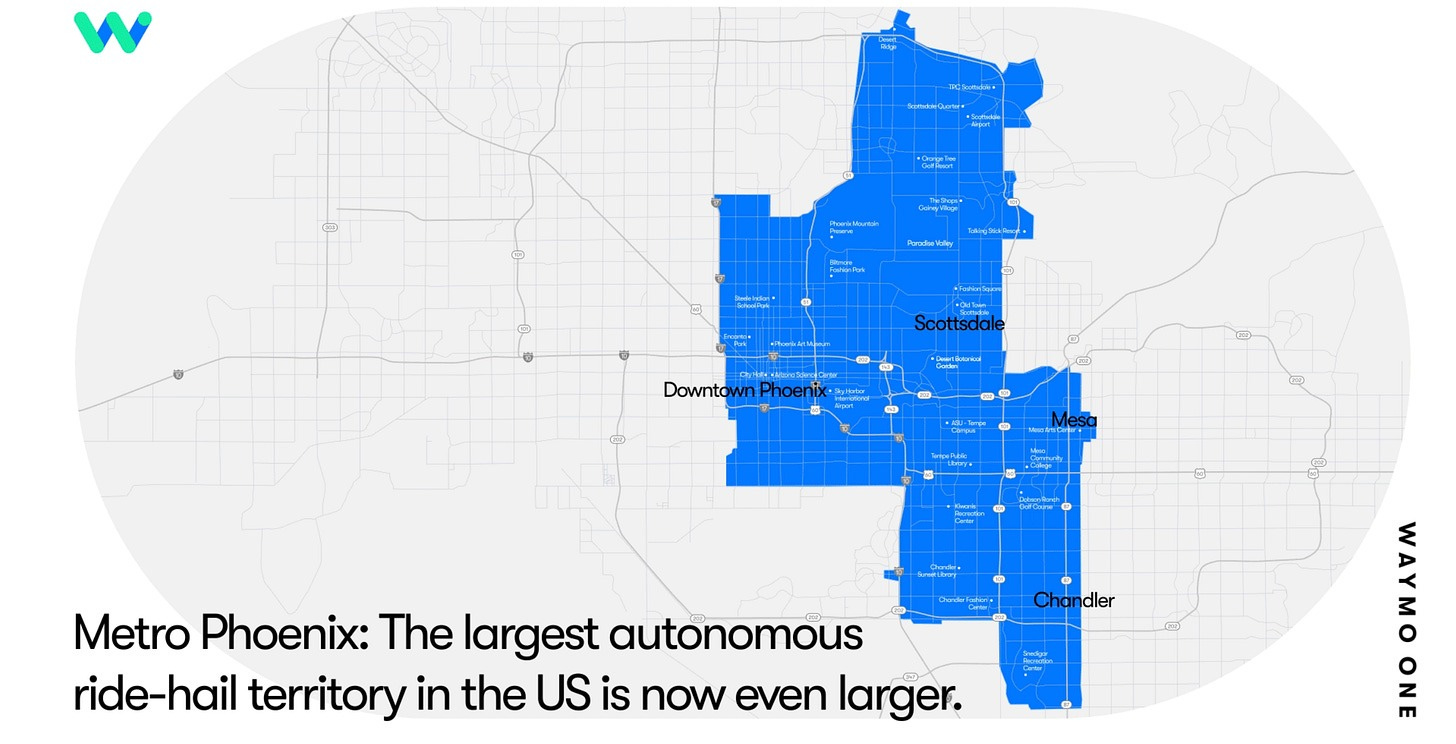
Source: Waymo
San Francisco Bay Area
The Bay Area underwent Waymo’s most dramatic geographic expansion in 2025, growing nearly 5x from approximately 55 square miles to over 260 square miles and finally unifying the disconnected San Francisco and Silicon Valley zones.
March 11, 2025: Waymo returned to Silicon Valley where Google’s self-driving car project began in 2009. The expansion added 27 square miles covering Mountain View, Los Altos, Palo Alto, and parts of Sunnyvale. This zone remained disconnected from San Francisco’s service area, requiring customers to use two separate service zones.
March 14, 2025: San Francisco International Airport granted Waymo a 30-day mapping permit for up to 2 human-driven vehicles.
March 17, 2025: California’s DMV approved Waymo’s deployment amendment for the Peninsula and South Bay, including San Jose.
April 10, 2025: San Francisco Mayor Daniel Lurie announced Waymo was invited to map Market Street, the car-free corridor closed to private vehicles since January 2020. Waymo planned summer operations.
May 19, 2025: The California Public Utilities Commission authorized Waymo to offer paid rides in nearly all of San Jose, plus Los Gatos, Milpitas, Cupertino, and larger portions of the Peninsula. This made Waymo the first driverless car company approved for commercial service in San Jose.
June 17-18, 2025: A major Peninsula expansion brought Brisbane, South San Francisco, San Bruno, Millbrae, Burlingame, Hillsborough, Stanford University campus, Menlo Park, and more of Sunnyvale online. Despite the proximity, SFO Airport remained excluded and the SF-Silicon Valley zones stayed disconnected. Bay Area coverage reached approximately 100+ square miles.
August 26, 2025: Market Street passenger operations began, with service along the corridor between Van Ness Avenue and Steuart Street during off-peak hours (9 AM-4 PM and 7 PM-6 AM).
September 4, 2025: San Jose Mineta International Airport announced Waymo had received its commercial operating permit, with curbside service expected before year-end.
September 16, 2025: SFO granted a phased Testing and Operations Pilot Permit with three stages: Phase 1 for human-driven testing, Phase 2 for employee-only autonomous rides, and Phase 3 for eventual public service.
November 12, 2025: Three transformative milestones occurred simultaneously. Waymo launched freeway operations on Highway 101 and Interstate 280 for paying customers. The Peninsula expansion finally connected San Francisco and Silicon Valley into a single unified 260+ square mile service zone spanning from San Francisco through all Peninsula cities to San Jose. San Jose Mineta International Airport launched 24/7 curbside service at both terminal Ground Transportation Centers, making it the second U.S. airport with this capability after Phoenix.
December 9, 2025: SFO entered Phase 2 operations with fully autonomous rides (no human driver) available to Waymo employees and designated airport staff at the Kiss and Fly pickup area.
The Bay Area expansion represented Waymo’s largest service area growth, connecting previously fragmented zones and enabling seamless travel from San Francisco to San Jose via freeway.
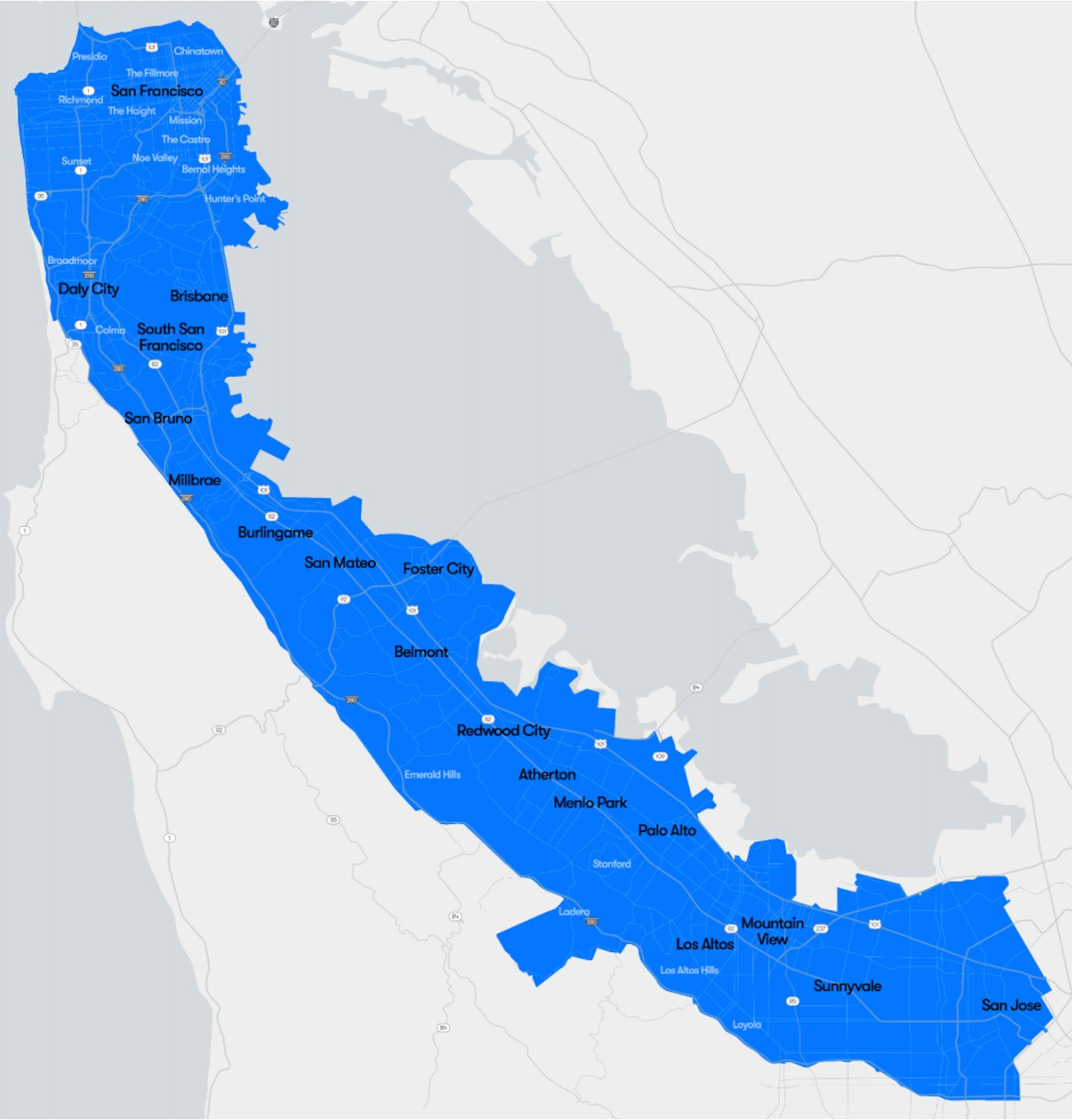
Source: Waymo
Los Angeles
Los Angeles entered 2025 with approximately 79 square miles of coverage. The city saw steady expansion throughout the year, eventually reaching over 120 square miles.
January 28, 2025: Waymo announced it would begin driverless freeway testing on I-10, I-110, I-405, and Route 90.
February 1, 2025: Freeway testing with employees commenced on the announced routes.
February 2025: Waymo added 10 square miles covering parts of Westchester and Inglewood, bringing LA coverage to approximately 89 square miles.
March 27, 2025: SoFi Stadium area service went live, covering Inglewood near the stadium and the HHLA shopping center in Westchester.
June 17-18, 2025: Waymo’s largest Los Angeles expansion jumped coverage from 89 to 120+ square miles. New areas included Echo Park, Silver Lake, Playa del Rey, Ladera Heights, Brentwood, Windsor Hills, East Hollywood, extended UCLA/Westwood areas, full Sunset Boulevard coverage from end to end, extended West Hollywood and Beverly Hills north of Santa Monica Boulevard, and direct routing from Mid-City to Inglewood via La Cienega and La Brea.
July 2025: Waymo piloted teen rider accounts for ages 14-17 in Los Angeles.
November 12, 2025: Freeway operations launched for paying customers on I-10, I-110, I-405, and Route 90 at posted speed limits up to 65 mph. This followed employee testing that began February 1, 2025.
LAX remains outside the service area with no announced timeline for airport access.
Austin
Austin represented Waymo’s first major 2025 market launch and demonstrated the company’s accelerating deployment capabilities.
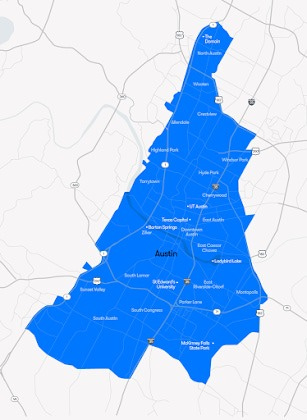
March 4, 2025: Waymo and Uber launched public robotaxi service exclusively through the Uber app, strategically timed for the South by Southwest festival running March 7-16. The initial service area covered 37 square miles including Downtown Austin, Hyde Park, Barton Hills, Riverside, East Austin, South Lamar, and Clarksville Historic District. More than 100 Jaguar I-PACE vehicles began operations.
July 17, 2025: Just over four months after launch, Waymo announced a major expansion to 90 square miles, representing a 143% increase. New neighborhoods included Crestview, Windsor Park, Sunset Valley, Franklin Park, Allendale, The Domain shopping district in north Austin, and McKinney Falls State Park to the south.
2025 ongoing: Discussions began with Austin-Bergstrom International Airport regarding future service, though commercial airport operations remained unavailable through year-end.
Source : Waymo
Atlanta
Atlanta became Waymo’s fifth operational U.S. market and first in the Southeast, following a methodical progression through 2025.
January 30, 2025: Waymo began offering driverless rides to employees for internal testing purposes.
April 15, 2025: Uber and Waymo jointly announced a summer launch and opened an interest list to the public.
May 2025: Select riders gained early access and completed tens of thousands of trips during the beta period.
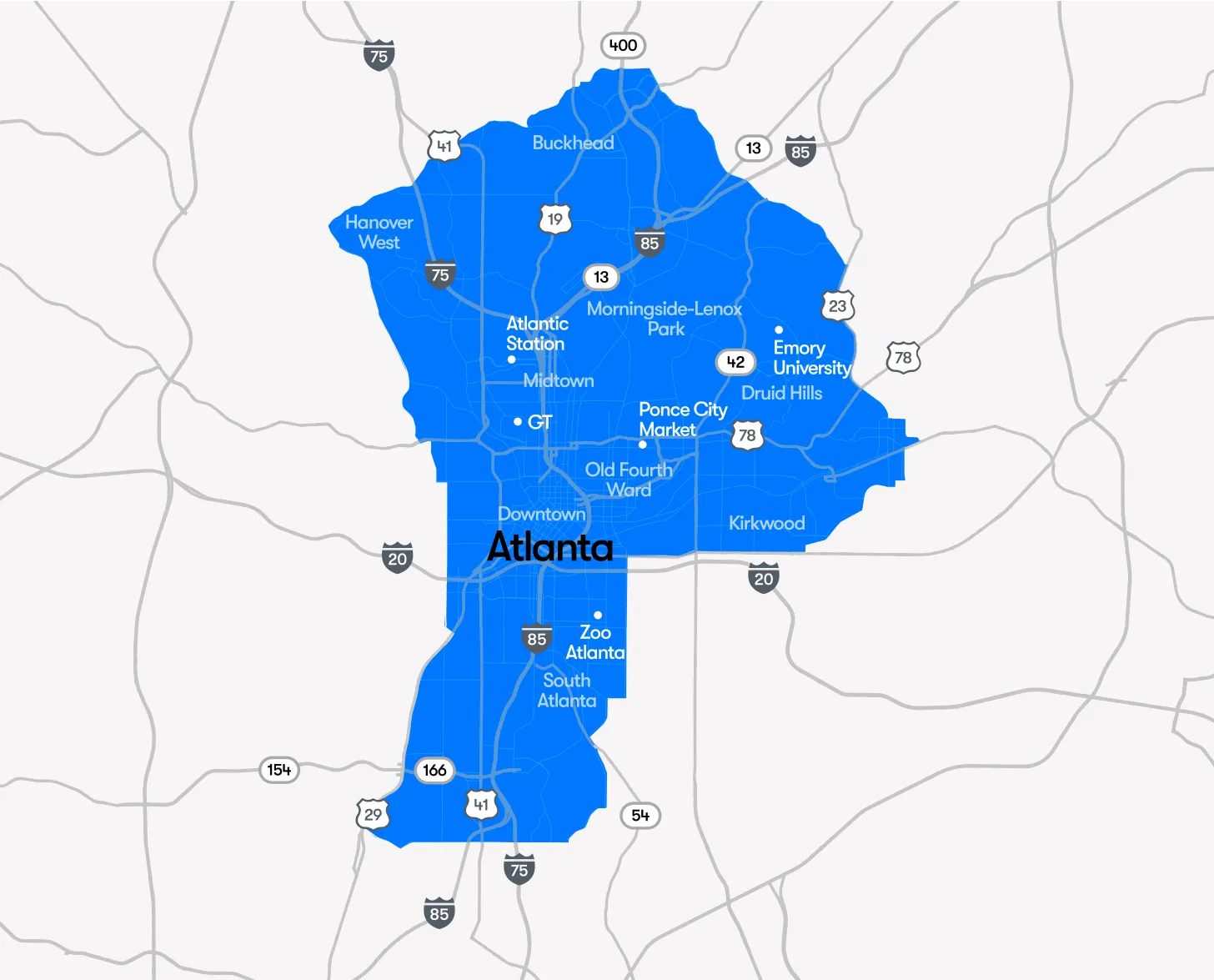
June 24, 2025: Official public launch via the Uber app. The service area spanned 65 square miles covering Downtown, Midtown, Buckhead, Capitol View, Lakewood Heights, and Old Fourth Ward. Operations are managed by Atlanta-based fleet partner Avomo, with rides available exclusively through the Uber app.
Through December 2025: No geographic expansions were announced for Atlanta’s initial 65 square-mile service area. Hartsfield-Jackson Atlanta International Airport remained outside the coverage zone with no announced timeline for service.
Source: Waymo
But Active Markets Are Just The Beginning
Waymo didn’t stop at five operational cities. Throughout 2025, the company announced an unprecedented wave of new market entries, signaling an acceleration from cautious regional expansion to national and international ambitions.
Markets Beginning Driverless Operations in 2025
Waymo announced fully autonomous operations (without safety drivers) had begun in Miami, Dallas, Houston, San Antonio, and Orlando. All five cities are targeting commercial launch to paying customers in 2026. Waymo is now operating in driverless mode in 10 cities.
This pace speaks volumes about operational maturity.
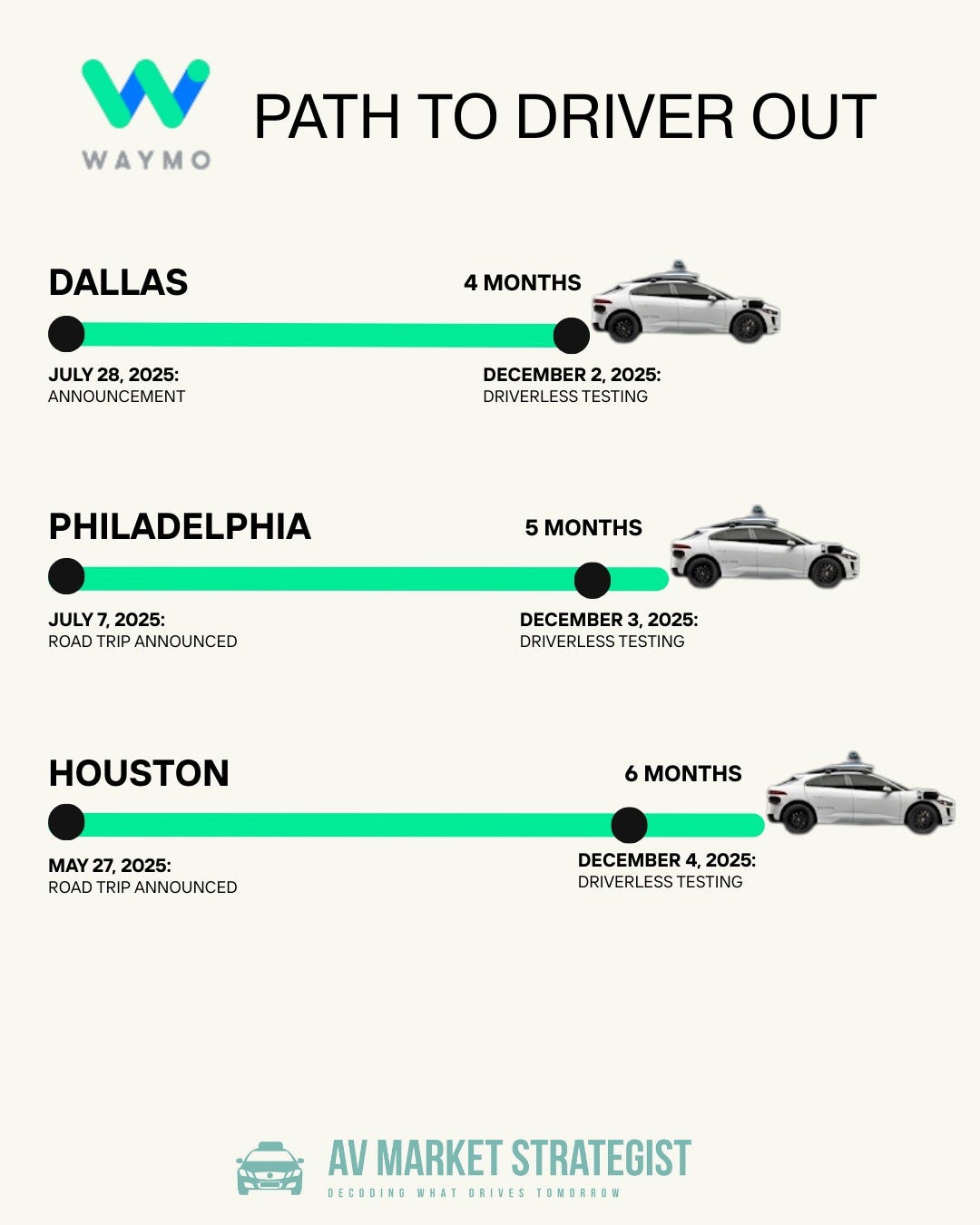
What’s even more remarkable than the quantity is the timeline. Consider the progression:
Philadelphia:
July 7, 2025: First road trip to collect data
December 3, 2025: Autonomous testing begins
Timeline: Roughly 5 months from initial announcement to driverless operations
Dallas:
July 28, 2025: Announced as next city with Avis partnership
November 18, 2025: Confirmed autonomous driving plans
December 2, 2025: Driverless testing launched
Timeline: 4 months from initial announcement to driverless operations
Houston:
May 27, 2025: Road trip announced
November 18, 2025: Autonomous driving plans confirmed
December 4, 2025: Fully autonomous testing begins
Timeline: Just over 6 months from initial announcement to driverless operations
This represents a fundamental shift in deployment velocity. Waymo spent years iterating in Chandler, Arizona before removing safety drivers. San Francisco took multiple years of cautious validation under intense regulatory scrutiny. Those timelines fueled the persistent narrative that Waymo’s approach couldn’t scale, that dependence on HD mapping and sensor-heavy hardware would make each new city a multi-year slog.
Markets With Active Testing (Safety Drivers Present)
March 25, 2025: Washington D.C. announced for commercial service via the Waymo One app in 2026, pending regulatory framework development.
July 28, 2025: Dallas announced with a notable partnership structure. Unlike Austin and Atlanta which use Uber, Dallas partnered with Avis Budget Group for fleet management, infrastructure, and depot operations. Commercial service targeted for 2026.
August 22, 2025: New York City granted Waymo the city’s first-ever autonomous vehicle testing permit, allowing up to 8 vehicles in Manhattan and Downtown Brooklyn with safety specialists. The permit was extended through December on October 1, 2025.
November 3, 2025: Detroit and Las Vegas announced for testing and future commercial operations.
November 20, 2025: Minneapolis, New Orleans, and Tampa added to the expansion pipeline with testing beginning immediately.
Markets Beginning Manual Mapping Operations
December 3, 2025: Philadelphia, Pittsburgh, Baltimore, and St. Louis announced with Waymo vehicles beginning manual driving operations (human drivers for mapping and data collection).
Additional cities announced for 2026 commercial service include San Diego, Seattle, Denver, and Nashville.
International Expansion
April 10, 2025: Tokyo, Japan unveiled at Takanawa Gateway City. Waymo began manual mapping operations in partnership with Nihon Kotsu, Tokyo’s largest taxi operator.
October 15, 2025: London, UK announced as Waymo’s first European market. Testing began in December with Moove handling fleet operations. Commercial service targeted for 2026.
California’s Massive Regulatory Approval
November 21, 2025: California’s DMV approved a massive permit expansion authorizing Waymo across nearly all of Southern California to the Mexican border, the entire Bay Area, plus Sacramento. This regulatory approval covers far more territory than Waymo currently operates, providing a foundation for rapid California expansion. However, CPUC approval remains required for each new commercial market before paid rides can begin
Fleet Growth Matched Geographic Expansion
This geographic expansion required a corresponding increase in vehicle deployment across all markets.
Overall fleet growth:
April 2025: ~1,500 vehicles
August 2025: ~2,000 vehicles
November 2025: ~2,500 vehicles
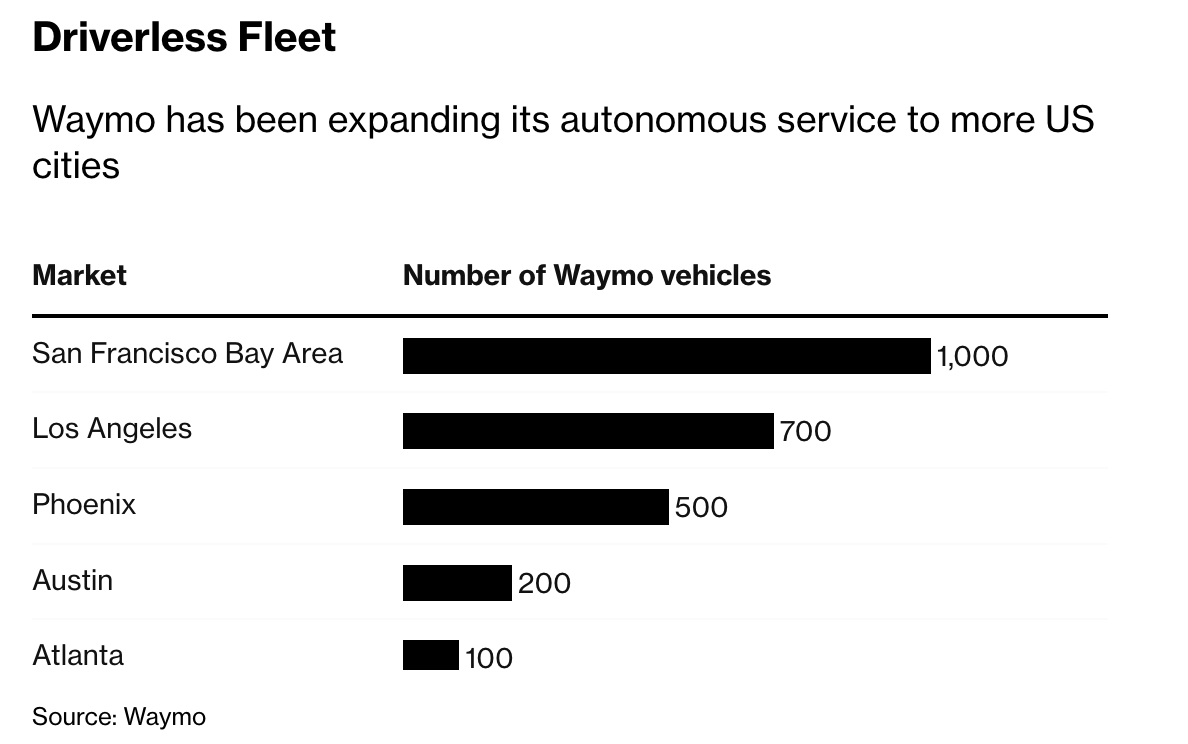
Fleet distribution as of November 2025:
Source: Bloomberg
Fleet composition underwent significant changes in 2025. The Jaguar I-PACE received its final delivery in early 2025 after Jaguar discontinued the model. However, Waymo is retrofitting more than 2,000 additional I-PACE vehicles from existing inventory through 2026 at the new Magna facility in Mesa, Arizona, bringing the total Jaguar fleet from approximately 1,500 to over 3,500 vehicles by 2026.
Two new vehicle platforms entered testing in 2025. The Zeekr RT, a purpose-built robotaxi developed with Geely, entered mass production with an announcement at CES in January 2025. Vehicles have been spotted testing in several markets. The Hyundai IONIQ 5 began on-road testing in late 2025 after the partnership was announced in October 2024. Both vehicles represent significant cost reductions compared to the Jaguar I-PACE.
The Magna partnership announced May 5, 2025 provides the manufacturing infrastructure for this expansion. The new 239,000 square-foot facility in Mesa, Arizona converts both Jaguar I-PACE and Zeekr RT vehicles into robotaxis equipped with the 6th-generation Waymo Driver. At full operation, the facility has capacity to produce tens of thousands of vehicles annually. Vehicles can enter service within 30 minutes of leaving the factory, dramatically reducing the deployment timeline.
The 6th Generation Waymo Driver, announced in August 2024 and deployed throughout 2025, enables this fleet expansion. The system uses 13 cameras (down from 29), 4 lidar sensors (down from 5), 6 radar units, and external audio receivers to provide 360-degree overlapping view up to 500 meters. Waymo states this generation has “significantly reduced cost” while maintaining safety performance and can reach driverless deployment “in about half the time” of previous generations. This cost reduction and deployment speed improvement makes the aggressive 2026 expansion economically viable.
Valuation Discussions Point Toward $100 Billion
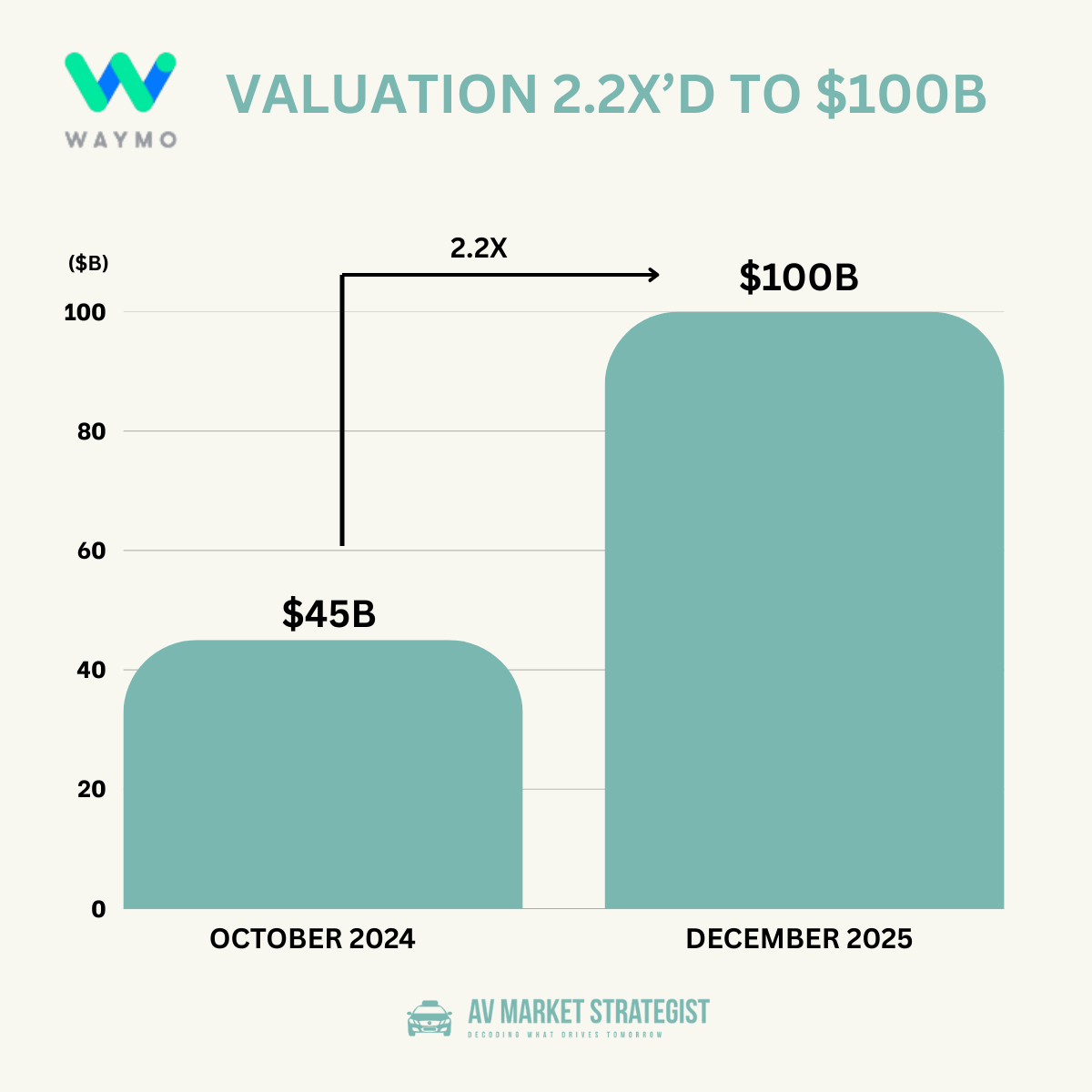
The expansion achievements of 2025 fundamentally transformed Waymo’s financial profile. In October 2024, Waymo completed a Series C funding round that established a $45 billion post-money valuation. The company raised $5.6 billion led by Alphabet, with participation from Andreessen Horowitz, Fidelity, Tiger Global, T. Rowe Price, Silver Lake, and Perry Creek Capital.
By December 2025, Bloomberg and CNBC reported that Waymo was in active negotiations to raise more than $15 billion from Alphabet with additional external investors at a reported target valuation of $100-110 billion. If completed in early 2026 as expected, this would more than double the company’s valuation in just 14 months and represent the largest autonomous vehicle funding round ever.
Revenue metrics show strong momentum supporting this valuation. Bloomberg reported an annualized revenue run rate of $350 million as of December 2025. Alphabet’s CFO has stated the company expects Waymo to “meaningfully” contribute to Alphabet’s financials by 2027.
Readers, what stood out and impressed you most about Waymo’s 2025?
-Daniel
You can learn more about Daniel and his work at The AV Market Strategist here.

Harry - awesome summary. Your blog is excellent and provides deep, quality insights into these topics. I hope you are able to rapidly grow your audience.
Absolutely wild to see the jump from 175k to 450k+ weekly rides in a single year.