

Today’s post comes from David Zipper, a co-host of Look Both Ways, a transportation podcast, and the author of over 200 stories about transportation and technology in outlets including Vox, Bloomberg, The Atlantic, and The Financial Times.
In 2023, Christopher White, the executive director of the San Francisco Bicycle Coalition (SFBike), received a phone call from a longtime donor who was threatening to yank his funding.
At the time, Waymo was seeking approval to operate its driverless taxis around the clock in San Francisco despite opposition from local officials. The donor was frustrated that the bicycle coalition had declined to endorse Waymo’s expansion. Self-driving cars, he argued, would ultimately make cycling safer because they caused fewer serious crashes than human drivers. After a heated conversation, he invited White to experience a Waymo ride firsthand.
For their joint Waymo trip, the donor selected a dropoff location on Cesar Chavez Avenue, a San Francisco arterial where a painted cycle lane is sandwiched between two lanes of car traffic and a row of on-street parking. “It’s one of our least favorite streets for biking,” White recalled recently. “He wanted to show me how well the robotaxi interacted with bike infrastructure.”
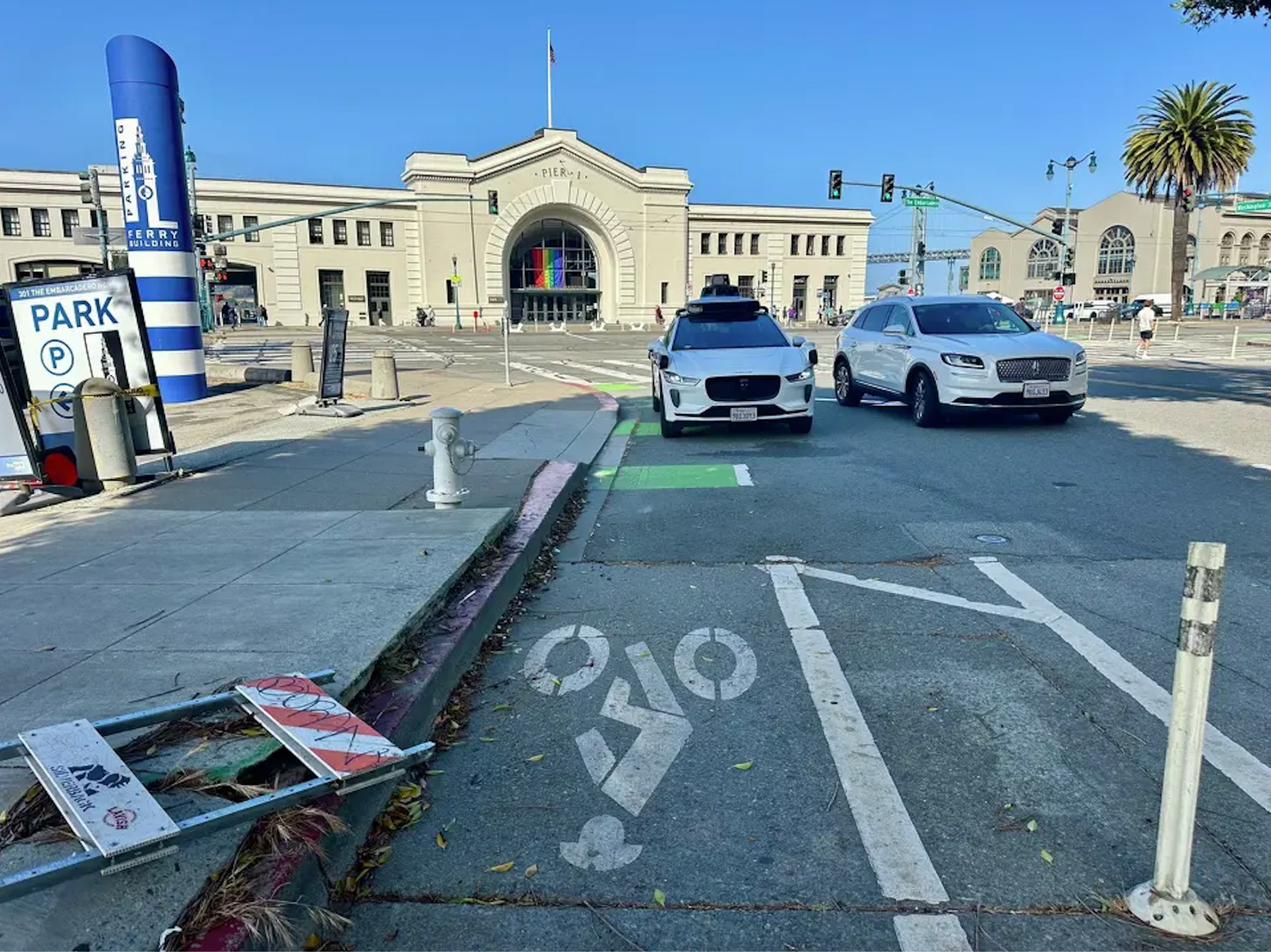
The dropoff did not go according to the donor’s plans. Upon reaching the requested destination, the Waymo “just pulled over into the bike lane,” White said. “I was mortified because somebody on a bike actually had to swerve out of our way into fast-moving traffic.”
Three years later, Waymos are still entering bike lanes when conducting pick ups and dropoffs (examples are here, here, and here). The issue became a point of contention in the District of Columbia during a recent hearing about robotaxis, after which Ethan Teicher, a Waymo spokesperson, posted on X that “riders in places like SF will tell you Waymo vehicles will frequently drive down the block or around the corner to find an appropriate spot.” White was skeptical about that assertion; he said that his members have observed Waymos entering bike lanes “frequently enough to cause concern.”
Beyond being illegal, such maneuvers endanger anyone traveling on two wheels. Last year a San Francisco cyclist filed a lawsuit claiming that she crashed into a Waymo that was blocking a bike lane – and that she then landed on a second Waymo that was also blocking that same bike lane.
This is not a good look for a company that stakes its reputation on the idea that its vehicles save lives. But it’s also true that human drivers pause in bike lanes all the time. If Waymo refused to do so when collecting or discharging a passenger, it could cede market share to competing services like Uber and Lyft that have no such restrictions.
Waymo’s ongoing bike lane controversy—which recently went viral on social media and was covered in outlets including San Francisco Chronicle and Futurism—highlights a tension in robotaxi operations: When autonomous vehicle companies face a choice between road safety and passenger convenience, what will they do?
At the risk of stating the obvious, the purpose of a bike lane is to separate people on bikes from big metal boxes that are moving much faster. A key tool in cities’ efforts to reduce bicyclist crash deaths (which hit an all-time record in 2024), bike lanes also confer a sense of security that can entice more people to start riding.
But those benefits dissipate if motor vehicles impede cyclists’ progress. Harried drivers can view bike lanes as tantalizingly open street space, particularly in places like San Francisco where parking is in short supply. Dedicated pick up/dropoff zones can help, but cities have installed relatively few of them since ridehail emerged almost two decades ago.
A driver seeing a curb full of parked cars may conclude that the bike lane is their next-best option. After all, they will only be there for a moment, and a cyclist can always go around.
Such thinking is deeply problematic. For one thing, it implies a double standard that was satirized in 2022 by a group of activists who gathered on San Francisco’s Valencia Street, a thoroughfare notorious for bike-car conflicts. When a driver halted in a bike lane, the activists dashed into the street and waved signs with apologetic messages—“Hang tight, we’ll be just a minute!”— that cyclists often hear.
The underlying issue is a serious one, said Ken McLeod, policy director at the League of American Bicyclists, a national association for people who cycle. “If a bicyclist comes upon a car in a bike lane, they may have to go into traffic that is going by at a very high rate of speed and a heavy volume.” Doing so is uncomfortable and potentially unsafe. If a passenger is inside the vehicle, there is also an added risk of them “dooring” a cyclist as they exit (which allegedly happened to the aforementioned San Francisco cyclist who is currently suing Waymo).
Because bike lane incursions are so dangerous, many (though not all) states have banned them. For instance, California Vehicle Code Section 21209 states that “no person shall drive a motor vehicle in a bicycle lane” unless they are about to turn, preparing to exit or enter a roadway, or intend “to park where parking is permitted.” Even so, ticketing is rare. Police are unlikely to witness—let alone penalize—an infraction that lasts only a minute or two. A driver may conclude that the time they save from blocking a bike lane is worth more than the risk-adjusted punishment. Such thinking may be rational, but it invites driving behavior that is hazardous and illegal.
So what does all of this mean for a robotaxi company? Waymo did not respond to a request for comment, but last December Chris Ludwick, a senior director of product management, offered insight into Waymo’s perspective when he told the Wall Street Journal that the company’s vehicles are programmed to violate the law in certain situations that require it, such as by crossing a double-yellow line to bypass a delivery van in the street. Fair enough; any reasonable driver would do the same. The only alternative is to remain stuck indefinitely.
But that’s a very different situation from a Waymo passenger requesting a pickup or drop off at a location with a bike lane out front. “Ninety-nine percent of the time there is somewhere just a little less convenient for them to pull over that would be far safer,” said White, of SFBike. Waymo doesn’t need to block bike lanes; doing so is a choice. Although Teicher, the company’s spokesperson, suggested that its vehicles avoid such conflicts whenever possible, White said that he has seen no data supporting that claim.
Of course, the company has a powerful incentive to treat bike lanes as auxiliary parking. If Waymo did not allow its riders to be picked up or deposited where they prefer, it would confer a modest but real advantage to the Uber, Lyft, and taxi services whose drivers willingly disregard the painted lanes on the street. Especially given the immense pressure Waymo faces to scale revenue, alienating customers is not an appealing prospect.
Still, based on his own observations White believes that Waymos may be a bit less likely to stop in bike lanes than Uber and Lyft drivers, who are notorious for doing so. If that is true (and anecdotal data seems to be the only kind available), Waymo defenders might reasonably argue that the company deserves credit for improving upon human driving behavior.
But a defense that “we don’t enter bike lanes as often as Uber and Lyft” seems to place the bar rather low, particularly for a company insisting that it sets a new and higher safety standard. On its website as well as network TV, Waymo claims that its vehicles reduce serious injuries by 94 percent (an assertion that some transportation and robotics experts contest).
These kinds of tradeoffs between street safety and passenger convenience are not unique to bike lanes. Waymos have also obstructed crosswalks, which is hazardous to pedestrians and a barrier to the mobility of those in wheelchairs. McLeod expressed unease about the juxtaposition of self-driving companies’ safety claims with their seemingly deliberate violations of certain rules. “We could have automated vehicle companies saying, ‘We are safer than humans, regardless of our compliance with traffic laws. Therefore, these traffic laws are unnecessary.’ I think that is a dangerously slippery slope.”
For now, Waymo is cultivating ties with street safety communities through its sponsorships of groups like the Vision Zero Network and the Governors Highway Safety Association. That outreach includes cycling organizations as well. Last year the company flew McLeod and other staff from the League of American Bicyclists to Los Angeles to participate in demos and the recording of a slick video. (White said that Waymo previously sponsored SFBike, but that the company ceased doing so in 2023 after the organization did not endorse its push for citywide robotaxi service. He added that his members are roughly evenly split on Waymo: Some think the companies’ vehicles make cycling less dangerous, while others worry they degrade all forms of mobility that do not involve a car.)
The good news is that enhancing the safety of cyclists and other vulnerable road users need not require Waymo to go against its own interests. “Hardening” bike lanes with fixed barriers can prevent cars from entering them in the first place (research suggests they also attract many more cyclists). Santa Monica recently followed the lead of cities including Pittsburgh and Chicago by deploying automatic cameras to issue citations to cars that block bike lanes, negating the need for police enforcement.
Even Waymo has voiced support for “efforts to further protect bike lanes” from incursions by motor vehicles. Rather than cajole drivers—whether human or robotic—to stay out of bike lanes, a better strategy might be forcing them to.
-David

Beyond hardening bike lanes we also need the political willpower to support the curbside management solutions that could also help with this. We should create the spaces for safe pick-up, drop-off, and loading, but that requires willingness to remove long-term parking, enforcement that actually keeps those spaces available, and ride hail users being willing to actually move the extra distance down the block to get to the safe, appropriate locations. None of those things are easy.
And I want to lean in a bit on why its not okay to assume bikes can just go around stopped cars - remember that cycling is ideally for all ages and abilities and what seems fine to you in your car looks a lot different with someone who is not a young or middle aged adult. I take my elementary-aged child riding their own bike in bike lanes and on-road when I deem it appropriate but when the bike lane is blocked (which I can’t always know a block in advance so I can move us onto the sidewalk), that can mean even more difficult maneuvers with a rider who isn’t ready to fight it out in the car lane. The same is true of my aging parents who would love to ride more but know that their peripheral vision and reaction times are slowing.
In San Francisco there is an official policy of the municipality to not enforce the stop in bike lanes for PUDO (pick up, drop off).
This was decided by the city in 2016, much before Waymo, to facilitate taxis.
The solution is to have *real* bike lanes, protected or grade separated.
The paint on the asphalt doesn't cut it.