

Today’s guest post comes from Chris Nielsen, Founder and CEO of Austin-based mobility operator eCab, who has spent nearly two decades building electric fleets inside one of America’s fastest-growing cities.
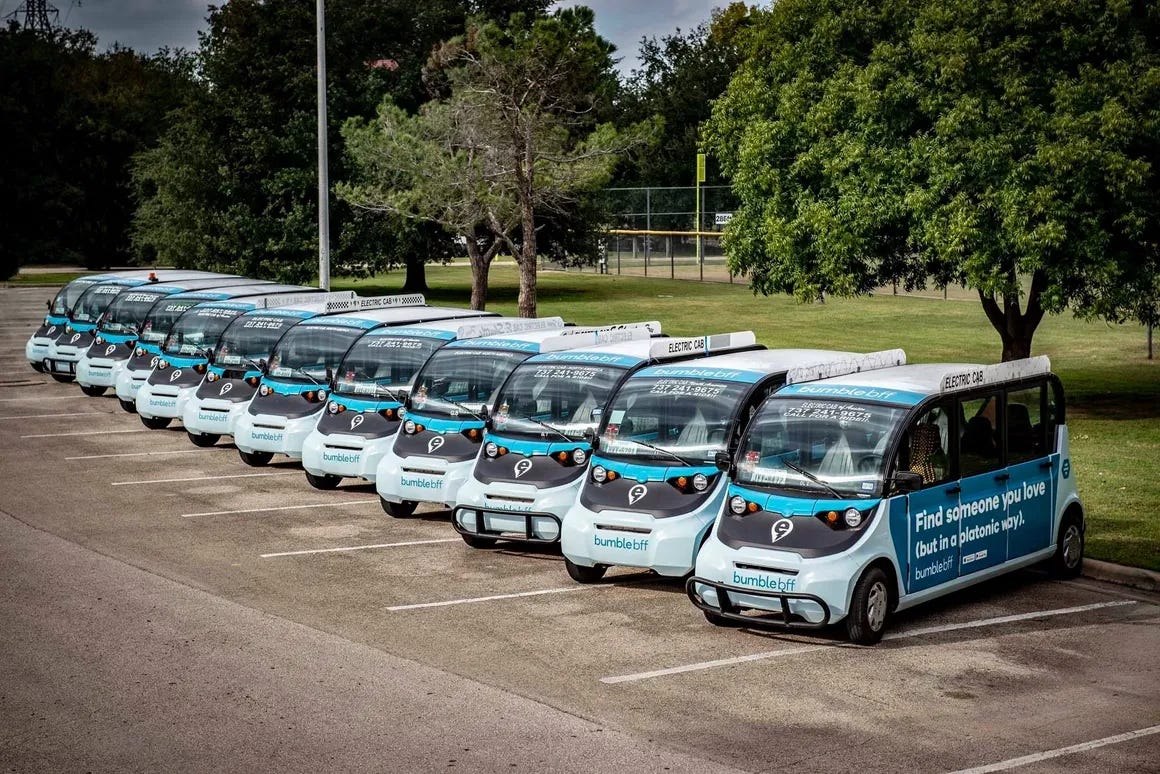
I’ve been running a real-world electric fleet in Austin for 18 years as the Founder and CEO of eCab. Not a pilot project or a carefully geofenced demo route built for investors and conference presentations. A real transportation business operating in one of the fastest-growing and most chaotic cities in America. We’ve never had institutional investment, and I’m by no means a trust-fund baby. I mention that because we’ve always had to focus on operating models that generate profit, not buzz.
Over the years, we’ve moved millions of passengers through football games, concerts, protests, SXSW crowds, flash flooding, road closures, construction zones, police reroutes, and the kind of late-night downtown unpredictability that never appears cleanly inside simulation environments. We’ve also worked directly with autonomous vehicle technology long before most people were seriously talking about robotaxis.
So when I hear people confidently predicting that fully autonomous fleets are right around the corner, I understand where the excitement comes from. The technology itself is impressive, and vehicles today can already navigate many environments better than most people imagined possible even a decade ago.
But after nearly two decades of live fleet operations, I also think the industry is underestimating what it actually means to run transportation systems inside real cities. Right now, most of the public conversation around autonomous vehicles is happening between software engineers, futurists, investors, and people who primarily experience transportation through controlled deployments. The discussion tends to focus on perception models, edge cases, compute power, mapping accuracy and safety statistics.
Those things absolutely matter, but cities don’t care about PowerPoints. The novelty of every new mobility platform eventually wears off, and the practicality of the service coupled with the overall rider experience ultimately determines who survives in the mobility ecosystem.
Cities care whether the system actually works on a Friday night when 80,000 people are trying to leave downtown at the exact same time while half the streets are under construction and someone has blocked a pickup zone with a delivery van.
That’s the part of transportation that’s difficult to explain unless you’ve spent years inside operations. The challenge is rarely just the vehicle itself. The challenge is everything surrounding the vehicle.
Autonomy removes the driver, not the chaos
One of the biggest misconceptions in the AV world is the belief that removing the driver removes the complexity. In reality, cities are unpredictable because people are unpredictable. A police officer manually overrides traffic flow. A concert lets out early. A water main breaks. A rideshare pickup zone suddenly becomes unusable because pedestrians spill into the street. Construction crews reroute traffic using temporary signage that didn’t exist six hours earlier.
Human drivers improvise around these problems constantly, and a surprising amount of urban transportation depends on that improvisation layer functioning properly. That reality is still massively underestimated by people who primarily understand cities through maps and simulations.
The challenge isn’t simply making a vehicle drive itself. It is building an entire transportation system that can continuously adapt to environments that break their own rules every day.
That’s one reason I’ve become increasingly skeptical of the way autonomy is marketed to the public. The vision being sold is one where transportation operates almost magically without people, but once you spend time around real autonomous deployments, you realize the labor never actually disappears. It simply moves behind the curtain.
Behind every “driverless” fleet is a surprisingly large operational support structure made up of remote operators, maintenance technicians, charging crews, dispatchers, recovery personnel, safety supervisors, infrastructure specialists, and field response teams constantly solving problems the public never sees. When an autonomous vehicle gets stranded, blocked, vandalized, confused, or trapped in some strange edge-case scenario, humans still step in to resolve the situation.
In many ways, the complexity hasn’t been eliminated at all. In some cases, it has actually increased because operators are now managing both robotic systems and the human systems supporting them simultaneously. I’m sure the cost of these operations will amortize over time as the technology scales, but I remain skeptical of the fully driverless utopia currently being marketed to the public.
That doesn’t mean I believe autonomy is doomed. Far from it. But I do think the industry needs to be more honest about what deployment actually looks like. Far too much emphasis is being placed on the technology itself and not enough on the actual public benefit.
What passengers really want
Underneath all of this is a bigger question that almost nobody seems willing to ask openly: Did the public actually ask for fully autonomous transportation in the first place?
I don’t believe people are lying awake at night wishing their Uber driver would disappear. What they actually want is transportation that’s affordable, reliable, safe, clean, and available when they need it. Somewhere along the way, the transportation industry quietly substituted those goals with a completely different mission: removing human operators. Those are not automatically the same thing.
This is where whiteboards and spreadsheets collide with reality. Humans are not just a cost center inside transportation systems. They’re also the improvisation layer, the judgment layer, and sometimes the accountability layer. Quite often, they’re the only thing keeping systems functional when reality stops behaving predictably.
The AV industry became so focused on asking whether vehicles could drive themselves that it forgot to ask whether society was actually demanding fully driverless transportation to begin with. Outside of investor circles and tech conferences, most passengers care about three things: Does the ride show up? Can they afford it? Will it get them there safely? Everything else is secondary.
Smart cars still need smart cities
From my perspective, the real bottleneck for autonomy isn’t software alone. It’s infrastructure. Most people see the LiDAR stacks mounted on vehicles like Waymo and Zoox and assume the systems are fully self-contained. They’re not. Autonomous fleets are deeply dependent on communications infrastructure, mapping fidelity, and real-time environmental awareness that most American cities simply were not designed to support.
GPS itself becomes unreliable in dense urban corridors surrounded by concrete and glass. Anyone can test this by walking through downtown Austin while using navigation on their phone and watching the location drift block by block. That level of ambiguity becomes a serious problem when autonomous systems are expected to operate safely at scale.
Without substantial investment into intelligent infrastructure and Public Infrastructure Network Nodes (PINNs), fully autonomous urban transportation becomes far more difficult than most people realize.
Then there’s the fact that American cities themselves were never designed for autonomous transportation systems. Our curb management, pickup zones, roadway layouts, communications systems, traffic coordination, and signage are fragmented and inconsistent almost everywhere you go. Autonomous fleets perform best in highly controlled environments, while cities are the exact opposite of controlled environments.
The real winners
That’s why I believe the companies that ultimately win this space won’t necessarily be the ones with the flashiest demos or the loudest marketing. Flashy gets the initial attention, but operating a reliable service that actually works and turns a profit is what ultimately determines who survives.
The winners will be the companies that understand operations. They’ll understand fleet logistics, charging coordination, maintenance cycles, municipal politics, teleoperations, infrastructure integration, and real-world deployment reliability. More importantly, they’ll understand that transportation is not simply a software business; it’s a systems-management business operating inside messy human environments.
That distinction matters because, right now, a lot of current AV business models are surviving on investor patience more than proven operational sustainability. Again, that doesn’t mean autonomy fails. I still believe autonomous systems are coming, and I think they’ll eventually become a meaningful part of urban transportation. I just don’t believe the end state looks like the science fiction version we’ve been sold.
The future is probably hybrid. Smaller human teams supervising increasingly intelligent fleets through remote intervention systems, intelligent infrastructure, and layered operational oversight feels far more realistic to me than fully removing humans from the equation entirely.
That future also feels more honest because it acknowledges something the transportation industry eventually learns the hard way: technology matters, but operations will decide who survives.
- Chris
Beautifully and thoughtfully written! Thank you Harry for inviting Chris to speak! I'm an Uber driver in Austin and just two days ago - Memorial Day - I had to navigate the whole downtown being blocked off to get to the other side to pick up a passenger who was late for his flight. Every road was blocked and the navigation was useless, so I decided how to get him there, and he arrived in time to get through security and buy some coffee. Probably 90% of my passengers say they will not take a driverless ride unless no rides with human drivers exist. I believe my job is safe for a little while! But there could come a day when 90% of the riders say the opposite - that they will not take a ride with a human driver unless the infrastructure breaks. I think that day is a ways away! For now, human drivers have skin in the game and survival instincts as their guarantee for safety. In my view that is the most important factor in trying to predict what will come, and I agree that it will probably be a hybrid environment for a while.
I would love to talk more about what autonomy-friendly infrastructure looks like.