

This week’s edition is brought to you by TaskUs — powering safe, scalable autonomous vehicle and AI operations through human-in-the-loop expertise.
Top Stories of the Week
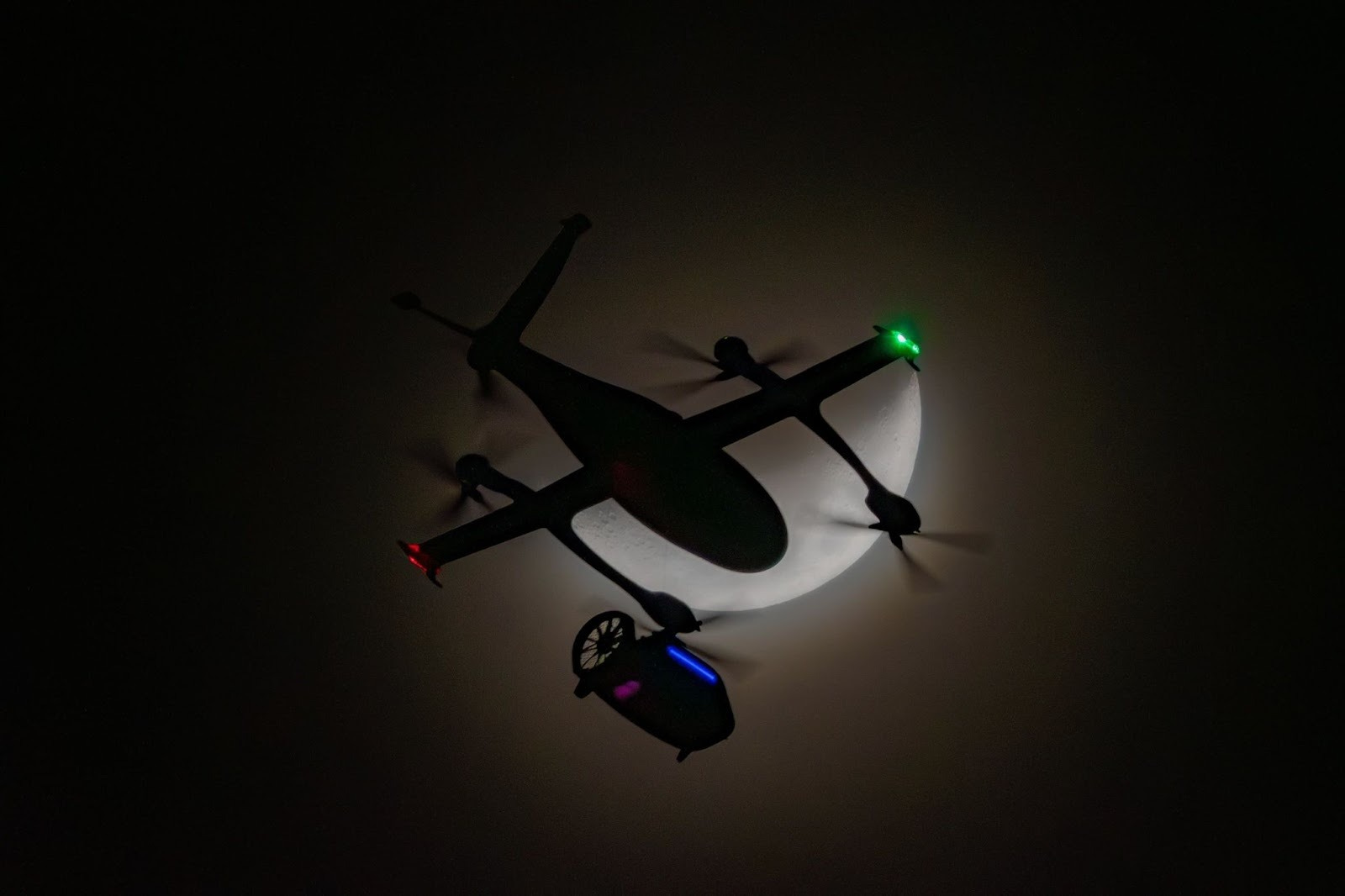
Zipline snaps up another $200M to fuel its drone delivery expansion (link). The autonomous drone delivery and logistics startup said the new funding adds to the round originally announced in January, bringing its Series H total to $800 million. The company plans to use the capital to accelerate expansion into at least four U.S. states this year, with Houston, Phoenix, and Seattle already announced as new markets.
Robotaxi Outage in China Leaves Passengers Stranded on Highways (link, no paywall). Pretty wild. A system malfunction reportedly caused a number of Baidu Apollo Go robotaxis to stop in the middle of traffic, including on highways, leaving some passengers stuck for extended periods and others exiting into live lanes. There were also a few reported collisions. Makes Waymo’s SF outage look relatively tame by comparison.
Related: Here’s a video of one of the crashes (link).
Other Stuff
Tesla Admits Its Robotaxis Are Sometimes Driven by Remote Humans (link, no paywall). Not sure this is that big of a deal. Remote assistance is already a core part of how most autonomous systems operate today, and even limited teleoperations at low speeds can be a practical fallback. The real question is how often it’s used and in what scenarios, not whether it exists at all.
Six of the firms insisted that their remote assistance workers, who work across the US and even, in the case of Waymo, in the Philippines, never actually drive the vehicles directly. Instead, the humans provide input that the autonomous vehicle software then decides to use or ignore. Not so for Tesla. “As a redundancy measure in rare cases … [remote assistance operators] are authorized to temporarily assume direct vehicle control as the final escalation maneuver after all other available intervention actions have been exhausted,” Karen Steakley, Tesla’s director of public policy and business development, wrote
Waymo starts robotaxi services at San Antonio International Airport (link). Waymo launched its San Antonio robotaxi service in February, though it’s still not fully available to the public yet. The company has been operating an invitation-based system that it is scaling on a rolling basis, an approach it used in Dallas, Houston, and Orlando too. Waymo said on Tuesday that it has brought “tens of thousands of people” into the San Antonio service and that it plans to make the service available to all public riders soon in the city.
GM-Backed Driverless Tech Firm Momenta Said to Confidentially File for IPO in Hong Kong (link, no paywall). Momenta builds AI-powered software for both driver-assistance features and fully driverless vehicles. The company raised $300 million from General Motors in 2021 and partnered with Uber in 2025 to deploy autonomous vehicles on its platform in international markets outside the U.S. and China.
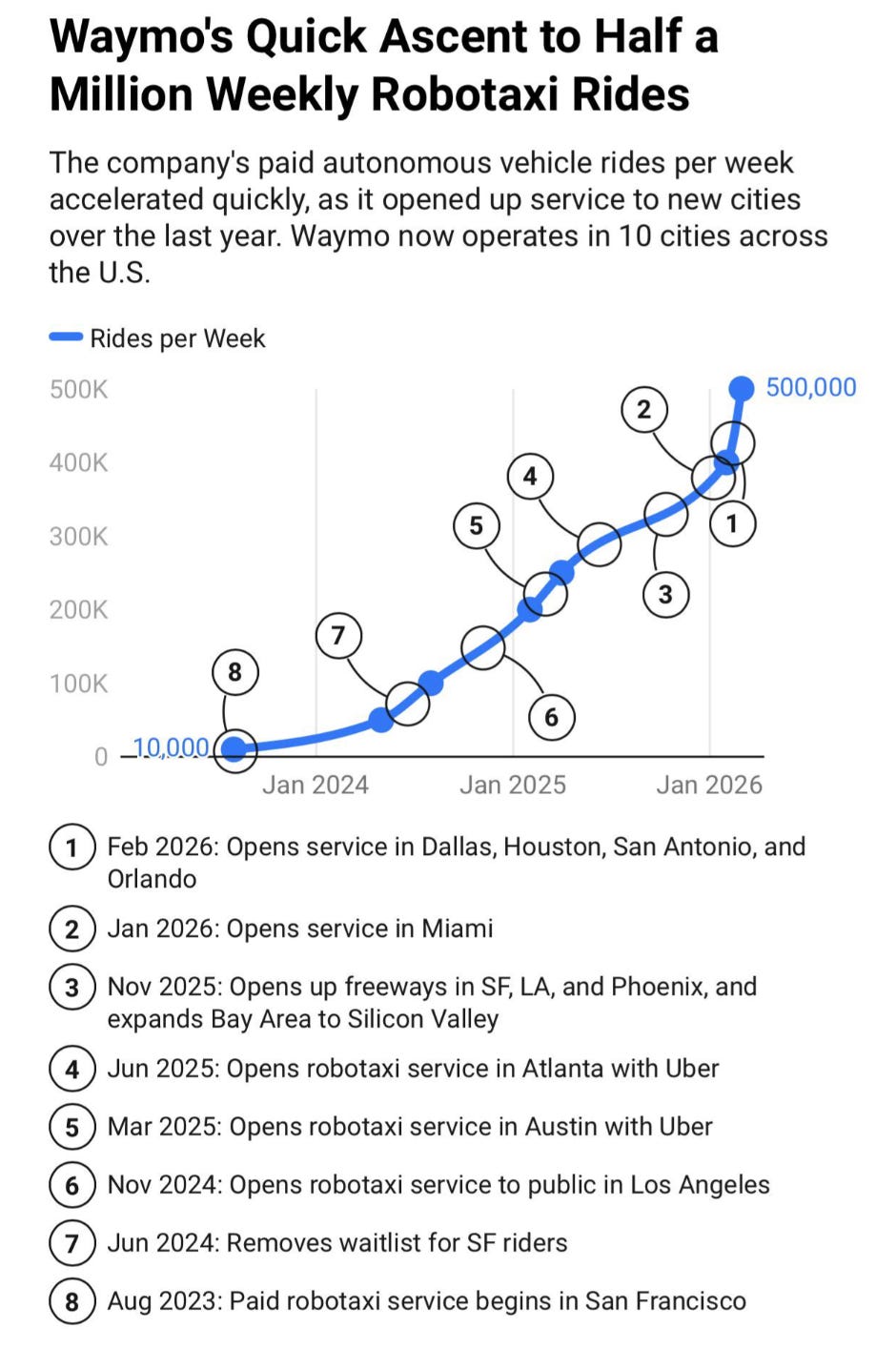
Waymo’s skyrocketing ridership in one chart (link).
Drivers in Dire Crashes Relied Too Much on Ford’s Hands-Free Technology, NTSB Says (link, no paywall).
The Human Edge in AV: Scaling Swift Emergency Response
TaskUs partners with the top autonomous vehicle (AV) and AI organizations to manage the human-critical workflows that make advanced systems safer and more reliable. When one of the leading companies deployed its fleets in new cities, they also needed to scale emergency response teams. TaskUs helped by deploying expert operators, creating 24/7 incident frameworks and implementing a unique fatigue management program. Get all the details and results in this case study.
Robotaxies & Flying Cars Will Reinvent Real Estate (link). This is definitely an optimistic view of the future, though I’m much more bullish on autonomous vehicles reshaping suburban real estate than eVTOLs. The big piece missing from this analysis is utilization. Whether by land, air, or sea, autonomous vehicles will need high utilization, especially in the early years, to generate attractive margins, or at least not lose too much money.
Related: The Impact of Autonomous Vehicles on Real Estate with Brad Hargreaves (link).
WeRide and Uber launch driverless robotaxi service in Dubai (link). Interesting timing for a launch in Dubai, but the Middle East is increasingly looking like the second biggest autonomous vehicle hotbed after the U.S.
WeRide currently operates more than 200 robotaxis in the Middle East and has reported operational profitability in the region since 2025. The company and Uber committed in February 2026 to deploy at least 1,200 robotaxis across Dubai, Abu Dhabi and Riyadh.
Humans vs Robots: Who’s Really Replacing You? (link). There will definitely be certain trips where humans outperform robots. Airports come to mind, where some passengers want help with bags and a faster, more flexible ride. AVs tend to be slower since they follow the rules, and I’m not sure that’s what you want on an airport run, especially once you hit the infamous LAX horseshoe gridlock. The real question is whether those edge cases will make up a meaningful share of trips.

The branding risk facing new robotaxi makers (link).
“Almost everybody’s first ride in an autonomous vehicle was in a Jaguar i-Pace,” says Reilly Brennan, co-founder and partner at Trucks Venture Capital, an investor in mobility startups. “Nobody got out of a Waymo ride and said, ‘I’m going to buy a Jaguar today.’”
Production of the Jaguar I-Pace came to an end in December 2024, and at the time, Waymo was only doing around 175,000 rides per week across Phoenix and San Francisco, and just starting in Los Angeles. So you couldn’t even buy one over the past year as Waymo really began to scale.
But I think the key point here is that OEMs still need to stand out. The Toyota Prius is the most common rideshare car, but it’s not exactly aspirational. If anything, “Uber Prius” has become synonymous with a pretty mediocre experience.
That’s where I actually think companies like Rivian and Lucid have an advantage. If you get into a nice Uber Rivian or Lucid robotaxi and it feels premium, quiet, and differentiated, that can absolutely translate into consumer demand. You could see a world where the robotaxi becomes the test drive. Someone takes a few great rides and thinks, I should just buy one of these.
So instead of worrying about being “white-labeled,” OEMs might want to lean into that exposure. The real opportunity isn’t just selling fleets, it’s turning high-frequency robotaxi rides into a funnel for personal vehicle ownership, or even eventually selling personal robotaxis directly to consumers.
Elmo and Upshift partner to launch remote control car subscription service in California (link).
Upshift is reinventing car ownership for the autonomous era. Members subscribe to a car that’s there when you need it, and gone when you don’t. Our partnership with Elmo allows us to build this future today, before personal autonomous vehicles are available” said Ezra Goldman, CEO and co-founder of Upshift.
Waymo Says Robotaxi Launch in Tokyo ‘Could Be Ready in a Few Months’ (link).
California lawmaker proposes that all remote operators for autonomous vehicles in the state must be based in the U.S., possess a California driver’s license, and be limited to supervising no more than three vehicles at a time (link, see bill). This would limit Waymo’s current use of remote operators based in the Philippines for deployments in California.

We’re less than two weeks away from our flagship Curbivore conference on April 17 in Downtown Los Angeles and the agenda just went live!
We’ve got a strong AV speaker lineup including Harrison Shih (DoorDash Labs), Alan Ohnsman (Forbes), Pat Tsen (CPUC), Phillip Pierce (Zoox), Lloyd Lee (Business Insider), Jon Miller (Nexar), and Ava Yazdani (Serve Robotics), along with many more leaders across the space.
Join industry experts across autonomy, mobility, and delivery for a can’t-miss gathering shaping the future of curbside commerce. Register now and use the code Autonomy25 to save an extra 25%.
What else we're reading/listening to
Zag Talk S2E5 with AV expert Missy Cummings (link).
Freakonomics Radio: In a Driverless World, Who Loses and Who Wins? (link). Check out part one of the two part series here: Are Human Drivers Finally Obsolete? (link).
Autonomous System Safety by Phil Koopman: A Simple Rule for Level 2++ Safety Accountability (link).
How Will London’s Driver Market Respond to Autonomous Vehicles? (link).
The Humans Powering Autonomous Vehicle Operations - Omar Zoubi, TaskUs (link). Our latest podcast episode features Omar Zoubi, VP of Autonomous Mobility & Rideshare Network Strategy at TaskUs, where he breaks down how human operators support AV fleets behind the scenes, from remote assistance and edge case handling to training and improving AI systems. He discusses how TaskUs partners across the AV ecosystem, the real-world scenarios where human intervention is still required, and how these operations scale as fleets grow. We also get into cost structures, operational complexity, and how companies think about efficiency and safety as they move toward commercialization, among other topics.
AVs behaving badly
Waymo car goes wrong way in Alamo Heights school zone, concerns parents (link). Maybe Waymo just doesn’t like kids.
A School District Tried to Help Train Waymos to Stop for School Buses. It Didn’t Work (link, no paywall).
AVs behaving “goodly” :)
FSD stops and waits for a little delivery robot to cross the street lol (link).
Neat Jobs
Autonomous Vehicle Lead, Firmware Engineering at Also. (link) via Ryan Cooling.
Senior Software Engineer, Behavior Test Engineering at Waymo (link) via Natania Antler.
Communications Intern at Zoox (link) via Marisa Wiggam.
Senior Product Designer, Driverless Operations at Waabi (link) via Ross Popoff-Walker.
Job Moves
Ankit Baid: McKinsey & Company -> Waymo (link).
Johannah Albert: Carvana -> Waymo (link).
Florian Müller: Luxoft -> Momenta (link).
Clément Chidiac: Mercari -> Wayve (link).
Shout-outs
Big thanks to TDD readers at Acute Strategy, and to Chris S. for referring new subscribers. If there’s someone you think would enjoy TDD, feel free to forward this email or use the referral button below, and we’ll make sure to shout out your company.
We’re now over 8,000+ subscribers! Interested in advertising with TDD? Check out our media kit here and reach out to us.
Until next week :)
-Harry