

Join us Wednesday, October 14, for the Austin edition of our Urban Autonomy Summit, presented by Nexar. Space is limited, so apply to attend here.
Today’s guest post comes from Eduardo Rojas, a startup advisor and former founding member of Uber’s Autonomous Mobility & Delivery team.
2026 is shaping up to be drone delivery’s inflection point.
Amazon Prime Air said it is now completing thousands of drone deliveries per day. Walmart, meanwhile, has crossed one million cumulative drone deliveries through partners including Wing and Zipline, with 40% of that volume completed in the last quarter alone.
And the rollout is accelerating. Walmart and Wing plan to expand drone delivery to more than 270 locations by 2027.
The delivery platforms are moving too. DoorDash brought its in-house drone program out of stealth this summer with DoorDash Air and its own FAA Part 135 certification. Uber has invested in Zipline, and the two companies are targeting one million drone deliveries per day by the end of 2029.
For the first time, drone delivery is starting to look like a real market rather than a collection of pilots.
But replacing today’s delivery trips is only part of the opportunity.
The bigger opportunity Is Latent Demand
The easiest way to think about drone delivery is that it replaces an existing delivery trip: a DoorDash order, or a delivery from Amazon or Walmart.
But I think the more interesting opportunity comes from orders that aren’t being placed today because delivery takes too long.
You wake up and realize there are no eggs. You are halfway through cooking and are missing an ingredient. You need medicine, a charger or one thing from the store. At 45 minutes, you may work around it. At ten, you order… assuming it doesn’t cost much more.
I saw this firsthand with Rappi Turbo in Colombia. Once I could get groceries in under ten minutes at little to no incremental delivery cost, my behavior changed. I started ordering multiple times per week and sometimes more than once per day. That level of speed and low cost was partly enabled by the era’s aggressive growth-over-economics mindset, but it still gives us a useful window into what can happen when delivery is both fast and cheap.
And the behavior does not appear to be unique to me. Amazon says Prime members using Amazon Now in India, a ground-delivery service offering deliveries within 20 minutes, tripled their shopping frequency after adopting it. It is not drone delivery, but it is a useful proxy for what can happen when delivery times compress.
If that behavior translates to the U.S., faster and cheaper delivery could become another growth engine for delivery marketplaces. Ashu Rege from DoorDash Labs made an interesting point on The Driverless Digest: people only need to travel to so many places, but the number of things they can have delivered is much larger.
Drones could be one of the catalysts that pushes delivery closer to that ceiling.
So, who is best positioned today?
I try to answer that question from a business and deployability perspective. In other words: who has the clearest path to scale, not who has the most impressive aircraft or autonomy stack.
For simplicity, I focus on the U.S. market. Global operating history still matters, but I put more weight on what each company is actually proving in the U.S. and how quickly that position is developing.
I also care less about the technology in isolation. Good technology should ultimately show up in deployment speed, service quality and commercial traction.
Where the demand comes from is another useful signal of near-term scalability. I see two broad models.
The first is large, concentrated nodes: Walmart stores, Amazon facilities, healthcare networks and other major retail or logistics locations. The second is micro nodes: restaurants and smaller merchants reached through marketplaces like Uber Eats and DoorDash.
Today, I give more weight to the large-node model because it is already showing a clearer path to scale. Micro nodes may ultimately represent the larger opportunity, but the economics and operating model are still much less proven.
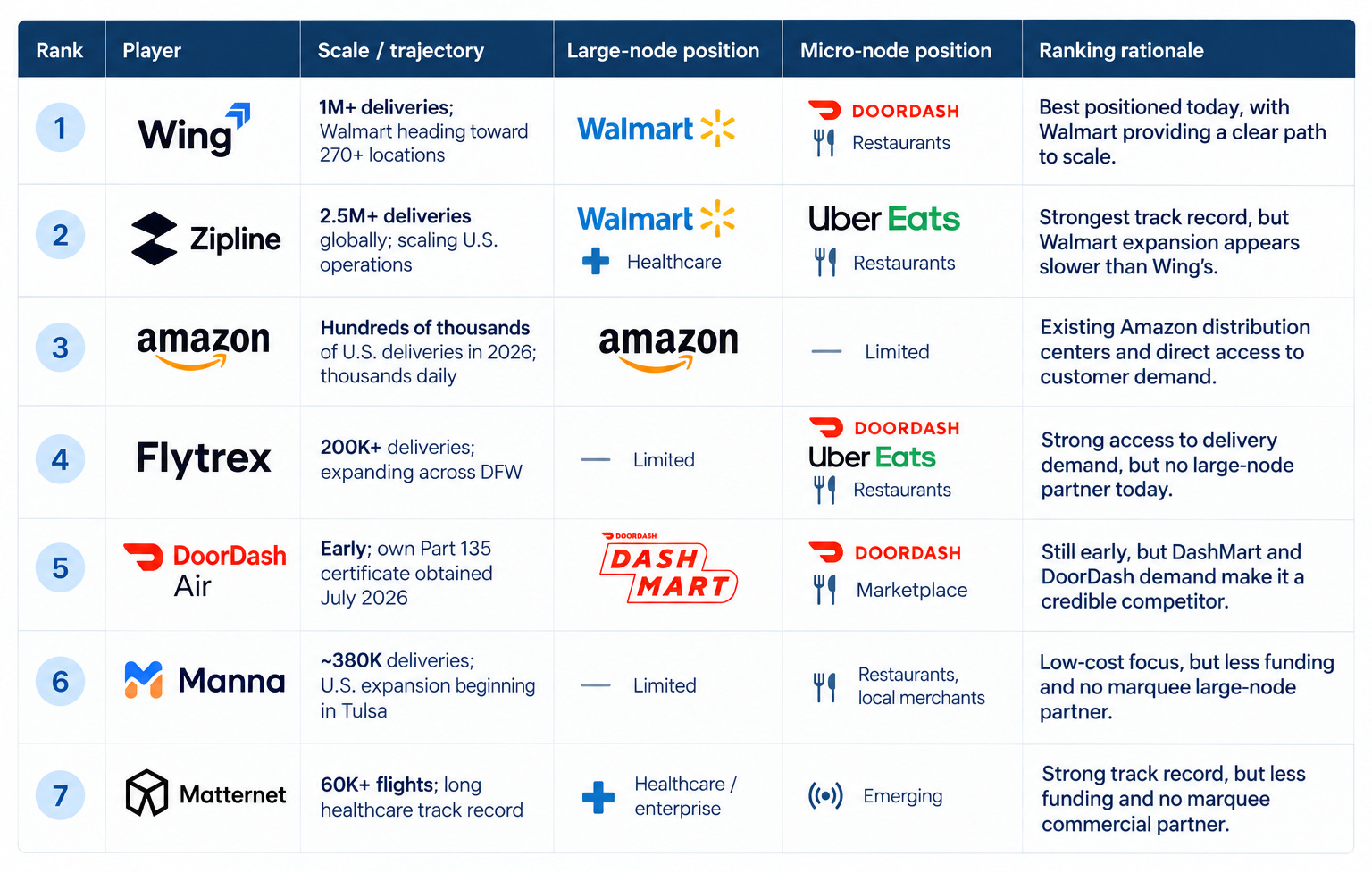
Today, Wing sits at the top of my ranking largely because of Walmart. That relationship gives them access to a large, concentrated source of demand, and the footprint is expanding quickly.
Zipline is a close second. They have the stronger historical operating record, but much of it was built outside the U.S. and under a different operating model. They also work with Walmart, although so far their U.S. retail footprint appears to be expanding more slowly than Wing’s.
Where Zipline gets particularly interesting is Uber. The two companies have said they are targeting one million drone deliveries per day by the end of 2029. It is a big ambition, and the demand potential is clearly there, but I want to see more traction before giving that model more weight. A lot depends on whether Zipline can make micro-node economics and operations work at scale.
Amazon ranks third because its current footprint is narrower. Structurally, though, they may have the cleanest model of all. They control the customer, inventory, fulfillment and delivery infrastructure, which gives them more control over the entire experience.
That is the ranking today, but it is still a snapshot. The bigger question is what determines who can actually scale from here. To me, it comes down to two things: speed and cost.
The Hurdle: $4 And 20 Minutes from order to door
For this analysis, I use two simple reference points: delivery should cost roughly $4 or less and take 20 minutes or less from order to door.
These are not industry standards, but they are useful reference points.
On cost, drone delivery should not be more expensive than delivery today. Gridwise’s 2025 data shows median Uber Eats courier compensation of $8.16 per delivery, including a $3.73 median tip. That leaves roughly $4.43 of driver compensation before tips.
Tips complicate the comparison because consumers do not necessarily view “no tip required” as the same thing as a cheaper delivery. So for drone delivery to create a clear cost advantage, I think the underlying delivery cost needs to get to roughly $4 or below.
It also needs to feel fast. If drones cost about the same as human delivery but take 40 minutes, there is little differentiation. If they arrive in ten minutes but cost $10, they remain a premium niche.
For drones to reach the mass market, they need to do both: feel materially faster and cost no more than delivery today.
Autonomy Meets Austin

We’re just two weeks away from the Austin edition of our Urban Autonomy Summit on Wednesday, October 14. This time, the conversation moves to Texas, where robotaxis, autonomous trucks, drones and more, are already on the road. Expect an afternoon of great discussions from all of the top executives building the technology, the fleet and infrastructure teams behind the scenes making it work, and the policymakers shaping what comes next. We’ll also be hosting a reception afterwards with drinks, bites, and plenty of time to connect. Space is limited, so apply to attend.
Speed Is Not About How Fast The Drone Flies
For the customer, there are only two timestamps that matter: when the order is placed and when it arrives. Everything in between is invisible. That is part of the magic of delivery: you place an order, and some time later a package appears at your door.
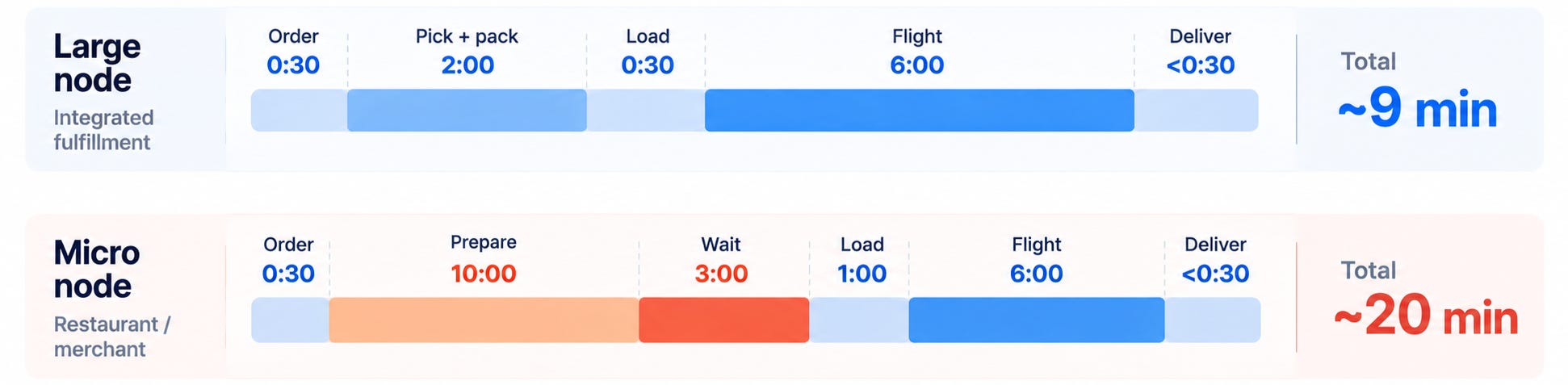
A six-minute flight does not necessarily mean a fast delivery. The order still has to be prepared, packed and loaded, which means the whole system has to be optimized:
Order → preparation or picking → packaging → loading → flight → delivery
This is where large and micro nodes start to diverge. Amazon and Walmart have enough volume at each node to dedicate labor, build SOPs and continuously improve the process. Restaurants on Uber Eats or DoorDash are much harder to standardize across thousands of locations. And for instant delivery, being fast only some of the time is not enough.
Cost Is A System Problem
The aircraft itself is only one part of the cost. A drone network at scale also needs infrastructure, real estate, loading labor, remote operations, maintenance, batteries, charging and customer support. Every one of those layers has to get cheaper as volume grows.
Loading shows how demanding the $4 hurdle is. Assume a fully loaded employee costs $20 per hour. At two loads per hour, labor alone adds $10 per delivery. At ten, it adds $2. To get that down to $1, the employee needs to handle 20 loads per hour, or 160 over an eight-hour shift. And that is before paying for the drone, batteries, infrastructure and everything else around the operation.
The same logic applies to physical infrastructure. The parking spaces used for launch pads have value, rooftops need permission, and equipment has to be installed and maintained. Then there is charging: today, each flight requires recharging before the next one.
Getting to $4/trip will require optimizing the entire system.
Large Demand Nodes Should Scale First
This is why Walmart and Amazon have a structural advantage.
Take a Walmart Supercenter. It already has significant order volume, enough demand to justify dedicated drone loading, and plenty of space for launch infrastructure. Most are also located in suburban areas, where drones can deliver to front or back yards without having to navigate dense urban building environments.
Amazon’s position is even cleaner. They have many of the same advantages as Walmart, but also control the technology, customer relationship and operations. More importantly, they have already shown they can optimize logistics at scale, so Prime Air is essentially another delivery mode they can plug into an existing system.
Large nodes make almost everything around flying easier and more predictable. That is why I expect them to scale first.
Micro Nodes Are The Harder Problem
Uber and DoorDash solve one side of the equation extremely well: demand. The challenge is that this demand is fragmented across thousands of locations, many with relatively low order volumes and little spare real estate.
Operators are trying to reduce that friction. Zipline’s Dropbox and Wing’s AutoLoader let employees load orders asynchronously, while Flytrex is using rooftop docks to position aircraft closer to restaurants. These systems help, but they still cost money, need to be installed somewhere and may require approval from both the restaurant and the property owner.
That likely means the first viable micro nodes will be the highest-volume locations: large QSRs, cloud kitchens, DashMarts, regional chains and high-volume local restaurants. They have enough order density to justify the infrastructure, but they also bring longer sales cycles, corporate negotiations and, in many cases, franchisee coordination.
There is also a consistency problem. Ultra-fast delivery only works if it is reliably fast. A service that takes 15 minutes one time and 25 the next starts to lose some of the magic, especially when much of that variability comes from a restaurant workflow the drone operator does not control.
This is where DoorDash has an interesting advantage with DashMart. They control the operation, which means they can design the workflow around the drone and manage speed much more tightly. DashMart could be a useful proving ground for the model before DoorDash tries to push it further into the long tail.
The near-term test is whether micro nodes work across hundreds or thousands of high-volume locations. The longer-term prize is restaurant number 8,742, where the Saturday-night employee has never thought about drone logistics.
How I Think The Market Converges By 2030
My view is that large nodes will remain the main driver of scale over the next four years, while the micro-node model continues to mature.
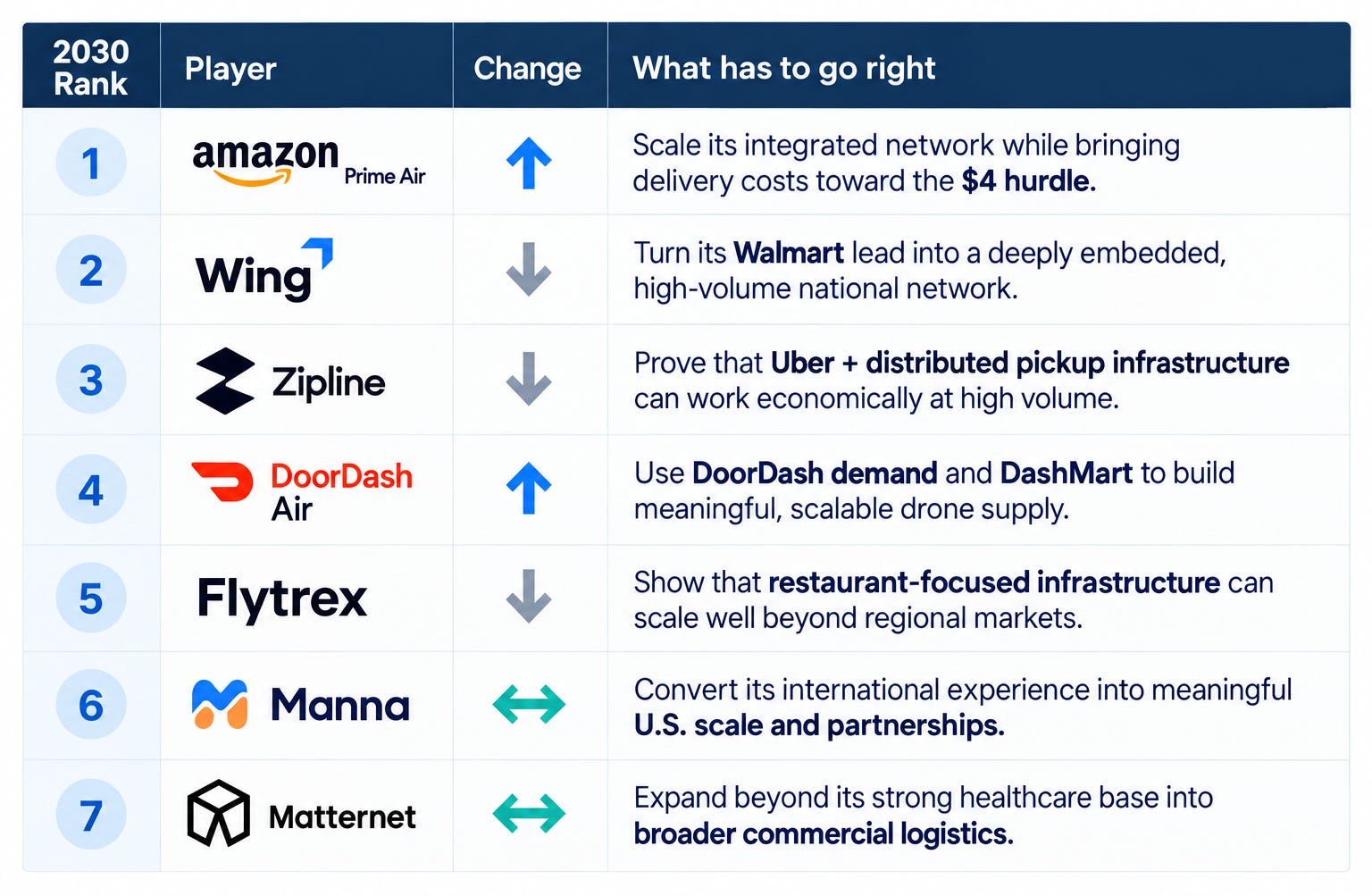
Amazon moves to the top of my list because they already have the demand and control the entire system. In the more bullish scenario, ultra-fast delivery becomes another reason for customers to use Amazon more often, which gives them even more incentive to keep investing in the platform.
Wing is well positioned for a similar reason. If they remain Walmart’s main drone partner, they have access to one of the best networks of concentrated retail demand in the U.S. The question is how deeply Wing can embed itself across that network, especially as Walmart works with multiple drone providers.
Zipline may have the most upside. They also work with Walmart, while Uber gives them access to a second, much broader demand pool. But that upside depends on solving the micro-node problem. Their target of one million deliveries per day by the end of 2029 is ambitious, but getting there will require a lot to go right commercially and operationally.
DoorDash has a different advantage. DashMart gives them a controlled environment where they can prove the model, optimize the workflow and build from there. I expect that to be their wedge before expanding further into third-party merchants.
The rest of the group can still build meaningful businesses, but today they lack one of the advantages the leaders have: their own demand, or a position as the primary partner to one of the existing demand leaders.
By 2030, I expect all of these companies to make significant progress and for drone delivery to become a common part of suburban logistics… at least in the suburbs.
For more from Eduardo, listen to our earlier podcast on Uber’s AV strategy (link) and read his earlier guest post on Waymo’s robotaxi lead (link).
Great article but please don't forget about Dexa (Drone Express). We have a Part 135 unmanned ai carrier certificate and we manufacture our own aircraft that is certified on the S1 list. We just recently flew drone deliveries for Grubhub in NJ. We are small but mighty! 😀