

Today’s guest post comes from Eduardo Rojas, a startup advisor and former founding member of Uber’s Autonomous Mobility & Delivery team.
Waymo is the clear leader in the U.S. robotaxi race.
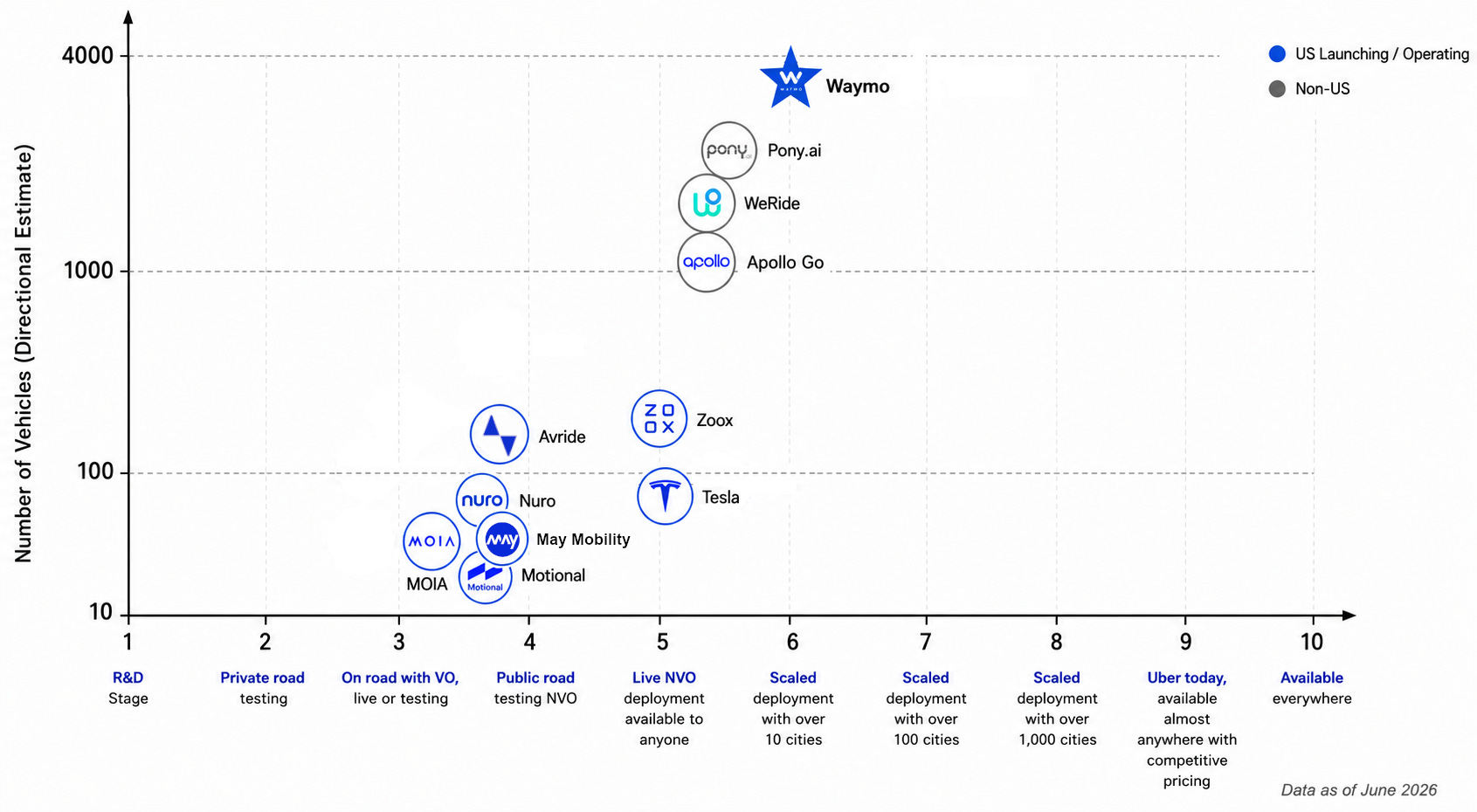
It is the only company operating commercial no-vehicle-operator (NVO) services across 10+ U.S. markets. Today, Waymo is completing more than 500,000 paid rides per week, and its U.S. fleet appears to be approaching 4,000 vehicles.
That lead is real, and it is not small. Its closest U.S. competitor, Zoox, reportedly has a fleet in the low hundreds of vehicles, less than 10% of Waymo’s fleet, and while Zoox is offering public rides in Las Vegas and San Francisco, the company still cannot charge customers as it awaits final regulatory approval for its purpose-built robotaxi.
Waymo built that advantage through patient capital, engineering depth and sustained execution. Alphabet’s profitability gave it room to absorb years of losses, keep investing through setbacks and pursue a problem that most companies could not afford to chase for that long. The engineering made driverless driving work; the execution turned it into a commercial product across 10+ U.S. markets and supported plans for an aggressive footprint expansion this year.
But the more interesting question is what happens next. Has Waymo built a lead that is structurally hard to catch, or has it simply won phase one of a much longer race?
I think the next 12 months will be critical to answering that question. Waymo is clearly ahead, but it has also been operating in the U.S. with limited direct competition. That is starting to change. Zoox is preparing to scale, Tesla remains the wildcard, Uber is assembling a portfolio of AV partners, and Chinese players have already shown that large-scale NVO deployments are possible.
Waymo won the first stage, but the market is still early. The next test is how it performs as the U.S. robotaxi landscape becomes more competitive.
Robotaxis vs. Ride-Hail
Waymo leads the autonomous mobility category in the U.S., but robotaxis still represent a very small part of the broader ride-hail market.
Waymo is completing roughly 500,000 rides per week, which annualizes to about 26 million rides. That sounds large because, for autonomous vehicles, it is. But against an estimated four billion annual U.S. ride-hail trips1, it represents roughly 0.65% of the market.
Even if Waymo reaches its stated goal of one million weekly rides, that would annualize to roughly 52 million rides, or about 1.3% of estimated U.S. ride-hail demand. That would be a significant milestone for the AV industry, but still only a small fraction of the broader rideshare market.
That said, Waymo already has a meaningful presence in key cities. San Francisco is the clearest example, where it has reportedly reached roughly 25% market share and is continuing to expand across the Bay Area.
But San Francisco is also Waymo’s cleanest product-market fit. It is dense, expensive, tech-forward, and filled with high-income riders who are more willing to try new technology and pay premium prices. Obi has reported that Waymo rides can cost 13–27% more than Uber and Lyft, which makes San Francisco a useful but imperfect test case. It is less clear that riders in less affluent or less tech-forward markets will make the same tradeoff, especially while Waymo’s coverage remains limited.
That is why the next phase is so important. The question is no longer whether Waymo can make driverless rides work. It can. The question is whether the company can become the default AV option in the most important U.S. markets before competitors establish a real presence. Waymo has proven that customers value the product in its strongest markets; it has not yet demonstrated that it can translate that lead into meaningful share of the broader U.S. rideshare market.
Waymo’s Lead Is Real. So Why Isn’t It Bigger?
If Waymo’s service works and consumer demand exists, why hasn’t the operator expanded faster?
I think the answer is supply.
Waymo’s fleet is still small relative to the size of the opportunity. A few thousand vehicles is a lot for robotaxis, but it is not enough to serve the largest U.S. ride-hail markets at real density. Expanding into more cities matters, but so does having enough vehicles in each market to offer short wait times, broad coverage and reliable availability.
I think its challenge has been finding the right vehicle partners. The Jaguar I-PACE helped Waymo prove the category but it was never a long-term scaling platform. Jaguar was winding down the platform, and Waymo needed a partner capable of supporting its expansion plans.
That is harder than it sounds. Traditional automakers are built around programs measured in hundreds of thousands, or millions, of vehicles. Robotaxi companies are still talking about fleets in the thousands, and eventually tens of thousands. Those volumes are meaningful for autonomous mobility but relatively small for a global automaker.
There is also a strategic tension. If autonomous mobility works, it may shift some demand away from car ownership and toward mobility-as-a-service. Automakers want to sell vehicles, while robotaxi companies want to turn those vehicles into service infrastructure. Their interests overlap but they are not perfectly aligned.
Waymo is now trying to address the supply constraint with two new platforms: the Zeekr-built Ojai and the Hyundai IONIQ 5. In a June ‘26 interview with Ben Thompson, Michael Morton from Moffett Nathanson estimated Waymo is importing Ojai vehicles at a rate of roughly 300 per month. If that pace holds, it could add more than 3,000 vehicles over the next year, roughly doubling the current fleet.
But imported vehicles are not the same as deployed robotaxis. The real test is how quickly Waymo can validate, permit, and put them into service—and whether the new platforms preserve the product experience that helped build demand.
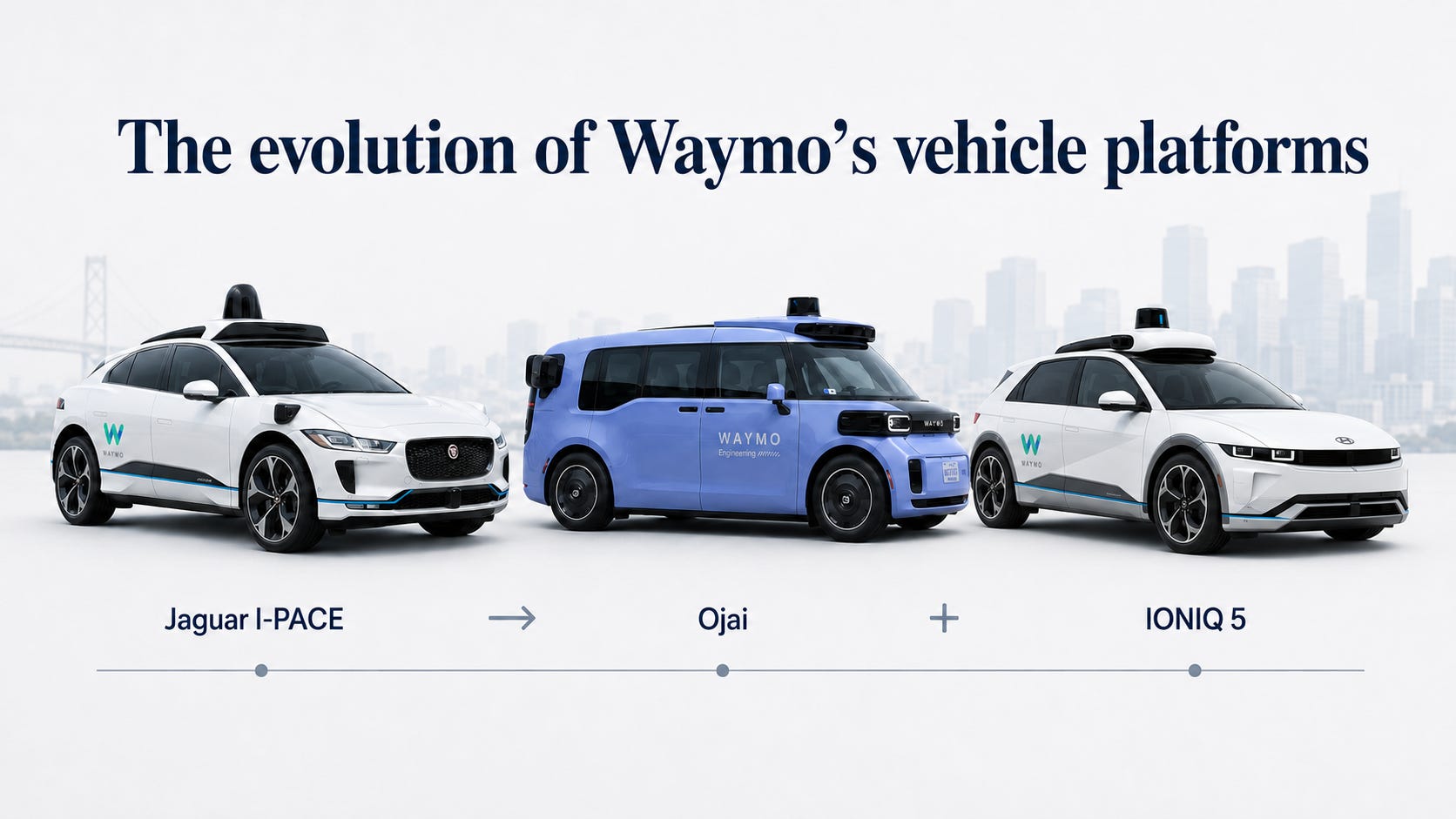
The Ojai introduces two additional risks. Because it is built in China by Zeekr, it is subject to the 100% China-specific Section 301 tariff in the U.S., making the vehicle materially more expensive. At least on first impression, it appears less premium than the I-PACE. That may not matter to all customers, but it could become more important if Waymo wants to sustain a 10–20% pricing premium as it expands beyond San Francisco.
The IONIQ 5 creates a different challenge. Avride, Motional, and potentially other AV companies are also integrating on the same vehicle, which means the physical product itself may become less distinctive. If several operators use the same platform, Waymo will need to differentiate more clearly through the Driver, the app, service reliability, and the overall rider experience.
The new vehicles should help Waymo scale. The open question is whether they can do so without diluting the product advantage that got them here.
The Opportunity: Win The Largest U.S. Ride-hail Markets
These new vehicles give Waymo a real opportunity to expand across the most important U.S. ride-hail markets.
Waymo has already entered or announced many of the largest markets. Based on my demand-weighted view of U.S. ride-hail, it is currently live in metros representing roughly 27% of estimated demand and has announced or signaled markets representing another 43%. In other words, Waymo now has a presence—or a stated intention to establish one—across close to 70% of estimated U.S. ride-hail demand.
That does not mean Waymo serves 70% of the market today. Nor does it mean its service areas cover entire metros. This is a metro-level demand proxy, not a measure of actual coverage. I count Los Angeles as a live market because Waymo operates there, for example, even though its service remains concentrated within a limited portion of the broader metro area.
But that still matters. Waymo is already in, or heading to, many of the markets that drive U.S. rideshare demand. Now it needs to make the service meaningfully available in each one: more vehicles, shorter wait times, broader coverage, airport access, and more consistent reliability.
In robotaxis, availability is the product. A service that works great but comes with long wait times or is not available in your area is still not a true substitute for Uber or Lyft.
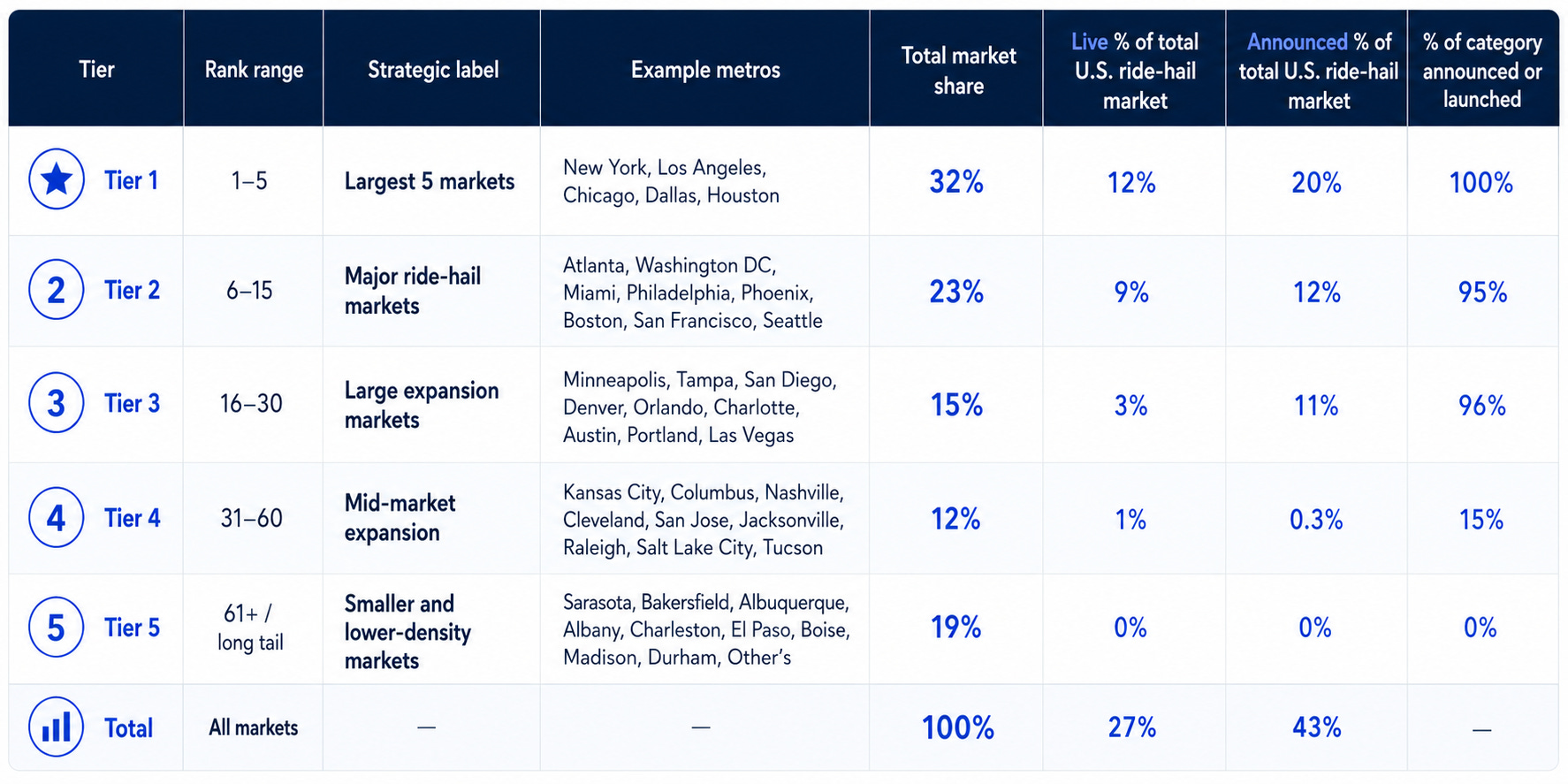
The key point is simple: Waymo has established the market footprint. The next 12 months are about building density within it.
That is both the opportunity and the risk. Waymo’s next chapter is less about proving the Driver and more about industrializing the fleet.
Competition Is Closing In
Waymo is not facing one obvious “Waymo killer.” The threat is broader than that. Several credible players are moving into deployment over the next 6–12 months.
Zoox is carrying public riders in Las Vegas and select riders in San Francisco, although rides remain free. Tesla’s Robotaxi service is available in limited areas of Austin, Dallas, and Houston. Avride has offered rides through Uber in Dallas since December 2025, initially with an onboard specialist behind the wheel. Nuro has secured both a California driverless testing permit and a permit to test passenger services with a safety driver. MOIA is testing autonomous ID. Buzz vehicles in Los Angeles ahead of a planned Uber launch in late 2026, while Wayve and Uber are preparing passenger trials in London.
None of these companies are at Waymo’s level today, and early deployment does not mean the technology is mature. NHTSA has opened a preliminary evaluation into 16 reported crashes involving Avride vehicles in Austin and Dallas. The crashes resulted in property damage and one alleged minor injury, and all occurred while an in-vehicle operator was supervising the system.
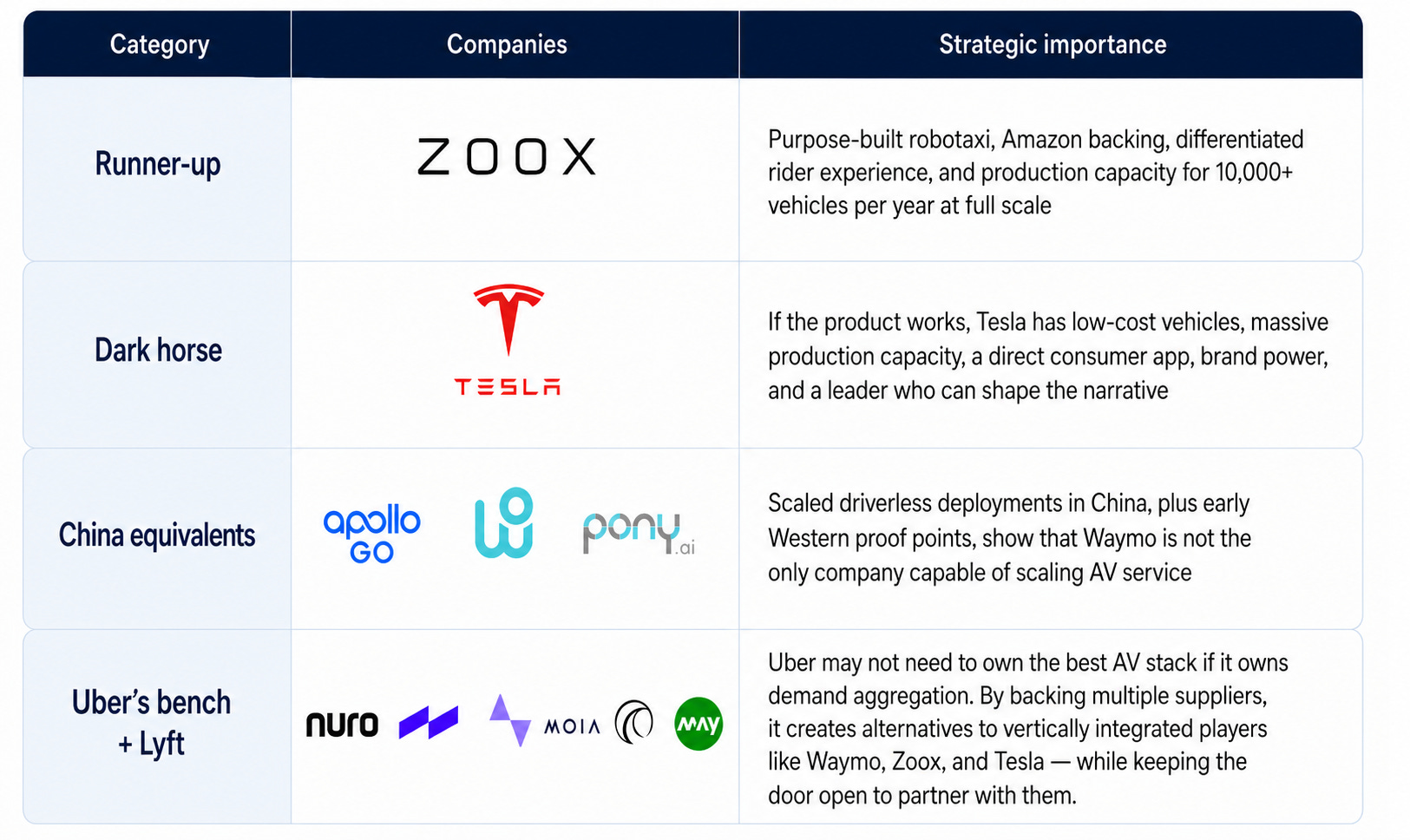
Zoox is the runner-up. It is probably the most credible U.S. challenger to Waymo’s rider experience, with a purpose-built robotaxi, Amazon backing, and a factory capable of assembling more than 10,000 vehicles per year at full scale. If Zoox secures the approvals needed to charge riders and expands beyond its limited footprint, it becomes a real second player in the U.S. robotaxi market.
Tesla is the dark horse. It is no longer competing only through announcements: its service is live in three Texas markets, although coverage remains limited. If Tesla can prove the product works reliably at scale, it would be difficult to compete with: low-cost vehicles, massive production capacity, a direct consumer app, a powerful brand, and a leader who can shape the industry narrative. But the rollout remains small and has included reported crashes, so this is still an execution story rather than a solved one.
Uber’s bench is the platform threat. It may not need to own an autonomous-driving stack if it controls the demand layer. By backing Nuro, Avride, MOIA, Wayve, WeRide, Pony.ai, and other suppliers, Uber is building alternatives to vertically integrated players such as Waymo, Zoox, and Tesla. Combining those autonomous fleets with Uber’s structural advantage—human drivers who can cover peaks, edge cases, and markets where AV supply remains thin—could allow it to keep wait times low while maintaining high AV utilization.
The Chinese players matter because they show that Waymo’s technology path is not unique. They are already operating across several markets in mainland China and are beginning to expand internationally. Pony.ai has launched paid robotaxi rides in Zagreb with local operator Verne, with Uber integration expected to follow. Lyft also plans to deploy Baidu Apollo Go vehicles in Germany and the UK.
The UK could become the first Western market where these companies compete from roughly the same starting line. Unlike San Francisco, where Waymo has had years to build brand recognition, operating experience, and customer habits before a serious competitor arrives, London could see Waymo, Wayve, and Apollo Go enter within a similar window. That would give us the clearest test yet of whether Waymo’s product is truly differentiated—or whether part of their advantage has simply come from being first.
Mainland Europe could become an important proving ground. Waymo and U.S.-backed providers are exploring the region, but so are European operators and Chinese AV companies. Europe’s fragmented regulatory landscape means deployment will likely happen market by market, giving new entrants multiple paths to build a safety record and commercial credibility. More importantly for the U.S. debate, if Chinese companies can prove themselves across respected European markets, that could eventually strengthen their case with U.S. regulators.
Waymo has already won the race to prove that robotaxis can work. The next race is to turn that technology lead into a durable market lead. The next 12 months will show whether it can challenge Uber and Lyft as the dominant ride-hailing platform—or whether it becomes just another autonomous fleet supplying those platforms.
Estimated using Lyft’s trip volume and market position. Lyft completed 828 million trips in 2024, when they operated only in the U.S., and reported 17% year-over-year growth. Extending that growth rate through 2026 implies roughly one billion annual Lyft trips. Assuming Lyft represents approximately 24% of the U.S. ride-hail market, that suggests a total market of around four billion trips per year.
👏👏👏
While your post is a bit long for my taste, the analysis is certainly thorough. But I think you didn't address the elephant, which is with us here in this very room: how can Waymo ever compete with a company that is FULLY vertically integrated, i.e. combines self-driving software and hardware stack, the manufacturing of dedicated robotaxi vehicles, AND a ride-hailing experience on one balance sheet.