

This week’s edition is brought to you by TaskUs — powering safe, scalable autonomous vehicle and AI operations through human-in-the-loop expertise.
Top Stories of the Week
Waymo now serves 500,000 paid rides weekly, doubling from 250,000 in less than a year (link). Just a quarter into the year and they’ve already reached half of their end-of-year projection of 1 million weekly rides.
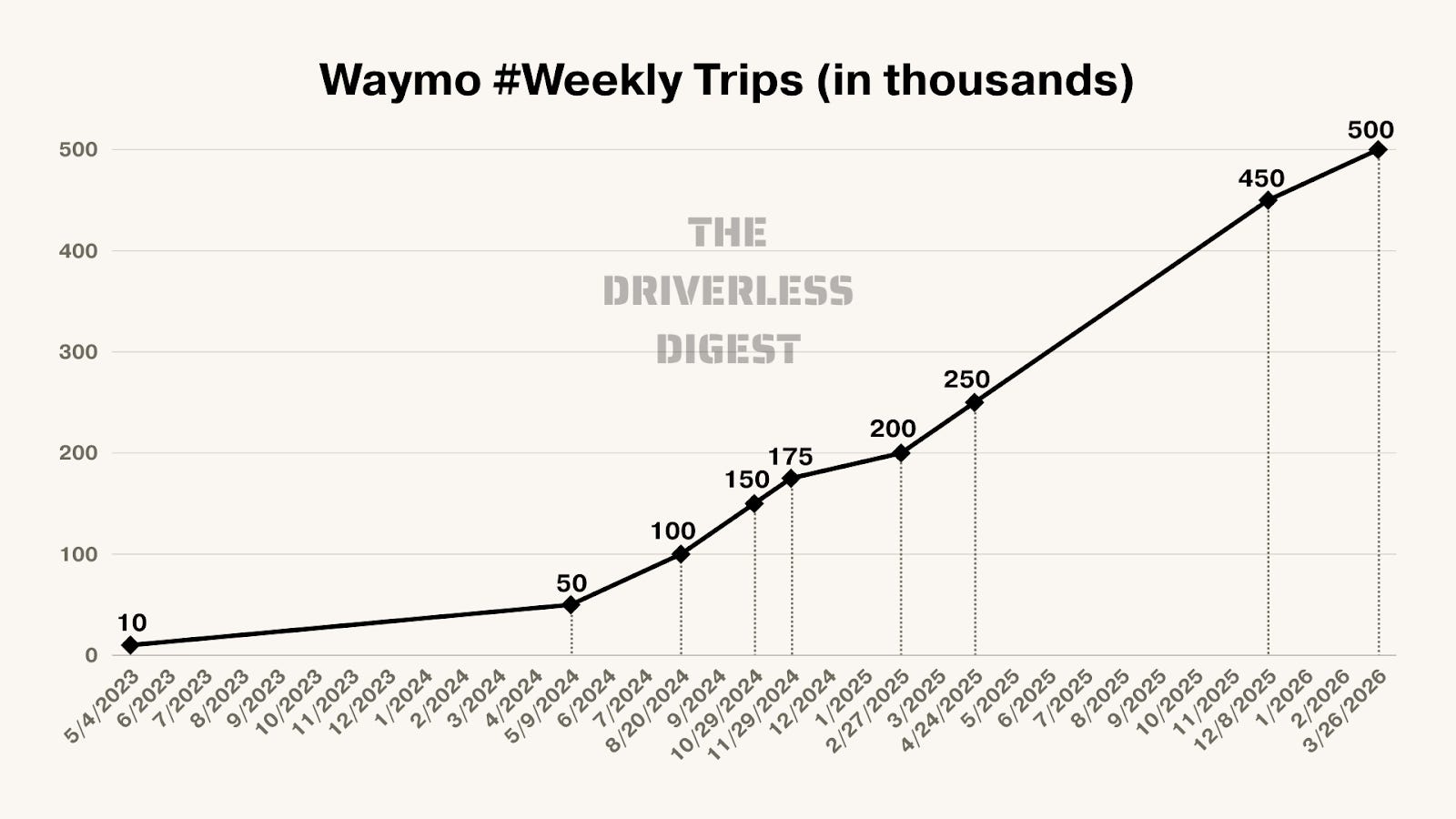
On the one hand, Waymo is clearly scaling. But it’s worth keeping in mind that Uber and Lyft do a combined 675,000 trips per day in the New York City market alone. So while Waymo’s growth is impressive, they’ve still just scratched the surface of the market.
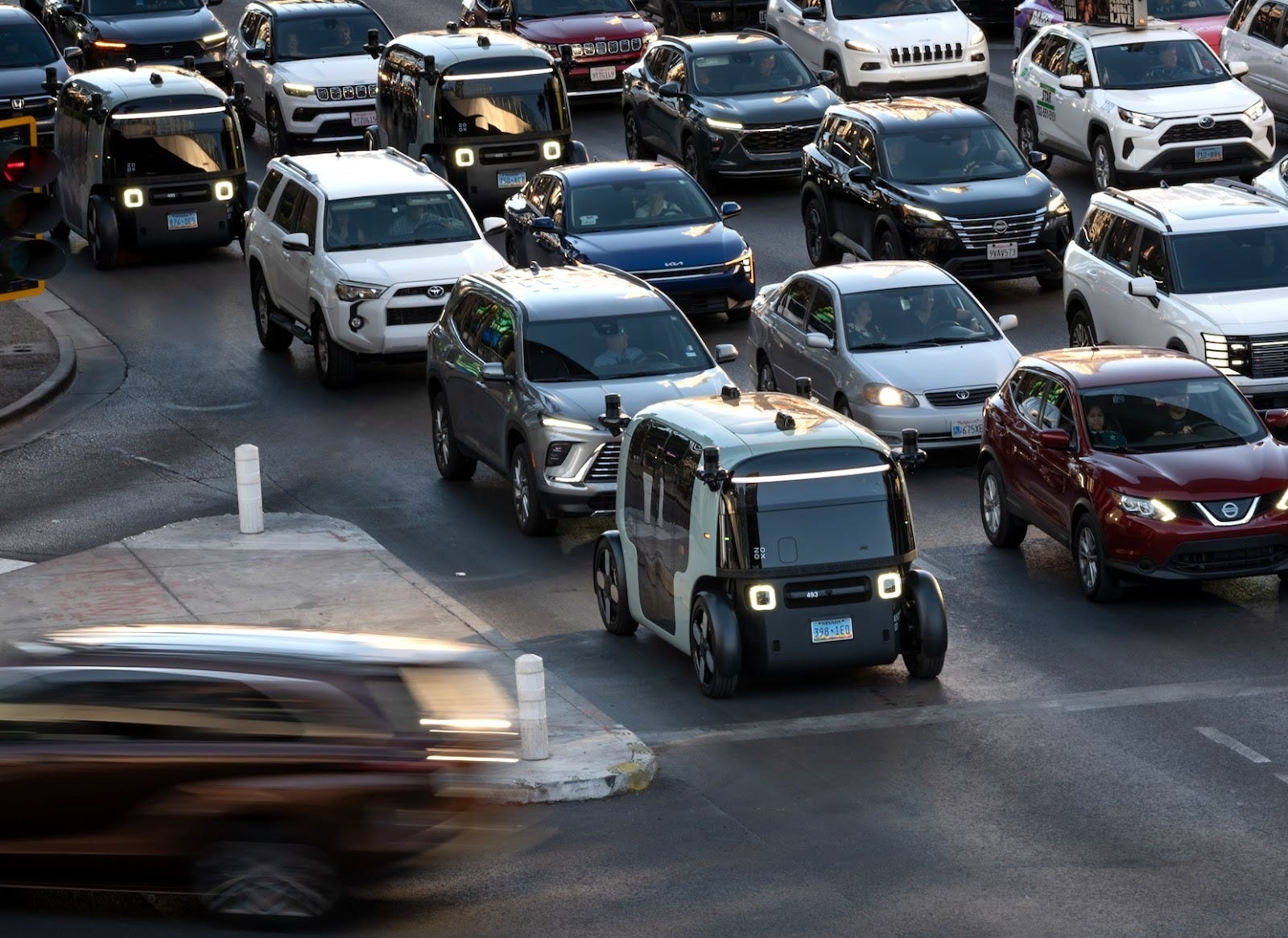
Zoox brings its robotaxis to Austin and Miami (link). The company plans to start offering rides in both locations later this year, while also expanding existing markets by quadrupling the size of their San Francisco service area, with a focus on “the eastern half of the city” for early riders, and more than doubling available destinations in Las Vegas, adding high-traffic venues like Sphere, T-Mobile Arena, and the Las Vegas Convention Center, while beginning testing at the Las Vegas airport ahead of future service.
Zoox is the company to watch after Waymo since they are the closest US-based AV company to launching commercial driverless rides. In San Francisco, they’re running a free limited early-access program for employees and invited riders, while in Las Vegas, the service is open to the public for free, with trips limited to a set of predefined destinations.
Related: ‘Was walking home and just saw the Zoox robotaxi go live for the first time. The taxi has no driver or steering wheel.’ (link).
Other Stuff
California regulator confirms Tesla is ‘not operating an autonomous vehicle service’ (link). The quote comes from my interview with CPUC Director Pat Tsen and has been making the rounds this week. It’s also the type of objective data point I like to focus on when it comes to covering Tesla.
Related: ‘Interesting commentary on $TSLA robotaxi status in CA here’ (link) via Thomas Reiner.
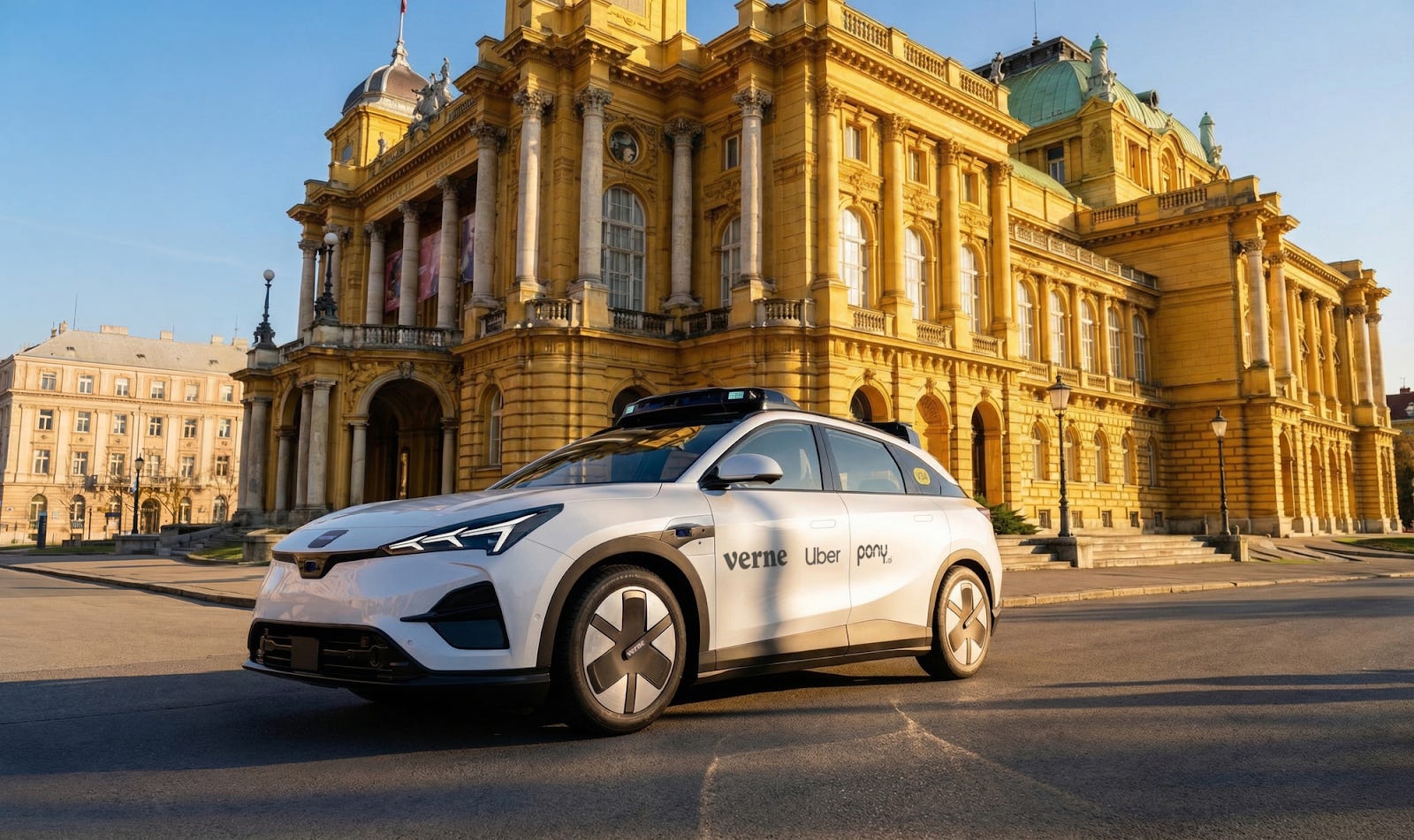
Uber aims to launch Europe’s first robotaxi service with Pony AI and Verne (link, no paywall).
Under the terms of the deal, Uber will provide the ridehail network, along with the customers; Verne will manage the fleet; and Pony AI will develop the autonomous driving technology. The first service will be in Zagreb, with more European markets to follow.
Related: Pony.ai Announces Unaudited Q4 & FY 2025 Financial Results (link).
Full year robotaxi revenue: $16.6 million.
1,446 vehicles in their fleet, with a 2026 year end target of 3,000 vehicles.
WeRide also announced its financial results for Q4 and full year 2025 (link).
$21.2 million robotaxi revenue, and $29.6 million gross profit for the year 2025.
2,113 vehicles in their global fleet, with a 2,600 fleet target by 2026.
Deployed across 12 countries and 40+ cities.
Remote assistance human-to-vehicle ratio: 1:40.
The Sensor Debate: Vision, LiDAR, and the Path to Real Autonomy (link). One quote that stood out from the piece by Jiajun Zhu, Co-founder and Co-CEO of Nuro:
A common argument, often framed as a first-principles view, is that because humans drive using only their eyes, machines should do the same. While that observation is factually true, it does not follow that it is the most principled design constraint for machines. Autonomous systems are not bound by human biology. In many domains, machines achieve superior performance precisely because they use sensing and capabilities that humans do not have. Mimicking human limitations is not a requirement for building the safest or most capable system.
Uber gave up on driverless cars. Now it's paying the price (link, no paywall).
Investors have noticed, punishing Uber stock over the past few months for being a potential AV laggard. Tesla and Waymo are building their own autonomous ride services, which threaten Uber.
The Human Edge in AV: Scaling Swift Emergency Response
TaskUs partners with the top autonomous vehicle (AV) and AI organizations to manage the human-critical workflows that make advanced systems safer and more reliable. When one of the leading companies deployed its fleets in new cities, they also needed to scale emergency response teams. TaskUs helped by deploying expert operators, creating 24/7 incident frameworks and implementing a unique fatigue management program. Get all the details and results in this case study.
I tried every robotaxi in America (link) via Sophia Tung.
Who’s driving Waymo’s self-driving cars? Sometimes, the police (link).
Waymo has relied on taxpayer-funded first responders to navigate its vehicles when they encounter issues, despite the existence of the company’s own roadside assistance team. In at least six instances identified by TechCrunch, first responders have had to take control of Waymo vehicles and move them out of traffic during emergency situations, including one in which an officer was in the middle of responding to a mass shooting.
Not exactly the best use of first responders’ time, and it feels like something that should be solved operationally, not outsourced to cities. At a minimum, Waymo should be paying for that time and hassle, especially as they scale.
It also makes you wonder why more of these situations can’t be handled remotely. Waymo has a remote assistance team, but there’s still a gap between that and true teleoperation, and this is where it shows. If they want to keep expanding, they’ll need a cleaner fallback that doesn’t involve calling in the cops when they get stuck.
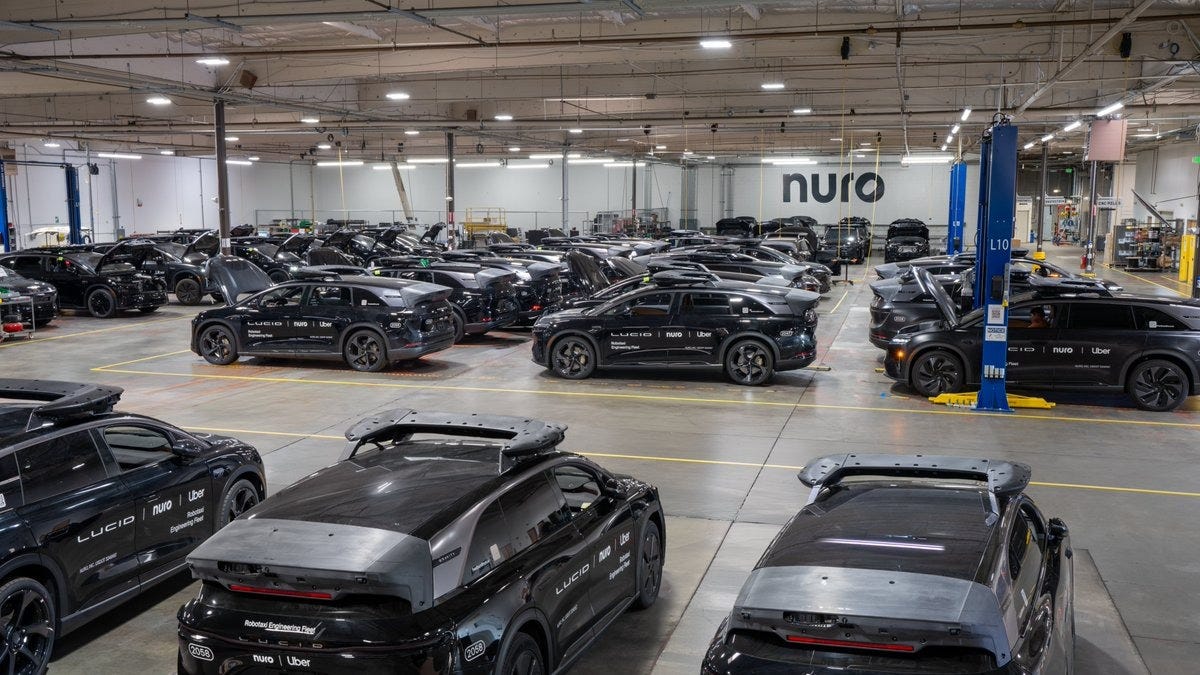
‘Meet the Nuro-Lucid-Uber fleet! Now almost 100 vehicles strong’ (link).
Waymo is No. 1 on Fast Company’s Most Innovative Automotive Companies list for 2026, with Baidu in second and WeRide in ninth (link).
Why a two-seater robotaxi makes more sense than you think (link, no paywall).
Why Fully Self-Driving Cars Are Almost Impossible | The Limit (link).
I flew my drone over one of the Waymo parking lots in San Francisco (link).
What else we’re reading/listening to
Cheeky Pint by John Collison: The 20-year journey to fully autonomous cars with Dmitri Dolgov of Waymo (link).
Juan Carlos: Who Runs a 150,000 Autonomous Vehicle Fleet? (link).
The AV Crisis Playbook (link).
How the CPUC Handles AV Permits, Data, and Enforcement - Pat Tsen (link). Our latest podcast episode features Pat Tsen, Deputy Executive Director for Consumer Policy, Transportation, and Enforcement at the California Public Utilities Commission (CPUC), where she outlines the role of the CPUC and how it differs from the California Department of Motor Vehicles (DMV), walks through the process to launch an AV service in California, and explains the CPUC’s technology-agnostic approach to AV regulation, including how it handles data, reporting, and enforcement, among other topics.
Related: California Regulator Says Tesla’s ‘Robotaxis’ Are More Like a Limo in the Eyes of the Law (link).
AVs/Humans behaving badly
‘The delivery robot experiment is going great’ (link).
‘Waymo blocks restaurant lot exit in Atlanta’ (link).
‘Why do I feel sorry for a limping robot, he’s just too cute’ (link).
‘I’m not going to be pushed around by the robots’ (link).
AVs/Humans behaving “goodly” :)
‘POV: you’re a delivery robot navigating the real world 🤖 We’ll call it Dot’ (link).
Related: Stay tuned for my upcoming podcast interview with Ashu Rege, Head of DoorDash Labs. Subscribe today so you don’t miss it!
‘Waymo nails Construction area perfectly!’ (link).
‘I hope their food got delivered’ (link). Feel like you should get a $5 credit for this :)
‘Nuro seamlessly handles chaotic temporary construction zone lanes’ (link).
Neat Jobs
Multiple roles at Lyft’s AV depot in Nashville (link) via Jeremy Bird.
Multiple software engineering roles at Waymo, via Mike Curtiss.
Technical Recruiter at Wayve (link) via Adam Flockton.
Job Moves
Paul DeLong: JPD Group -> MOIA America (link).

Shout-outs
Big thanks to TDD readers at Uber, Carvolution, and to Ian A. and Carter S. for referring new subscribers. If there’s someone you think would enjoy TDD, feel free to forward this email or use the referral button below, and we’ll make sure to shout out your company.
We’re now over 8,000+ subscribers! Interested in advertising with TDD? Check out our media kit here and reach out to us.
Until next week :)
-Harry
The law enforcement dependency point from the TechCrunch piece is interesting.
What makes it tricky is that it's likely circular: emergency vehicles arrive to help, but the AV detects them and enters an emergency state. Now it needs to get out of the way, but that often means breaking traffic rules a human driver would bend instinctively. So the vehicle stays stuck, and the officer ends up moving it themselves.
At 500K rides per week, that stops being an edge case.
From a TDD reader via email: Curious to hear your thoughts on Tesla’s robotaxi prospects. Some argue their low production costs could eventually let them dominate, but progress still seems pretty slow so far.
My take: That’s the big “what if” with Tesla. If they can actually crack self-driving and get anywhere close to Waymo on safety, they’ve got some massive structural advantages from their vertical integration. They can produce 5k+ cars per day, while Waymo’s entire fleet is only around 3,500 vehicles. On top of that, they’ve got a pretty rabid fan base that could put personally owned vehicles onto a Tesla robotaxi network, in addition to fleet vehicles, which could help solve the peak demand problem that Waymo and other AV operators run into.