


It’s been a while since I’ve seen updated Yipit market share data for San Francisco, so it was nice of Uber’s CFO, Balaji Krishnamurthy, to share the latest numbers on Twitter recently, even if he was doing it to roast me.
Since Waymo, Uber and Lyft don’t share their city-by-city breakdown of rides publicly, Yipit data gives us one of the clearest looks at how the three are actually stacking up against each other within a given operating area.
Balaji’s reason for sharing the chart was to bolster Uber’s claim on their recent earnings call, that “in more mature AV markets including Los Angeles, San Francisco, and Phoenix, Uber’s category share, both citywide and in AV operating zones, is higher today than it was a year ago.”
Initially, I was skeptical of this claim since Waymo famously gained a ton of market share in San Francisco when they launched. But Uber is arguing that while Waymo may have gained market share quickly after launching in these three markets, it hasn’t continued taking share from Uber over the past year.
The citywide part of that claim isn’t especially surprising. Uber’s operating domain is much larger than Waymo’s, it can serve airports, and it has fewer geographic restrictions overall. And since Uber is still growing its ride volume every quarter, it’scplausible that its growth across the broader market could outpace Waymo’s growth within a much smaller operating area.
But the second part of Uber’s claim, that its market share has also increased within Waymo’s operating zones, is more interesting and deserves a closer look.
Zooming In
We covered Waymo’s rise from 0% market share in SF in August of 2023 to equaling Lyft’s market share of 20% in November of 2024.
Waymo continued on that growth trajectory and things were looking good in April of 2025. If you were to extrapolate their growth rate, Waymo was even ‘on track’ to pass Uber in 12 months.
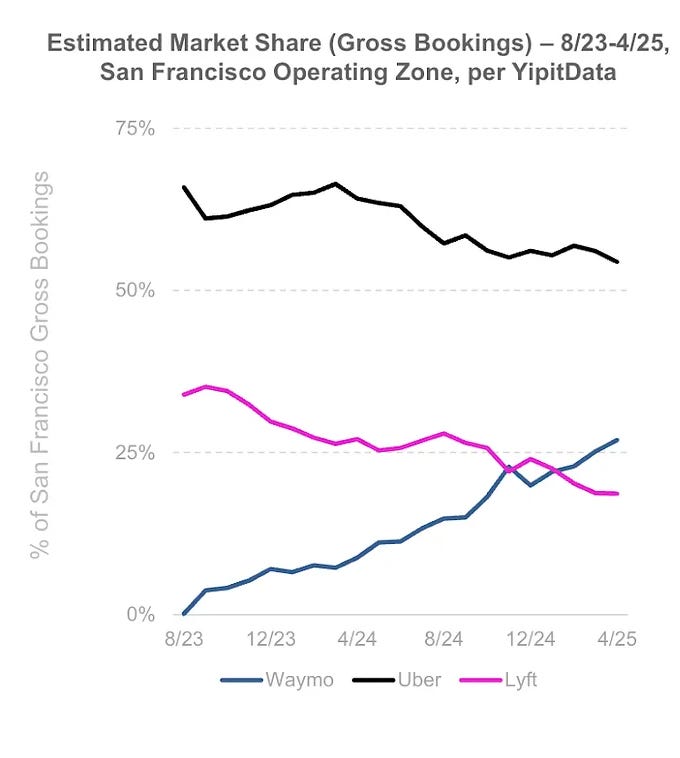
But that obviously never happened and this is the crux of Balaji’s argument.
Yipit Data Caveats
From the looks of the latest Yipit chart, Waymo’s market share actually went down from 20% in June 2025 to 15% as of June 2026, while Uber’s ticked slightly up. Great news for Uber right? Not so fast.
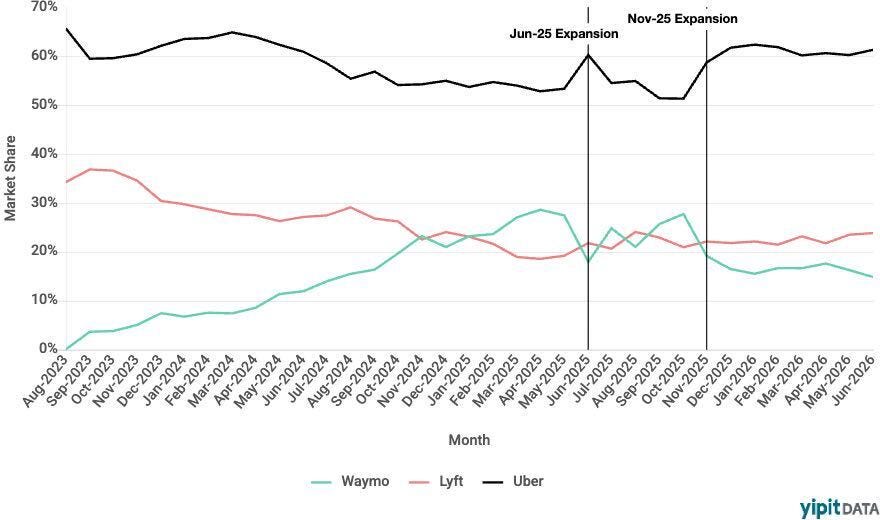
As Twitter user m0xt pointed out, there is an important caveat with the Yipit data. It only measures trips that start and end within Waymo’s operating domain, and that domain expanded substantially over the past year, first farther down the Peninsula in June 2025 and then to a 260+ square-mile Bay Area service area stretching from San Francisco to San Jose in November.
That matters because every time Waymo expands, Yipit adds a bunch of new territory where Uber is already well established and Waymo is starting from scratch. So you would naturally expect Uber’s share within the newly expanded operating zone to jump and Waymo’s to fall, even if Waymo is still gaining share across the Bay Area overall.
You can see this clearly around Waymo’s June and November 2025 expansions, when Uber’s share jumps and Waymo’s falls. In other words, some of what looks like Uber regaining market share may simply be an artifact of Waymo expanding its service area.
CPUC Data Also Bolsters This Narrative
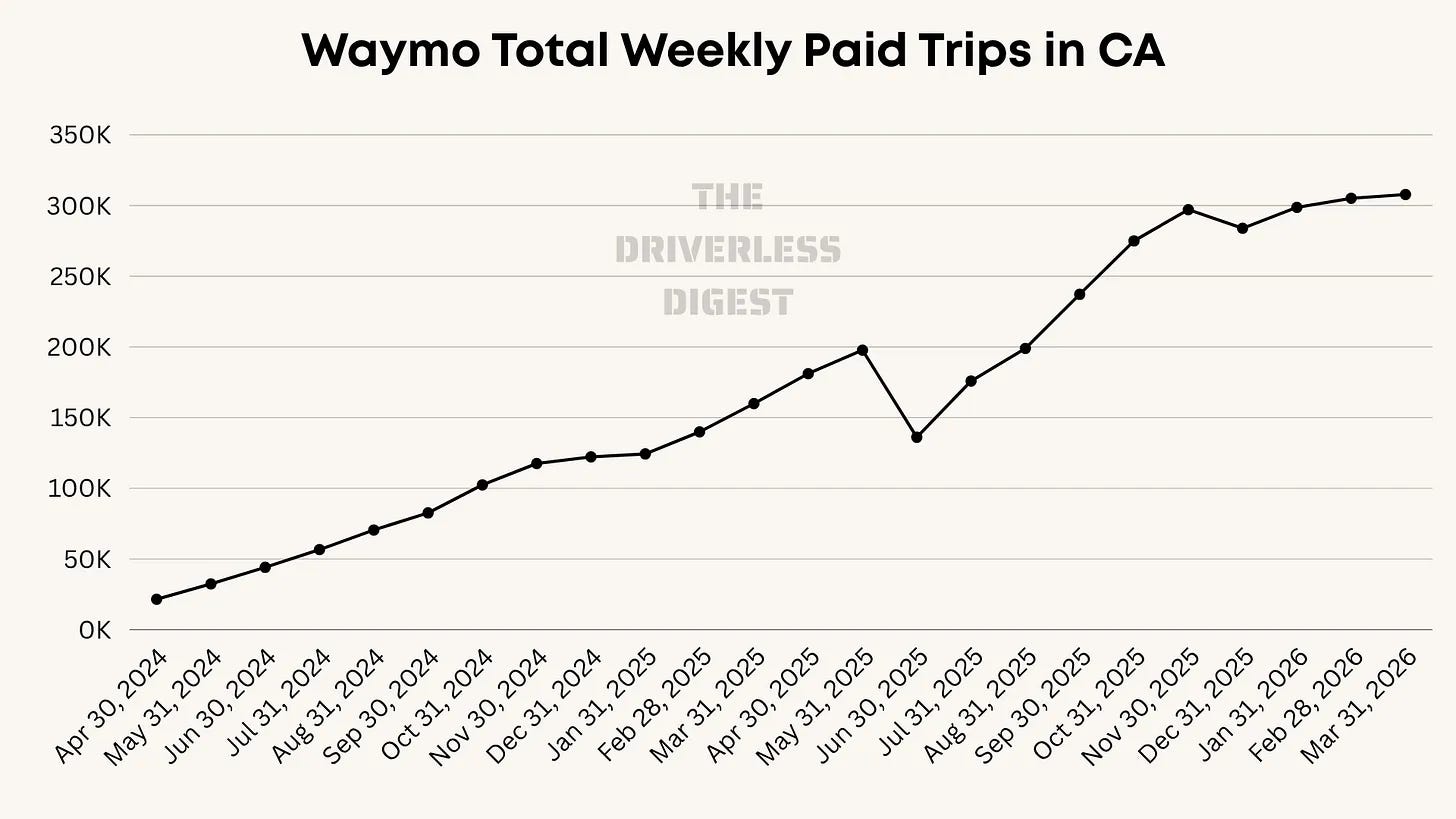
Although Yipit data is nice to have, California Public Utilities Commission (CPUC) data gives us another important piece of the puzzle since it represents the actual number of paid trips Waymo is doing across California (Los Angeles and San Francisco).
And if we look carefully at the chart above, we see Waymo at 200,000 trips per week as of May 31, 20251 and by November 30, 2025, they were at 300,000 trips per week, a 50% increase.
Yet over roughly the same period, the Yipit chart shows Waymo’s market share within its operating zone declining.
Those two things aren’t necessarily contradictory. Waymo expanded its operating domain twice during this period, meaning Yipit was measuring Waymo against Uber and Lyft across an increasingly large geography. Waymo could therefore be doing significantly more rides overall while holding or even losing share within the much larger area it now serves.
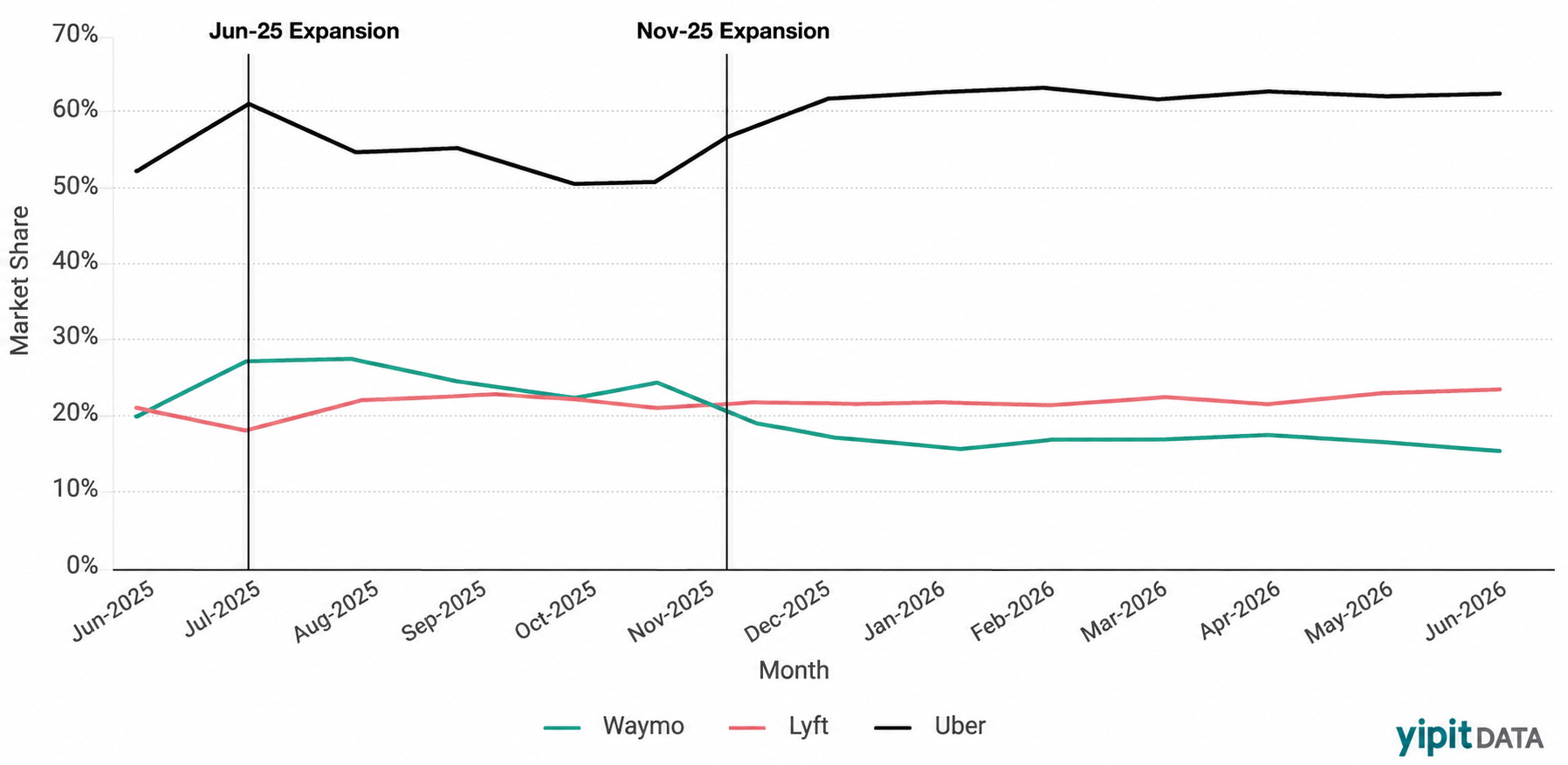
It would be interesting to see Yipit run the same analysis using a fixed geography, for example, Waymo’s original San Francisco operating zone. That would give us a much better apples-to-apples comparison of whether Waymo has actually gained or lost share against Uber over the past year.
So while Uber’s statement appears to be technically correct, it leaves out some pretty important context: Waymo increased its California ride volume by 50% during this period while also significantly expanding its operating domain.
My Takeaway
I’ve been covering Uber for over a decade, so I’m pretty familiar with the linguistic gymnastics they sometimes use to make their position look as strong as possible. And I don’t blame them. It’s their job to make the case to investors, and it’s my job to call them out when the data deserves a closer look.
And I actually think this is a perfect example of what my original tweet was getting at, even though I was mostly joking.
Yes, Uber has maintained or even increased its market share within the AV operating zones where it competes with Waymo. But during that same period, Waymo grew from roughly 200,000 to 300,000 paid trips per week in California and significantly expanded where it operates. That’s hardly evidence that Waymo has stopped growing or that it isn’t taking meaningful ride volume.
The ironic part is that CPUC data does suggest Waymo’s growth may have started slowing by Q1 2026. So Uber’s argument would have been more convincing if it looked back over the past six months instead of the past year.
San Francisco is obviously an especially good market for Waymo. It’s a dense 7-by-7-mile city with lots of tech evangelists and early adopters, and those dynamics won’t necessarily translate to every market. But I think Waymo has already demonstrated that it can enter a major rideshare market and gain meaningful share relatively quickly. And as it adds airport access and re-starts freeway service, the gap between what Waymo and Uber can offer gets smaller.
If anything, the bigger question is whether Waymo can scale supply fast enough to actually compete head to head with Uber. Vehicle availability has arguably been a bigger constraint than demand, and Waymo is still priced at a premium to Uber. If Waymo can add vehicles, expand its operating domains and eventually bring prices down, there’s still plenty of room for it to take additional share in my book.
Readers, what do you think? Are you Team Balaji or Team Harry on this one now that I’ve had my coffee?
Nice explanation without descending into he said, she said. There are more changing variables for Waymo so difficult to compare Uber and Waymo in a meaningful way. Expansion to the East Bay very soon will make it even more difficult.
Excellent insights Harry. Another way to look at this would be the fleet economics - is an average Waymo car getting more utilization than a driver driven Uber? - this is the one thing investors will look at to see if AVs are a real promise