

Stephen Zoepf is the CEO of DZCO and has two decades of experience in the mobility industry. He holds a Ph.D. from MIT, led Stanford's Center for Automotive Research, and served at the U.S. Department of Transportation.
All companies deploying autonomous vehicles (AVs) could be doing far more to help the cities they operate in.
Most researchers expect AVs to outperform human drivers and avoid road fatalities over time, but without generally accepted standards of proof, finger-pointing continues. Meanwhile, less severe AV-related nuisances pile up: noise, interrupting crime scenes, snarling traffic and slowing first responders. Municipal stakeholders bear these burdens today and need relief now, not after the years long process of building compelling safety evidence.
Companies like Uber and Waymo leverage enormous datasets to produce research supporting their positions. Waymo for instance is highlighting human drivers speeding around its own law-abiding vehicles. Meanwhile, Uber commissioned a 2025 driver-earnings study of three cities, which the report says were selected to contribute to ongoing regulatory debates.
These observations demonstrate the powerful tools that AV operators and ridehail platforms have already built to gather, store and analyze city-scale data. Yet this data is mostly being used to support glossy PR and investor-facing documents rather than actually improve safety outcomes for city residents.
With a little creativity and partnership, there are boundless possibilities for AVs to become the data-gathering partners that cities desperately need. AV partners needn’t even offer data that expose their own operations or strategies in order to help, which is the common refrain.
It’s Already Been Prototyped with Potholes
In April, Waymo and Waze (both Alphabet companies) launched a pilot reporting pothole locations to five cities.
The pilot program uses Waymo’s perception and physical feedback systems to detect and provide up-to-date information on potholes where Waymo operates.
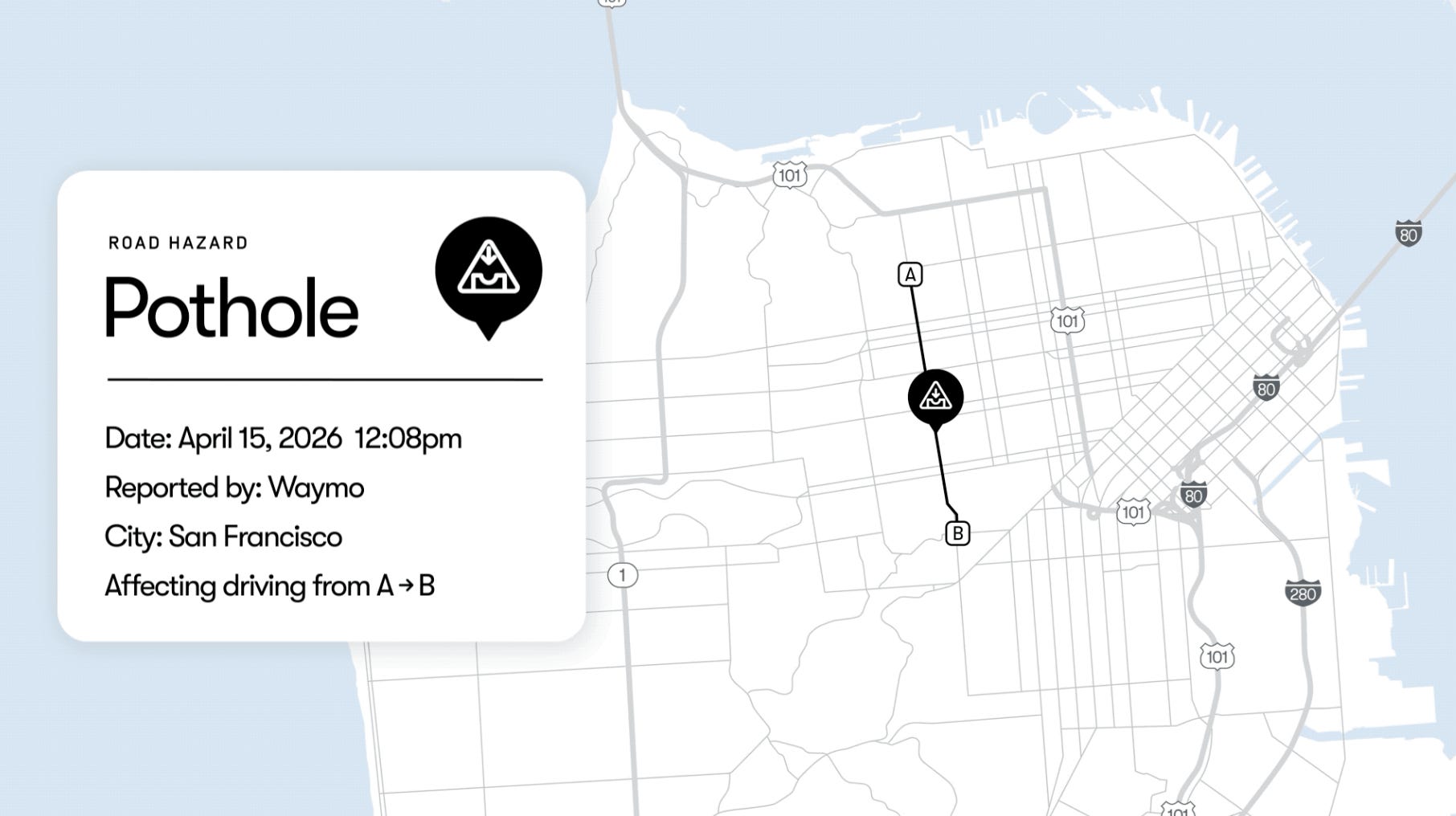
While it’s small-scale, the most interesting piece is that it reportedly routes Waymo’s detections into the same work-order system as 311 calls. While guardrails are required to understand distributive impacts, this type of deep public-private partnership can yield significant efficiency gains and collective benefits in the near term.

Giving Back At The Curb
Curb space is a precious urban commodity. AV companies have proposed that cities create staging areas that could alleviate deadheading, but it’s less clear whether said companies have proposed *paying* for this space.
While curb economics are being resolved, AV companies could already be flagging where bike and bus lanes are chronically blocked.
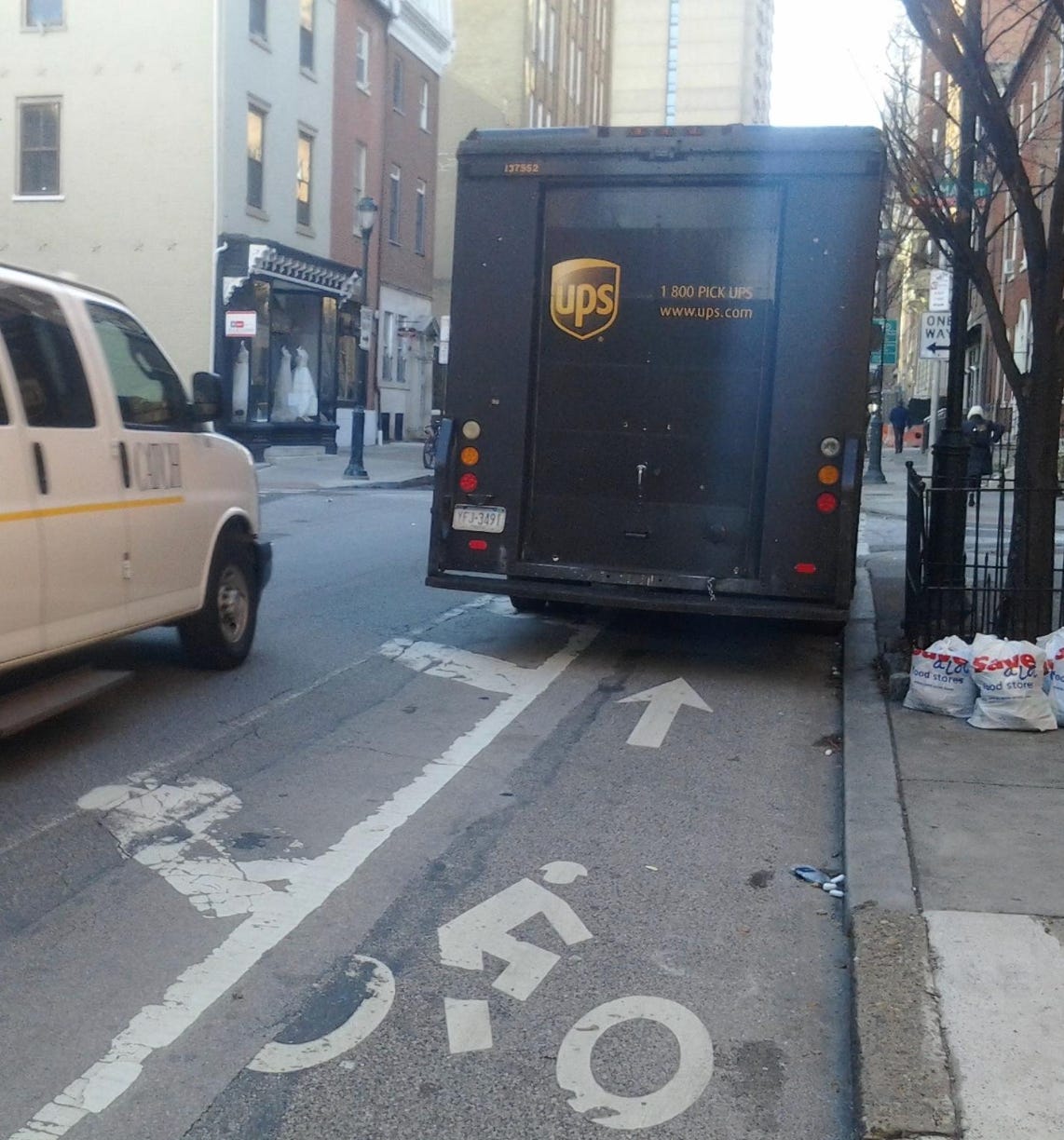

Over time, occupancy data would show a city where to build loading zones: the places where double-parking is already the norm. AV companies help create the evidence, but the city sets the policy.
Some cities measure curb occupancy with cameras or magnetometers, requiring expertise and budget that most cities don’t have. AVs, on the other hand, are constantly scanning and observing.
All passengers need safe areas to embark or disembark, and time wasted looking for these spots creates pollution and congestion. Rather than just looking for their own spots to park, AVs could provide near-real-time information on curb space, lowering VMT (Vehicle Miles Traveled) and congestion for everyone in the process.
Minding Pedestrians
Pedestrian and bicyclist travel is among the least understood elements of city mobility. In 2021 the Federal Highway Administration (FHWA) itself acknowledged that cities often lack the resources to gather this data and that there’s a “need for innovative approaches.” For example, Milwaukee used brief manual pedestrian counts at 66 intersections and extrapolated it to a full-year across more than 4,400 intersections.
Similarly, cities often don’t know the extent or condition of their own sidewalks or crosswalks. Sidewalk repairs are often complaint-driven, but some researchers have used clever photography analysis or lidar sensors on wheels to collect this data.
Automated vehicles detect pedestrians and crosswalks as a matter of course; simply storing time-averaged counts of pedestrians would give cities enormous ability to more efficiently deploy resources to support walking residents.
A city could use those counts today to prioritize crossing upgrades and signal timing by where people actually walk, rather than by who calls 311 (or worse, where pedestrians are struck). What could be more innovative than reusing data companies already collect to support collective goals?
Tracking Construction
Again per FHWA, transportation agencies also have a hard time tracking road construction – 511 work-zone data is often manually entered. What is permitted may not reflect what’s actually being built, and a city would seldom know the exact extent of a given infrastructure project on a given day.
The Work Zone Data Exchange (WZDx) format was built primarily to allow AVs to consume data provided by the city, but there’s no reason data couldn’t flow the other direction too, allowing cities to fill in the gaps in their own knowledge. This would let cities close outdated 511 entries, and alert early if a work zone doesn’t match its permit.
These concepts could extend to burned-out streetlights, downed signs or any number of city maintenance issues. None of it would be competitively sensitive – we simply need effective ways for the information to be collected and delivered.
Closing the Gap
Both Uber and Waymo have already made public statements in the spirit of these goals. Waymo’s team has publicly backed curb permitting standards. This spring, in a paper entitled “Unlocking the Promise of Autonomy,” Uber writes that partnering with cities on congestion, infrastructure and safety are among its principles.
To make good on these statements AV companies need to act more proactively. The debates over automation will inevitably continue, but these types of actions could do wonders to heal the relationships between governments and AV companies in the near term, delivering concrete value to city residents, whether they choose to ride in an AV or not.
Readers, what do you think about these three ideas and what other ways could AVs give back to cities? Do you think AV companies are doing enough or should they be doing more?