

Today’s post comes from Josie-Dee Li, a product manager working on charging electric & autonomous trucks and writing about EV & AV mobility trends in a personal capacity at Electrons & Asphalt.
The rider’s decision tree in a multi-robotaxi city
In an earlier article, I wrote about what it feels like to ride Zoox as an early user in San Francisco. Being in SF has also given me the chance to try the other leading robotaxi services firsthand. Naturally, the next question is how Zoox stacks up against Waymo and Tesla robotaxi in everyday use.
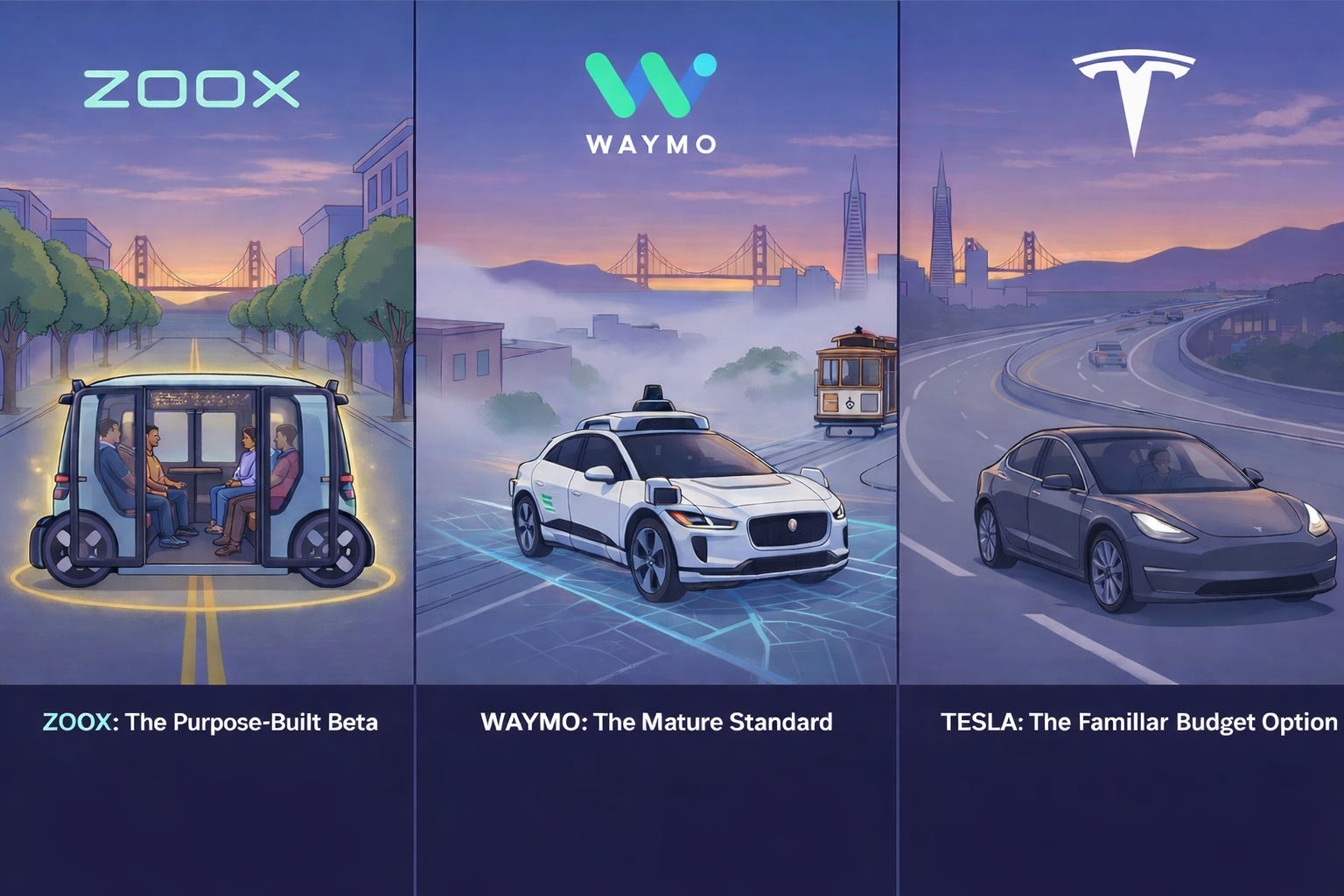
After more than 150 rides across all three, my main takeaway is that each is optimizing for a different rider priority. Waymo feels mature and consistent. Tesla feels familiar and cost efficient. Zoox feels the most purpose built and experiential, but also the newest and most visibly in progress.
What surprised me most is that I am no longer deciding whether to take a robotaxi. I am deciding which one fits my mood, time constraints, and tolerance for experimentation. That shift alone says a lot about how quickly the autonomous vehicle market is maturing.
Comparing Zoox to Waymo and Tesla
After 2+ years and nearly 100 rides in Waymos, it’s honestly hard to remember what it felt like in the early days. Today, it’s ubiquitous, incredibly consistent, still magical, and while it’s usually the pricier option, I continue to rely on it because that consistency in driverless experience and higher safety threshold is exactly the point.
Waymo: maturity and consistency at scale
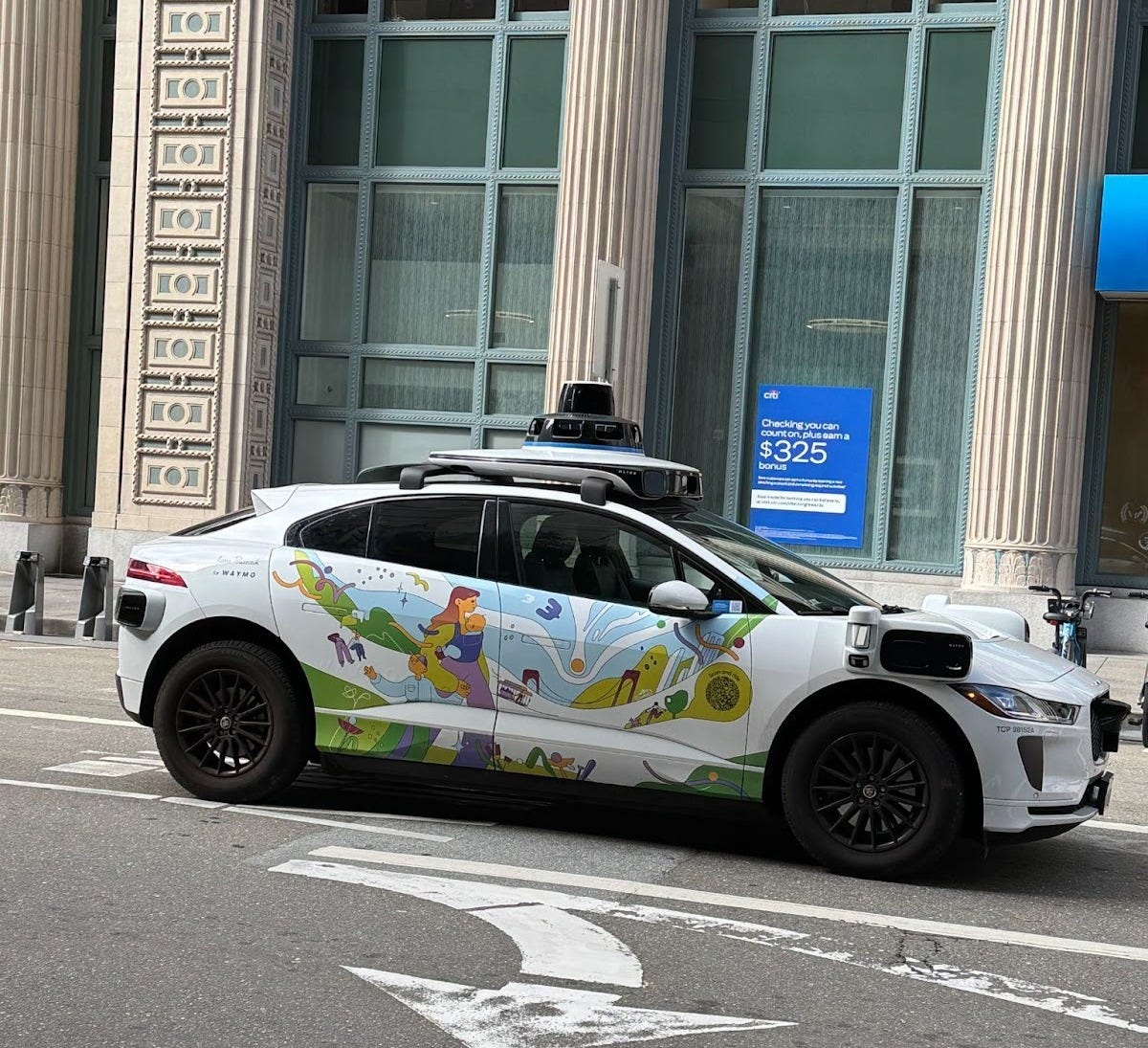
Waymo feels mature. Pickups and dropoffs are efficient and predictable, something I know they’ve worked hard on as they scaled. There’s very little ceremony required to get in and start a ride, and I don’t feel like I’m rushing to unblock traffic because the car pulls away while you’re still buckling your seatbelt. Automatic door unlock at pickup and trunk opening at dropoff make the whole experience feel effortless.
In contrast, starting a Zoox ride still feels like a rushed coordination exercise: open doors from app, buckle seatbelts, move heavy bags off seats, close doors and start ride from touchscreen. I’ve started treating it like a game…how quickly can we get moving and reduce the chance that other cars get annoyed? It gets noticeably harder with more people onboard.
Waymo nails personalization in the pickup experience. When there are multiple Waymos on the same block, it’s obvious which one is mine. I still feel a little rush when the car greets me by name and says it right, every time. I’m curious whether Zoox will eventually add more personally identifiable signage or verbal cues as their fleet grows and their thinking evolves around street-level interactions.
My friend Doug, CEO at Mystro who weighed in before about his own early rider experiences, summed up his Waymo value proposition: “Waymo is a consistent, clean, luxurious, and often solitary experience. It’s a bit like staying at an upscale hotel on a work trip.” He also pointed out how much their driving behavior has evolved since the early days, and I think that progression from overly cautious to quietly confident is exactly what scale and repetition can unlock for Zoox. Some of the differences are likely just a function of maturity, given how much longer Waymo has been operating at scale in comparison.
Tesla robotaxi: affordability and familiarity
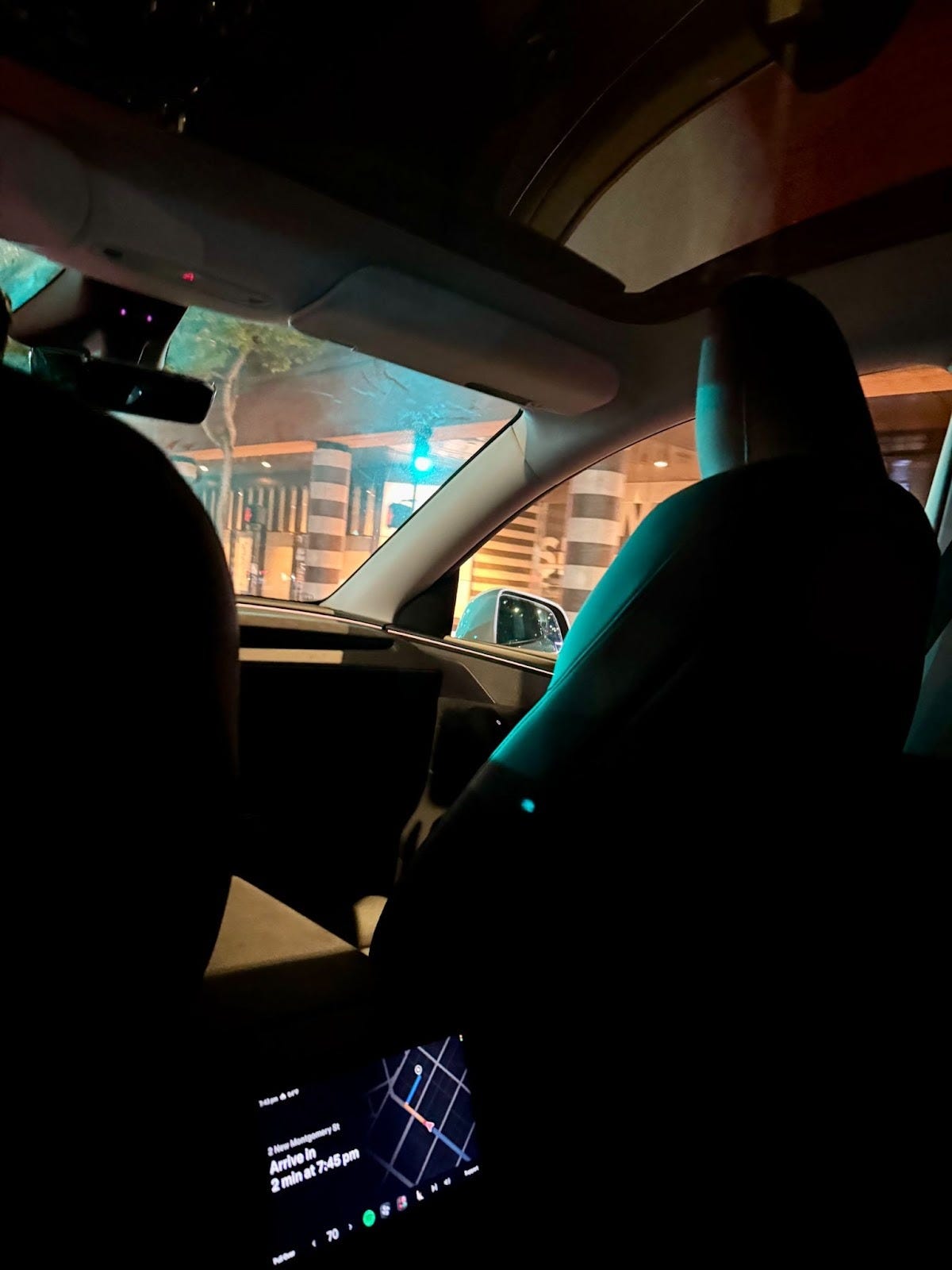
Then there’s Tesla. It’s hard to compare directly because there’s still a human safety driver in the front seat. And yet, I’ve been pleasantly and consistently surprised by how positive and seamless my experiences have been over the last 25 rides in 6 months, despite the mixed public discourse and viral clips around safety driver takeovers and edge cases in other markets. I’ve only noticed one obvious takeover, but I’m not always paying attention because I sometimes forget I’m riding what’s supposed to be an autonomous experience that actually just feels like I’m taking Uber Electric. The biggest difference is car quality - the last Tesla robotaxi I got into smelled like a brand new car.
Operationally, Tesla shines in consistency and familiarity. Pickup and dropoffs near my place are always in the exact same spot (unless demand is very high and prevents me from riding at all), which is refreshing compared to both Waymo and Zoox, when I often don’t know exactly where the car will stop or how far I’ll have to chase it down.
Spotify automatically starts playing when I get in, just like my own car, which was for a while my favorite Tesla robotaxi feature, even though I’m self-conscious about my singing and music choices in front of the driver. For me, this was a clear advantage over Waymo until they finally launched native Spotify integration after two years of yelling at Google Assistant and complaining to support when that didn’t work. Zoox’s default radio has been better than expected, but it’s still no match for my own playlists. I swear my Spotify Wrapped last year was shaped by my go-to “Waymo songs.”
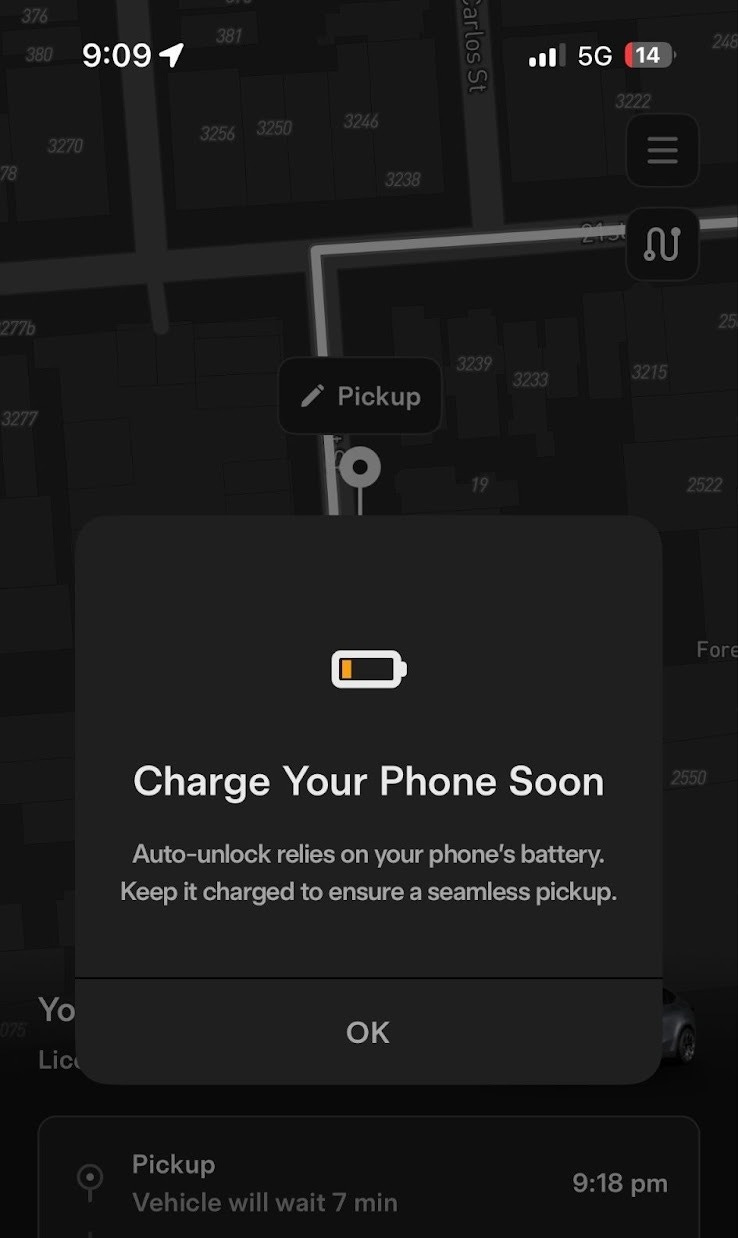
I appreciate Tesla’s robotaxi app alerts when my phone battery is low and could prevent automatic door unlock. That said, it’s still frustrating that I can’t see the trip price once I’ve booked the ride, and I can’t enter a specific pickup address in their app. Same goes for Zoox, in addition to not being able to see estimated ETA until I get in and start the ride on the screen. I’ve also noticed that Tesla’s routes around the Mission often differ from my own car’s navigation, which makes me wonder if there is similar risk-avoidance logic to Zoox’s circuitous routing.
Tesla is, for now, hands down the cheapest paid option compared to Waymo, Uber, and Lyft. With its massive service area across the Bay Area and ability to drive on highways, I treat it as the budget ride. Low prices seem to have created artificial scarcity, especially as it becomes available to more riders and their fleet scales (latest CPUC data registered 1655 Tesla robotaxis in CA). It’s gotten better, but there are still rush hour and weekend evening times when high Tesla demand and high Waymo prices force me back to human-driven rideshare. Obi’s latest report based on data collected late last year proved that Tesla is significantly cheaper than other AV options, averaging $8.17 per ride.
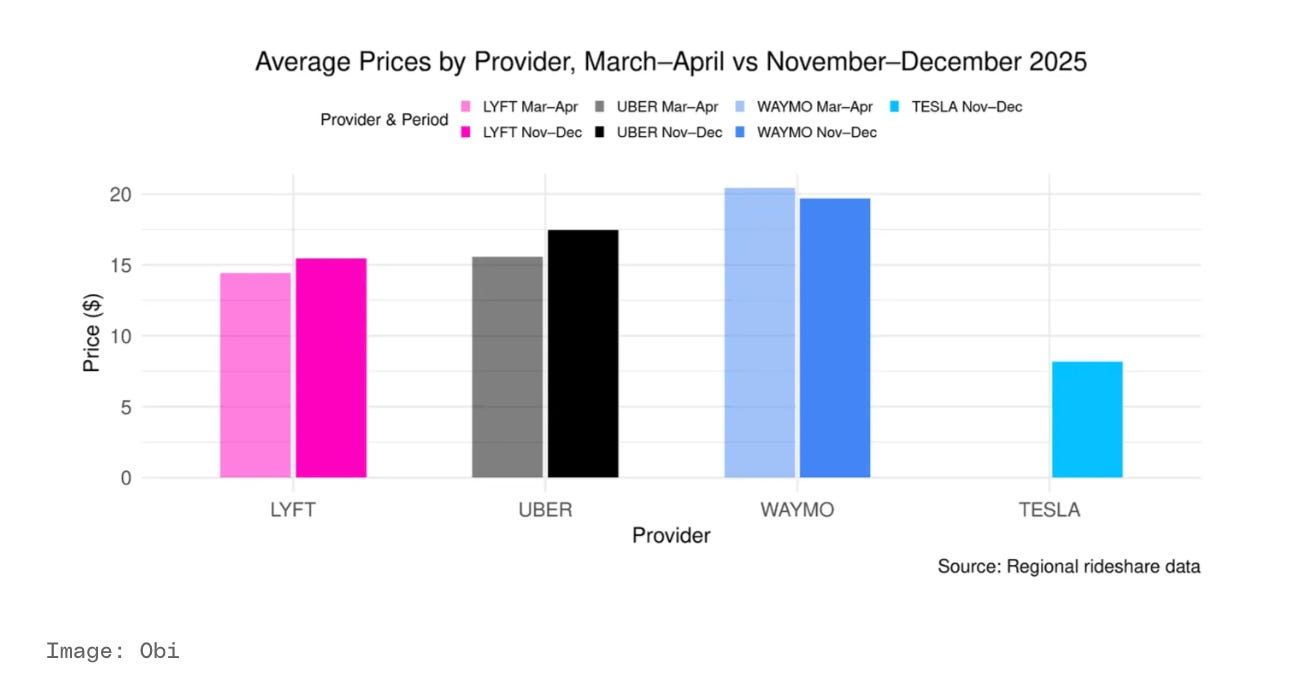
My own experience reflects this, but I’ve noticed that Tesla prices have slowly increased since September. The same 8 minute ride that used to be consistently just over $3 is now $6, which may have been an anomaly that night, but I’ve generally seen my recent rides priced around Obi’s reported average, instead of the $2-4 range I used to see in the early days.
If Waymo feels like a scaled, professional service, Tesla feels like an ambitious, fast-evolving experiment that occasionally blends into a familiar human-driven rideshare experience.
Too many options to choose from?
When it’s time to go somewhere and public transit isn’t direct or fast enough, it’s getting increasingly hard to choose how to get there. Not because there aren’t enough options, but because there are suddenly so many, each optimized for a different mood, moment, or constraint. I find myself running through a decision tree before I open an app to get home.
How I decide which ride to take
Waymo is still my ideal option. It’s consistent, entertaining, and productive. It’s the ride I can count on to be on my phone in peace, play my own music and sing without judgement, or open my laptop in a temporary mobile office…all on my terms. Doug agrees: “Waymo usually costs the most but it’s a nice luxury. It’s the most consistent experience and my choice when I feel like treating myself.”
Tesla robotaxi is my budget pick across the Bay Area. It’s familiar and predictable, and I’ll default to it when I need to get somewhere on the cheap and am willing to wait a bit.
Zoox sits in a different category entirely. Here, I index on convenience and experience, and for now, the fact that it’s free. I take Zoox when I have time, when I’m curious, when I’m willing to be patient, or when the ride itself is part of the point. Fortunately, it picks up where I live and much of my daily life overlaps nicely with its current but limited service area. It fills a nice last-mile niche for me, and I would even pay a capped fee in the future to continue riding these short distances.


Comparing to human-driven options
Of course there’s always Uber / Lyft, both extremely reliable and still the fastest option, but increasingly a last-resort backup for me. I feel a small but real sense of disappointment when I get into a random car with variable cleanliness, smells, and music, paired with the familiar internal tension: how outgoing do I feel, how much does the driver want to talk, and how rude is it if I’m on my phone the whole time?
That said, human drivers still win in specific contexts. Doug captured this nuance well: “The cautious driving means [AVs] occasionally freeze when presented with a confusing situation, which could happen at night, or in a sketchy part of town, or when I’m in a hurry. A human Uber driver can feel like a guardian in these situations.” In addition to appreciating when a driver helps me with my bag at the airport, I also enjoy the occasional spontaneous conversation with drivers, and they’ve told me they appreciate it too, because so few people willingly engage now.
What’s delightful to me is that I’m no longer choosing whether to take an autonomous ride…I’m choosing which one and why. Each option represents a distinct tradeoff profile and rider experience. That abundance of choice is new and uniquely San Francisco (for now, outside China). And it’s only going to get more interesting from here. It also echoes a broader theme from SF’s recent Urban Autonomy Summit conversations that autonomy is now a mobility system and city integration challenge.
Zooming out to how AVs fit into the urban mobility ecosystem
Being a good robotaxi citizen
Living with multiple robotaxi services daily also changes how you behave around vehicles on the street. Being an early rider has made me unexpectedly civic-minded. I find myself hustling to get into the car and start the ride quickly so it doesn’t block traffic, double-checking doors are closed before I leave, and feeling a real responsibility as an early and enthusiastic adopter to not give robot cars a bad reputation. There’s a sense that these vehicles are still on trial, not just by regulators, but by the public. Small moments of friction can potentially turn into outsized criticism or bad PR.
Feeling safer on the street, not just in the car
The more time I spend riding and obsessing over robotaxis, the safer I feel not just inside them, but around them. As a driver, pedestrian, and cyclist, I find their behavior predictable and cautious in a way that makes the street feel calmer, even if it occasionally tests my patience. One upside I didn’t fully appreciate at first is how strictly AVs follow speed limits and how that often forces human drivers to do the same.
When safety creates new friction
This is where I find myself thinking about Malcolm Gladwell’s provocation that autonomous vehicles may ultimately be too safe. His argument is that perfectly cautious vehicles can be exploited by human behavior, introducing a strange new kind of inefficiency at scale. I see glimpses of that today when pedestrians or cyclists confidently step in front of robotaxis, knowing they’ll always stop. Whether that dynamic becomes a feature or a flaw of autonomous urban mobility is still very much an open question.
When robotaxis meet city systems
The question of efficiency vs. restraint at scale showed up in a Driverless Digest conversation with Jeffrey Tumlin, former head of the San Francisco Municipal Transportation Agency (SFMTA). He framed AVs not just as a safety problem, but as a transportation system problem… one that cities have little regulatory control over today, limited access to real-time safety data, and real concerns about congestion, vehicle miles traveled, and equity. He isn’t anti-AV but raised a municipal need for more transparency, better data, and smarter regulation so AVs can improve outcomes for everyone on the street, not just the rider inside.
The invisible work behind every ride
That framing resonated. It’s a reminder that the rider experience and vehicles on the road are only the visible layer. Behind every autonomous ride is an invisible race for depot land, power access, charging throughput and uptime, and inspection/cleaning/maintenance optimization. This is the operational and still very human work that ultimately determines whether these systems can scale responsibly. As a rider, I feel those constraints indirectly through wait times and service area limitations. As a PM working in EV charging, I find myself wondering on every ride about depot optimization, charging decisions, and operational readiness. Behind the scenes, those factors matter just as much as the driving technology itself.
What choice reveals about AV maturity
In the meantime, I think the more robotaxi options we have, the better. Not because any one of them is perfect today, but because competition expands choice and forces differentiation. Getting off the Zoox waitlist has made me feel less like a customer and more like an active participant in shaping their niche, compared to Tesla’s fast-moving, cost-optimized bet on ubiquity and Waymo’s ever expanding service that is miles and markets ahead of everyone else in this robotaxi race. Each is teaching us something different about what autonomous mobility could become.
Ubiquitous autonomous choice is still years away. Zoox’s CEO Aicha Evans has even suggested it could take a decade before AVs are commonplace across most cities. Riding the betas, giving feedback, and watching these systems evolve first-hand in San Francisco makes one thing clear: autonomy is materializing in focused, iterative deployments, where each ride, route, and service area subtly recalibrates how riders think about trust, value, and choice.
- Josie-Dee
