


Over the past couple of years, we’ve had countless people message us with the same question: “How can I get hired at Waymo?”
It’s easy to understand why. Waymo is widely considered the top company in the autonomous vehicle industry. It is the largest player and clear leader in the US robotaxi race, with a proven product and the deep pockets of Alphabet behind it.
The compensation doesn’t hurt either. This Principal Software Engineer role in California, for example, lists a base salary range of $349,000 to $431,000.
None of us here at The Driverless Digest have ever worked for Waymo, but enough readers have asked us how to get through the door that we decided to dig into it.
So here’s our practical guide to landing a job at Waymo.
The Waymo Appeal
First up, beyond the salary and the name on your resume, what is the real appeal of working at Waymo?
For many candidates, it is the chance to work on problems that simply do not have an existing playbook. Waymo is trying to deploy autonomous driving at scale in the real world, which means tackling some of the hardest problems across AI, robotics, software and engineering.
There is also the opportunity to work on technology that millions of people could eventually use, while helping shape an industry that is still relatively early in its development.
How To Land An Interview
The majority of Waymo’s open roles are based in the US, where the company is headquartered in Mountain View, California. But Waymo is also hiring internationally, with roles across the UK, Poland, Japan, Taiwan and India.
So, where do you start?
Find the Right Role
The obvious place to start is Waymo’s careers page. And at the time of writing, their site lists around 345 open roles.
Linkedin can also be helpful, and at the time of writing, they list 543 Waymo job postings. The difference is likely because some Waymo roles can be based in multiple cities, and LinkedIn surfaces those as separate location-specific listings. So 543 postings doesn’t necessarily mean 543 unique jobs.
One advantage of LinkedIn is that it makes it easy to spot jobs almost as soon as they’re posted. We regularly see new Waymo openings show up within hours. And while there’s no guarantee that applying early gives you an advantage, with popular roles attracting a lot of interest quickly, it certainly can’t hurt.
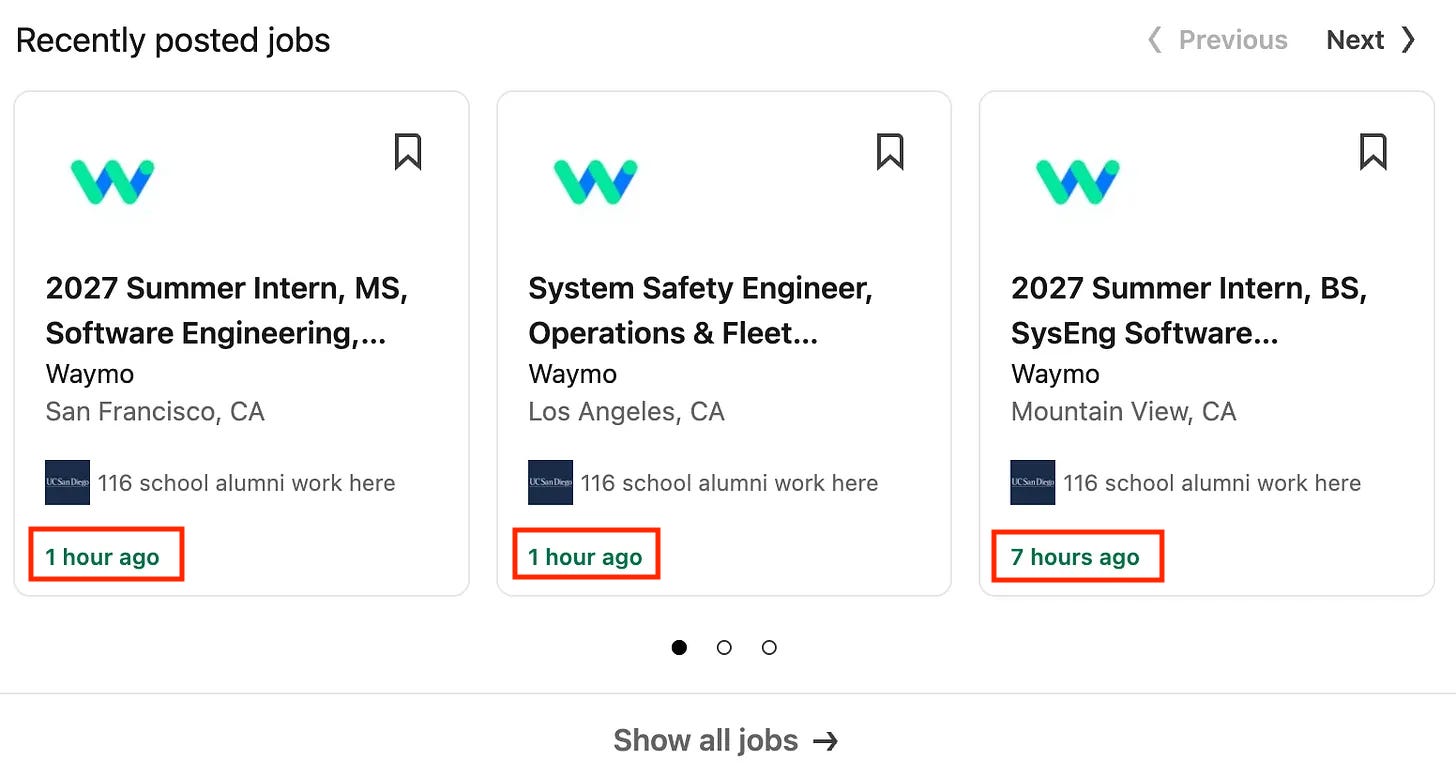
Linkedin also allows you to set up a Waymo job alert so you’re notified when new roles go live.

Pay attention to what Waymo employees and hiring managers are posting on Linkedin, too. This can help you identify not just open roles, but the people building out particular teams and the areas where Waymo is actively hiring.
And since we’re talking about finding jobs, a quick plug for ourselves: every Friday we run Neat Jobs in The Driverless Digest, where we highlight interesting openings across the AV industry, including plenty from Waymo.
Here’s a short list of recent and interesting Waymo roles we’ve spotted, directly from hiring managers and team leads:
2027 Summer Intern, MS/PhD, Data Science - Commercialization Testing at Waymo (link) via Sophia Valdez.
EMobility Deployment Lead at Waymo (link) via Sara Tanner.
Product Manager, Driving Performance Expansion at Waymo (link) via Jacopo Sannazzaro.
Multiple Strategic Partnerships roles at Waymo, via Jimmy Lyons.
Staff Tech Lead Manager at Waymo (link) via Claire Yan.
Staff Product Data Scientist, Paid Media at Waymo (link) via Hongying Z.
UK Operations Lead at Waymo (link) via Leticia Cavalcante.
System Disruption Manager at Waymo (link) via Jackie Lindsey.
Apply Online
Yes, once you’ve found a role (or multiple roles), the boring answer still matters: apply through Waymo’s careers page.
But recognize what you’re up against. Waymo doesn’t disclose how many applications it receives, but many of its LinkedIn job postings rack up hundreds of people clicking to apply within days, and sometimes within hours. So while you should absolutely apply online, your odds of standing out through the application alone are probably not great.

Make sure your resume is tailored to the specific role rather than firing off the same application to a dozen openings. If the job description emphasizes a particular technical skill, project or type of experience, make it easy for the recruiter to see where you’ve done that work.
And applying online gives you something specific to work with when you start reaching out to people at Waymo.
That’s where the rest of this guide comes in. If you really want to improve your chances, you probably need to do more than hit “Apply” and hope for the best.
Networking
This one is obvious, but it works. A lot of potential candidates like to aim high and ask the CEO or other prominent executives for help or advice on getting hired, but they are often flooded with requests.
Instead, look for product managers, engineers and others working in the area you’re targeting and see if you have a genuine connection. Maybe you went to the same college, worked at the same company, grew up in the same hometown or have a mutual connection. It would be hard for me to turn down a college or high school alumni if they made a reasonable request or ask of my time.
And remember, networking doesn’t have to mean immediately asking someone for a referral. Sometimes the better approach is simply learning more about their team, what they work on and what Waymo looks for in candidates more broadly.
Get Yourself Into the Room
Another way to meet people from Waymo is to go where the autonomous driving, robotics and mobility industries gather in person. This is obviously a lot more work but because of the high barrier to entry, not many people do it. So I think it’s a great way to stand out.
Keep an eye out for conferences, trade shows, technical events and local meetups where Waymo employees might be speaking, exhibiting or attending.
A few events worth considering:
CES: one of the world’s biggest tech events, with a huge automotive and mobility presence. Waymo exhibited at CES 2026, so it’s one to watch if you want to meet the company in person.
CVPR: particularly relevant if you work in computer vision, perception or machine learning. It’s a good place to meet researchers and engineers working on the technical building blocks of autonomy.
ATS: Our own Harry Campbell spoke at this event last year and told me, “I’ve never met or seen so many Waymo people in one room before”.
Actuate, Long Horizon and TechCrunch Disrupt all take place in San Francisco, the first two focus on physical AI while Disrupt covers the wider tech ecosystem.
Our Urban Autonomy Summits are also worth looking into, as you’re likely to bump into at least a few people from Waymo.
The next Summit is in Austin on October 14, so apply now to secure your spot before registration fills up! (link).
Local robotics and autonomy meetups: don’t overlook the smaller stuff. A 50-person technical meetup can actually be more useful for networking than a 20,000-person trade show because you have a much better chance of having a proper conversation.
Mobility expert Barak Sas has also put together a handy little guide to the biggest mobility events each year.
Essentially, pick the events that line up with the type of role you want. If you’re a computer vision engineer, CVPR makes more sense than a general mobility conference. If you’re interested in autonomy operations or mobility policy, an event like ITS World Congress could be more useful.
Wow Waymo With A Project
Finally, there is perhaps the most ambitious option: build something that gets noticed.
This could be a product, research project, piece of content, open-source tool or anything else that demonstrates what you are capable of. It is way more work than sending in a resume but it can also make you much harder to ignore.
Our friend Jackson Lester is a good example. Before joining Waymo, he built AV Map, which tracks autonomous vehicle deployments around the world. He also made a few great contributions to The Driverless Digest - such as the 15 Charts That Explain The Autonomous Vehicle Industry and his piece I Lost My Wallet in a Waymo...and Tracked It All Night - which we like to think helped a little (if you’re interested in contributing an article to TDD, feel free to reach out).
Ethan McKanna is another interesting example. He built Robotaxi Tracker and later landed an internship at Tesla.
In other words, don’t just tell Waymo you’re interested in autonomy. Show them.
The Hiring Process
The process starts with a review of your resume by Waymo’s recruiting team. If your experience matches what they are looking for, you will have an initial conversation with either a recruiter or a sourcer. This first call is also your chance to ask about the role, the timeline and what comes next.
From there, things get a little more serious. Candidates move on to one or two behavioral or technical interviews, either over the phone or by video, with a potential manager or colleague. Expect questions around your knowledge of the role, as well as behavioral, hypothetical and case-based questions.
If you make it through that stage, you’ll be invited to a virtual onsite. This means meeting with up to five interviewers, including potential teammates and people from other teams you would work with. Each session is expected to last around 45 minutes.
At this point, if Waymo decides you are the right person for the job, your recruiter will make the offer. Once you accept, the recruiting team will take you through your compensation, benefits and everything you need to know to get started.
There is one particularly important point for anyone applying to Waymo right now. The company says technical assessments and coding challenges must be completed independently unless the instructions specifically say otherwise. AI tools and LLMs are not permitted during live interviews either. You can use AI to polish the grammar or clarity of your resume, but the application itself needs to represent your own work and professional history.
Interview Tips and Tidbits
Waymo is pretty open about what it wants to see from candidates, and its interview tips give a useful idea of how to approach the process.
Ask clarifying questions
Waymo asks open-ended questions to understand how you approach and solve problems. If a question is deliberately broad, do not jump straight into an answer. Ask clarifying questions first to make sure you understand the problem and avoid making incorrect assumptions.
Define the problem
Before explaining the solution, take a moment to define and frame the problem as you see it. If it is a big one, break it down into smaller pieces and work through them logically.
Show your thinking
Waymo says it is not looking for perfect answers. Talk through your thought process and show how you use data to make decisions.
Connect the dots
When talking about past experience, Waymo says to pick examples that show how you have dealt with “ambiguity, complexity and prioritization”. These experiences can help showcase your ability to thrive in its working environment.
The overall message is pretty simple. Waymo wants to see how you think, not just what you know. Ask questions, frame the problem, explain your reasoning and show how you have handled complexity in the past.
An Anonymous Engineer’s Perspective
We recently spoke with an anonymous AI and machine learning engineer who gave us a rare candidate’s perspective on the interview process at Waymo.
He explains the types of questions candidates can expect. “Most of the questions that I always got asked were like an open book solution. So there’s no right or wrong solution. It’s just how you present it and how you think about it.”
He describes one of the questions as “literally so unheard of”, saying it felt less like a test of technical knowledge and more like a test of ingenuity. The question asked how he would design a system so that, no matter how many cars Waymo added to a particular location, it would still have immediate observability and statistics on what was happening. Any takers?
He also advises candidates to: “Ask questions as you might be thinking something, but the interviewer might have something else on their mind, so it’s about having to and fro, asking clarifying questions, narrowing the problem down and setting realistic constraints.”
In general, this engineer told us, Waymo wants candidates to be “very, very specific. They don’t like abstract ideas.”
Other Resources/Ideas
/Waymo
Reddit is another useful place to dig into firsthand experiences from Waymo candidates and employees. There are plenty of threads covering the application process, recruiter screens, technical interviews, interview questions and what candidates wish they had known beforehand.
A few worth checking out:
What to expect for an upcoming interview for Waymo Business Intelligence Analyst Role
Waymo BI Analyst Final Loop – Recruiter Not Responding, Is This Normal?
Just keep in mind that these are individual experiences, and Waymo’s process can vary significantly depending on the role and team.
Work your way up
If you can’t get into Waymo today, another option is to build relevant experience elsewhere in the autonomous vehicle industry first.
That could mean joining another AV developer like Zoox, Wayve or Avride, but it could also mean working at a fleet operator like Moove, an autonomy supplier like NVIDIA, simulation company, OEM, mapping company or one of the many startups supporting AV deployment.
Even a year or two working directly in the industry can make a big difference. You’ll understand the terminology, the technical and operational challenges, how AV deployments actually work and, just as importantly, you’ll start building relationships with people across the industry.
When you apply to Waymo again, “I want to work in autonomous vehicles” is one thing. Being able to point to actual experience helping deploy, operate or build them is a much stronger story.
Best of luck with the application, and happy job hunting! And if you do end up getting hired, please reach out and let us know.
One point here generalizes to a lot of senior interviews: strong candidates often rush to solve the question, while strong interviewers are also watching how they define it. Clarifying assumptions, structuring the problem and explaining trade-offs can be more revealing than landing on a ‘perfect’ answer. The interview starts before the solution.