

This week’s edition is brought to you by Rocsys – global leader in hands-free charging and fleet service solutions for electric and autonomous fleets.
Top Stories of the Week

Waymo introduces $30-a-month premium tier for riders who want faster pickups (link, no paywall).
Riders will receive a number of perks, including priority pickups, 10 percent cash back on every trip, early robotaxi access in new cities, and up to five free cancellations a month. Waymo Premier will be initially offered to select riders in San Francisco, Los Angeles, and Phoenix.
I like it. Priority pickup will probably be the biggest benefit for riders. And on the business side, this is a smart way to segment customers. Waymo has fewer levers than Uber or Lyft to manage supply and demand, since it can’t just use driver incentives to bring more cars onto the road during peak demand times. So it makes sense to prioritize your most loyal riders while creating a new recurring revenue stream in the process.
Urban Autonomy Summit
We had a great turnout at the Detroit edition of our Urban Autonomy Summit, presented by Nexar, with over 200 attendees! It was exciting to bring the event to the cradle of the U.S. auto industry and connect with so many people shaping the future of mobility and autonomy. Big thanks to all the TDD readers who attended, and to our partners at Terawatt, TaskUs, Rocsys, and Voltera for helping make it happen.


We're heading to Austin next (link) on October 14, followed by San Francisco on January 27, 2027. Reach out if you’d like to get involved as a partner. Spots are filling up fast!
Other Stuff
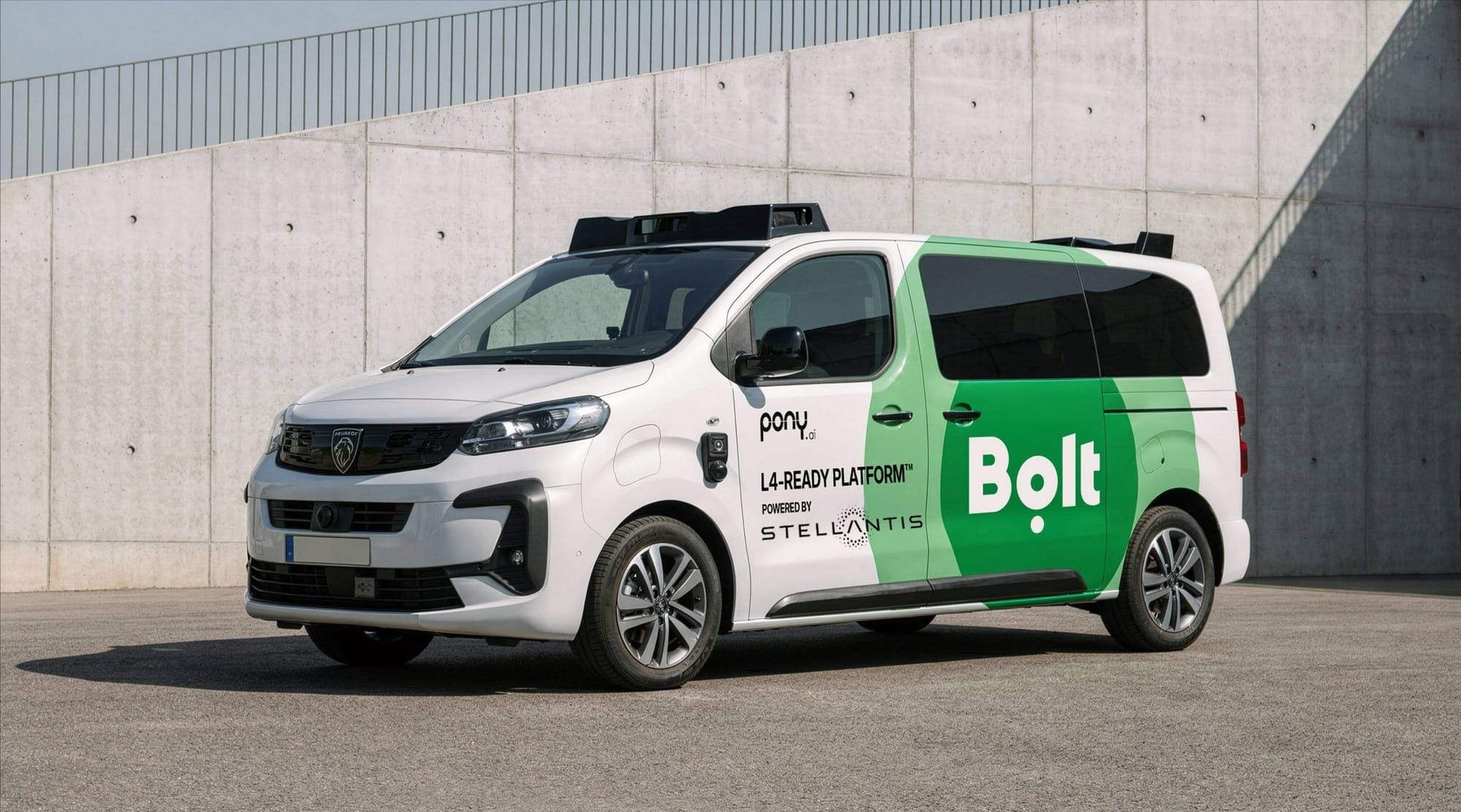
Bolt, Stellantis, Pony.ai to launch autonomous vehicle test program in Luxembourg (link, no paywall).
Their pilot program will focus on validating the safety, performance and regulatory readiness of Pony.ai’s autonomous vehicles in Luxembourg’s traffic environment, the companies said. Stellantis will contribute a mid-size van based on its L4-Ready platform, they added
Maybe I’m becoming harder to impress, but it’s difficult to get too excited about another AV pilot with a safety driver behind the wheel. Europe has no shortage of autonomous vehicle announcements, pilots, and demonstrations, but the question I keep coming back to is: where are the driverless rides?
And to be clear, this isn’t a knock on Pony.ai’s technology. We already know Pony can operate driverless services in China. The more interesting question is what Europe needs to do from a regulatory and operational standpoint to move beyond safety-driver pilots and toward actual driverless deployments.
At this point, I’m almost more impressed by companies like Bliq pursuing an advanced L2/L3 approach with remote supervision and no one behind the wheel than an “L4” pilot that still relies on a safety driver. If a human is sitting there ready to take over, it’s hard to know how autonomous the system really is. The real milestone isn’t launching another pilot. It’s removing the driver.
Related: Europe’s First Driverless Vehicle Approval with Bliq CEO Julian Glaab (link).
‘Europe does not have an AV pilot problem. Europe has an AV commercialization problem’ (link).
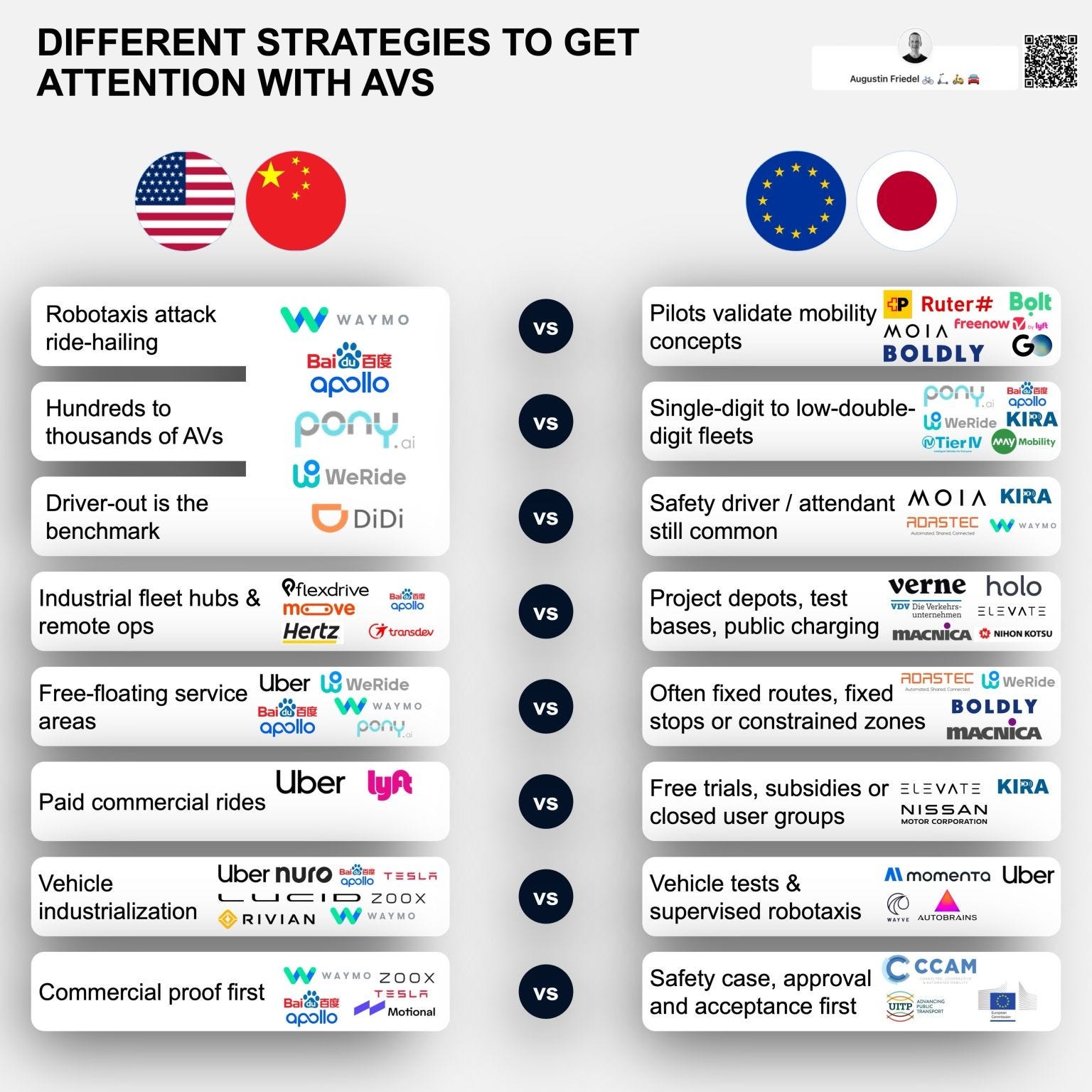
Lyft Flexdrive CEO, John Parks: Big milestone for the Flexdrive team this week as our staff has fully taken over day-to-day fleet operations for Waymo out of their temporary depot in Nashville (link).
Terawatt’s energy mission (link).
Pittsburgh firm wants parking fees for driverless cars (link). Interesting piece on Meter Feeder that mentions our coverage of Waymo’s snooze fee feature. Chime in on the discussion here.
Welcome to the Waymo World Cup (link, no paywall).
Match attendees can catch driverless rides to six of the 16 North American venues: stadiums in Atlanta, Houston, Los Angeles, Miami, and the San Francisco Bay Area.
Uber Opens London Waitlist for Wayve Robotaxis Ahead of Launch (link, no paywall).
Customers in the UK can join an “interest list” in the Uber app starting Monday to indicate their preference and increase their chances of being matched with a Wayve robotaxi when the service begins, Uber said in a statement. The ride-hailing company didn’t disclose a timeline for the launch.
Another European robotaxi pilot with safety drivers. But to Wayve’s credit, they’re at least pursuing a mapless approach, which gives them a compelling scalability story. If Wayve can prove its technology works across cities without extensive mapping, expanding into new markets could be much faster and less capital intensive than traditional robotaxi approaches. The real challenge, though, isn’t launching a pilot. It’s removing the safety driver and scaling commercially.
Streamlining Charging Operations, Hands-Free and At Scale

We are excited to have Rocsys, the global leader in hands-free charging solutions, as the sponsor this month. Rocsys enables robotaxi fleets to maximize uptime and throughout by delivering consistent, predictable performance that allows vehicles to charge seamlessly, reliably, and safely as soon as they return to the depot. To learn more, contact Erin Galiger, Rocsys Director of North American Markets, at egaliger@rocsys.com.
Motional: Cracking the Long-Tail Code in Autonomous Driving with nuReasoning (link).
‘The future of ride-hailing in Southeast Asia will not be fully autonomous’ (link).
‘Letters: These riders can’t use Waymo’s driverless cars and are treated like second-class customers’ (link, no paywall).
Waymo’s lack of wheelchair accessibility has generated criticism from some disability advocates, but I think the issue is more nuanced than it’s often portrayed.
Uber and Lyft drivers are notorious for issues with riders traveling with service animals, so Waymo has arguably improved accessibility for many riders. And the company’s new Zeekr-based vehicle includes accessibility features like braille labels and audio guidance.
But Waymo still doesn’t have a great solution for riders who rely on wheelchairs and cannot transfer into a standard vehicle on their own. Today, those riders are generally directed to a human-operated wheelchair-accessible vehicle service rather than an autonomous vehicle, which makes sense since the whole point of Waymo is that there is no driver.
At the same time, the technology to support wheelchair users isn’t new. All licensed London black cabs are wheelchair accessible, demonstrating that accessible vehicle fleets can work at scale. The bigger question is whether accessibility should be built into the first generation of the Ojai or whether it’s reasonable to expect companies like Waymo to address it in future vehicle platforms. Personally, I’m sympathetic to both sides. Ojai is still an early product, but if robotaxis are going to become a meaningful part of the transportation system, wheelchair accessibility can’t remain an afterthought forever, especially since Waymo has rightly made accessibility and mobility independence a core part of its broader mission and messaging.
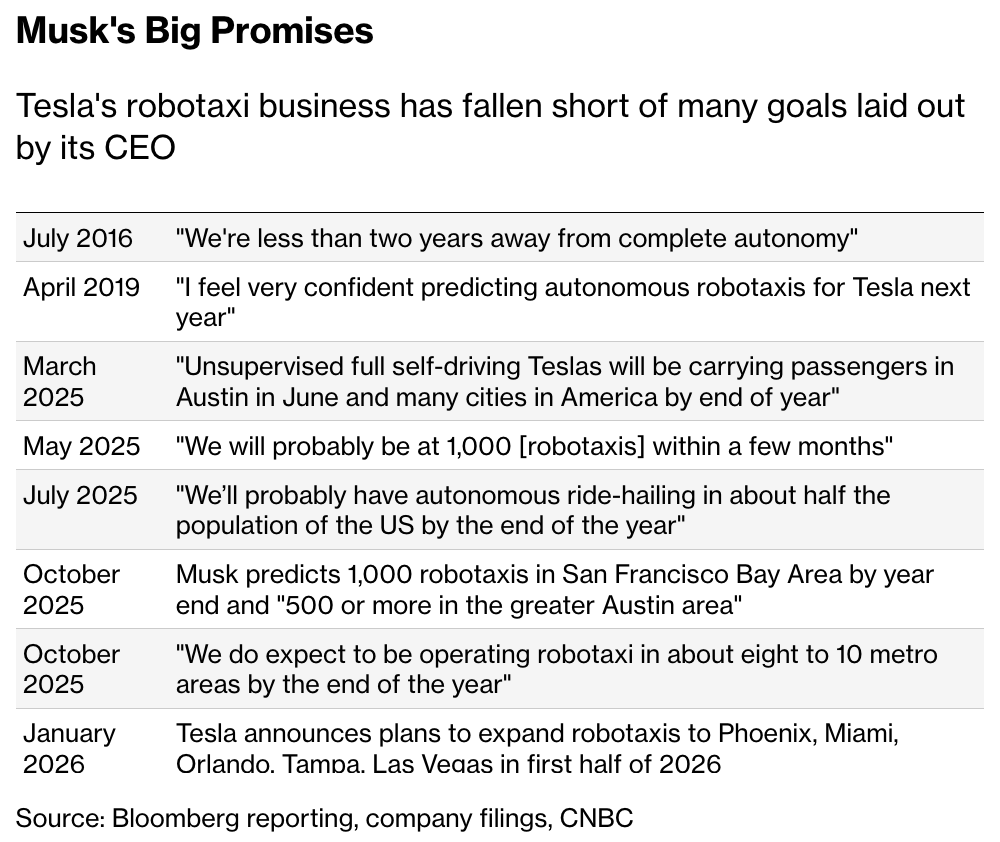
Tesla’s Robotaxi Falls Short With Long Waits and Stalled Rides (link, no paywall).
Almost a year later, Tesla has just 59 vehicles in its entire robotaxi fleet as of Tuesday, limited to three Texas cities.
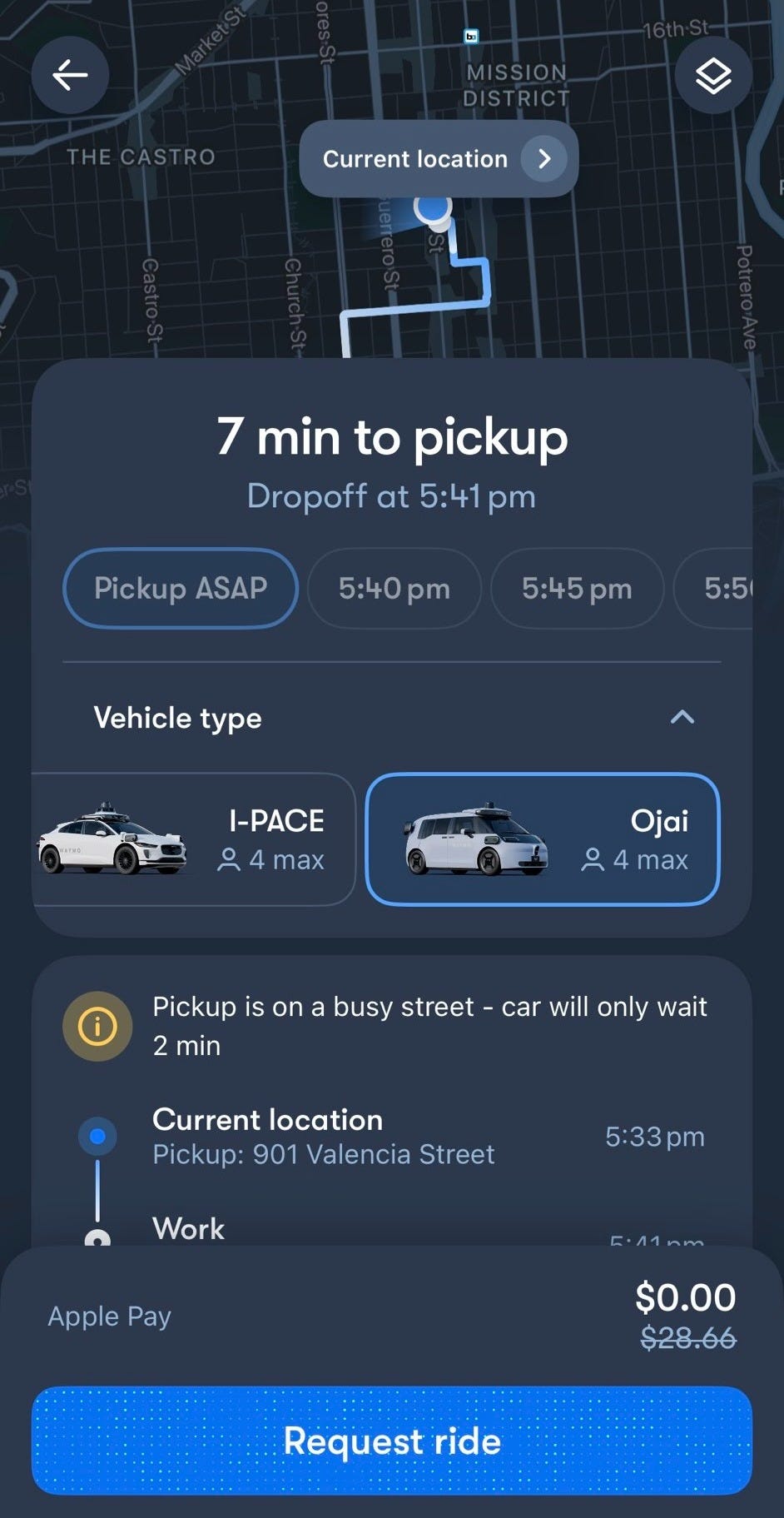
Ojai is live! (link). I think it’s interesting that the Ojai and the I-PACE are two separate options on the Waymo app even though they both hold four passengers. The downside of this setup is that you’re effectively bifurcating the fleet, which could lead to longer ETAs since Waymo now has to match riders with a specific vehicle type instead of drawing from a single pooled fleet.
‘Nuro test vehicle in SF.’ (link).
Waymo bought Apple’s self-driving car proving ground for $220M (link). The sale was recorded in June 5, and the massive 5,500-acre proving ground includes a 115-acre city course, a 35-acre vehicle dynamics area, a four-mile oval track, and a freeway course purpose-built for autonomous vehicle testing.
PepsiCo and Gatik Announce Multi-Year Agreement to Deploy Autonomous Freight in North America (link).
Waymo says it built a better benchmark for comparing robotaxis to humans (link).
The biggest difference between this new model — which Waymo calls the Reference Driver — and its predecessor is that it is able to reproduce a human driver’s behavior in the run-up to a crash. Previously, Waymo’s models (and other industry models) focused on replicating “last-second, reactive” human maneuvers, according to the company.
Exclusive-Uber’s Commitment to Self-Driving Startup Nuro Is Close to $500 Million, Sources Say (link).
Waymo Readies First National Ads as Rivals and Critics Proliferate (link, no paywall). I liked the ad.
Autonomous vehicles were supposed to cut traffic—what if they don’t? (link). Not sure I agree with the title (I certainly never thought that) but the ‘paper’ the article is about seems to echo an article we wrote on TDD last year (link).
A similar analysis conducted late last year on Waymo’s CPUC data from January 2024 through September 2025 by Matthew Raifman, who studies policy and autonomous vehicles at UC Berkeley, also found that 44 percent of Waymo’s miles were driven with empty vehicles and that two-thirds of those empty miles were robotaxis driving around waiting to be assigned a customer... In total, about 40 percent of the miles traveled by a Lyft or Uber driver are deadhead miles, suggesting there’s little difference in congestion whether there’s a human behind the wheel or not.
Lockton and Nexar Introduce Human-Benchmark Framework for Autonomous Vehicle Safety (link).
‘When we talk about autonomy, everyone looks at the vehicle, but the real work is in the support layer. You can’t have a fleet without a foundation that’s ready to handle the day-to-day grind of thousands of units (link)’ via Nick Allen at TaskUs.
What else we’re reading/listening to
Autonocast by Alex Roy, Ed Niedermeyer, and Kirsten Korosec: #365: How To Insure Autonomous Vehicles w/ Steve Miller of Hub International (link).
Europe’s First Driverless Vehicle Approval with Bliq CEO Julian Glaab (link). Our latest podcast where we discussed Bliq’s transition from ride hailing to autonomous vehicles, why the company is betting on privately owned AVs, and what Europe’s evolving regulatory landscape means for the future of autonomy, among other things.
Autonomy Insiders by Daniel Abreu Marques, with William Riggs: What Waymo’s Data Reveals About Who Actually Rides Robotaxis (link).
AVs/Humans behaving badly
‘I schedule a Waymo for 4:15, it arrives at 4:09 and is leaving 2 mins before the scheduled arrival time? And then they charge me for being on time??’ (link). This is a poor pickup experience and an easy way to damage the brand. Scheduled rides are often reserved for high-stakes trips like airport runs and important meetings, which is why riders pay a premium and expect the vehicle to arrive early and to wait. Having a Waymo show up ahead of schedule, wait just two minutes, and leave before the actual pickup time is a big miss. If the issue was that it was stopped in a bike lane, the car could have circled the block and returned closer to the scheduled time. It feels like a relatively easy fix, and it’ll be interesting to see how quickly Waymo addresses it.
‘Waymo decides to drive on the wrong side of the road’ (link).
‘It is insanity’: SF luxury condo owners fume over aggravating neighbors - They’re Waymos (link, no paywall).
AVs/Human behaving “goodly” :)
‘A good example of predictive AI from the Waymo Driver: in a split second, it predicted an initial crash of human-driven cars in the next lane, anticipated a secondary collision, and proactively shifted lanes — all while managing its distance from the vehicles around it’ (link).
‘When riding in the Ojai for the first time it plays an updated welcome video showing how to manually open the doors in case of an emergency’ (link).
May Mobility: Nagoya’s streets don’t leave much room for hesitation. Tight streets are exactly where reasoning in real time earns its keep (link).
Shout-outs
Big thanks to TDD readers at Zag Daily for referring new subscribers. If there’s someone you think would enjoy TDD, feel free to forward this email or use the referral button below, and we’ll make sure to shout out your company.
Neat Jobs
Fleet Operations and Field Engineering Lead at Wayve (link) via Ken M.
Vehicle Recovery, Safety, & Logistics - EAST at Waymo (link) via Luke Gunderson.
Job Moves
Jillian Noël: Piva Capital -> Terawatt (link).
Adam Warner: EverDriven -> TaskUs (link).
Leticia Cavalcante: Waymo (link).
We’re now at 11,000+ subscribers! Interested in advertising with TDD? Check out our media kit here and reach out to us. Newsletter spots are currently sold out until September.
Until next week :)
-Harry