

This week’s podcast is brought to you by Terawatt – purpose-built charging for autonomous vehicle fleets.
Listen to this episode on Apple Podcasts, YouTube, Spotify, and Substack. We now have transcripts available too (Click on the “transcripts” button in the top right corner of this post to access them).
In today’s episode, I’m speaking with Dr. Matthew Raifman, Research Lead for policy and automated vehicles at UC Berkeley’s SafeTREC Center, who has researched on the safety and societal impacts of automated vehicles. We dive into Matt’s work at SafeTREC and how the group collaborates with state agencies and funding bodies on transportation safety and policy. We discuss what drew Matt to the California Public Utilities Commission (CPUC) data from Waymo that he recently analyzed in The Driverless Digest, and whether cities and autonomous vehicle companies are truly aligned in their goals.
We unpack the current state of AV data reporting, including how vehicle miles traveled (VMT) are defined across different periods for rideshare and autonomous vehicles, what trends are beginning to emerge, and where there may be opportunities for better alignment between cities and AV operators. Matt explains the concept of deadheading in both AV and human-driven rideshare fleets, methods for reducing it, and why distinctions like P1 versus P2 VMT periods matter—both for cities trying to manage congestion and for AV companies optimizing their operations.
We also explore the environmental implications of autonomous vehicles, what CPUC data reveals about Waymo’s time between trips and passenger wait times, and the open question of whether AVs should idle or drive around between trips. Drawing lessons from early rideshare pick-up and drop-off zones, we discuss potential approaches to reducing congestion as AV fleets scale, examine the limitations of currently available AV data, and the key questions that remain unanswered.
Chapters
(00:00) Introduction to Dr. Matthew Raifman
(02:15) Matt’s work at UC Berkeley’s SafeTrec Center
(03:17) How does SafeTrec collaborate with state agencies and funding bodies?
(04:41) What got Matt interested in the Waymo California Public Utilities Commission (CPUC) data he wrote about in TDD?
(7:00) Do cities and AV companies have aligned goals?
(09:20) The current state of AV data reporting
(11:00) Definitions of Vehicle Miles Travelled (VMT) periods for rideshare and AVs
(12:30) Trends in the (VMT) periods, and synergies between AV companies and cities
(16:20) AV vs human driven rideshare deadheading, methods of reducing it
(20:45) The P1 vs P2 VMT periods theory, and benefits of P1 to AV companies
(27:35) How AVs impact the environment
(29:30) Matt’s post in TDD, and what it says about Waymo’s time between trips, and waiting time
(34:40) Should AVs stop or drive around between trips?
(38:44) Lessons from pick-up and drop-off zones in early rideshare, and potential solutions to congestion
(45:00) The limitations of the currently available AV data, and some questions that still remain unanswered.
(43:39) Conclusion and final thoughts
Designing Charging Hubs for Autonomous Fleets
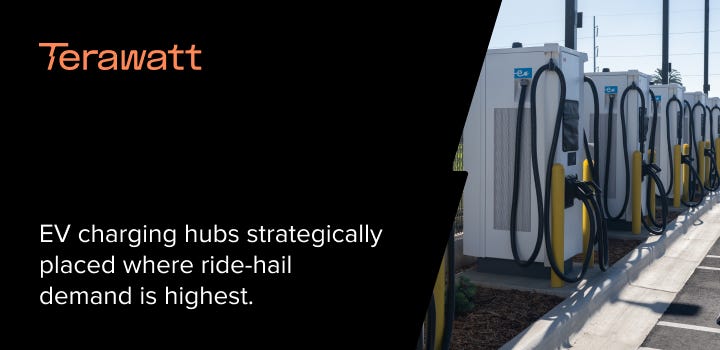
We are excited to partner with Terawatt, one of the leading providers of charging infrastructure. To learn more about Terawatt’s network of AV charging hubs and track record of 99%+ uptime, reach out to Logan Szidik at lszidik@terawattinfrastructure.com
Notes/Links:
The views expressed by Dr. Matthew Raifman in this episode are his own, and do not reflect the views of the Regents of the University of California or UC Berkeley.
Link to Matt’s article on The Driverless Digest about Waymo’s time between trips, mentioned at the 29:30 timestamp (link).
Link to Matt’s Linkedin post/chart on Waymo’s deadheading, mentioned at the 21:14 timestamp (link).
Link to my Waymo deadheading article, mentioned at the 49:45 timestamp (link).
SafeTREC at UC Berkeley, where you can find Matt’s articles and other ones from his colleagues (link).
-Harry


