

Top Story of the Week
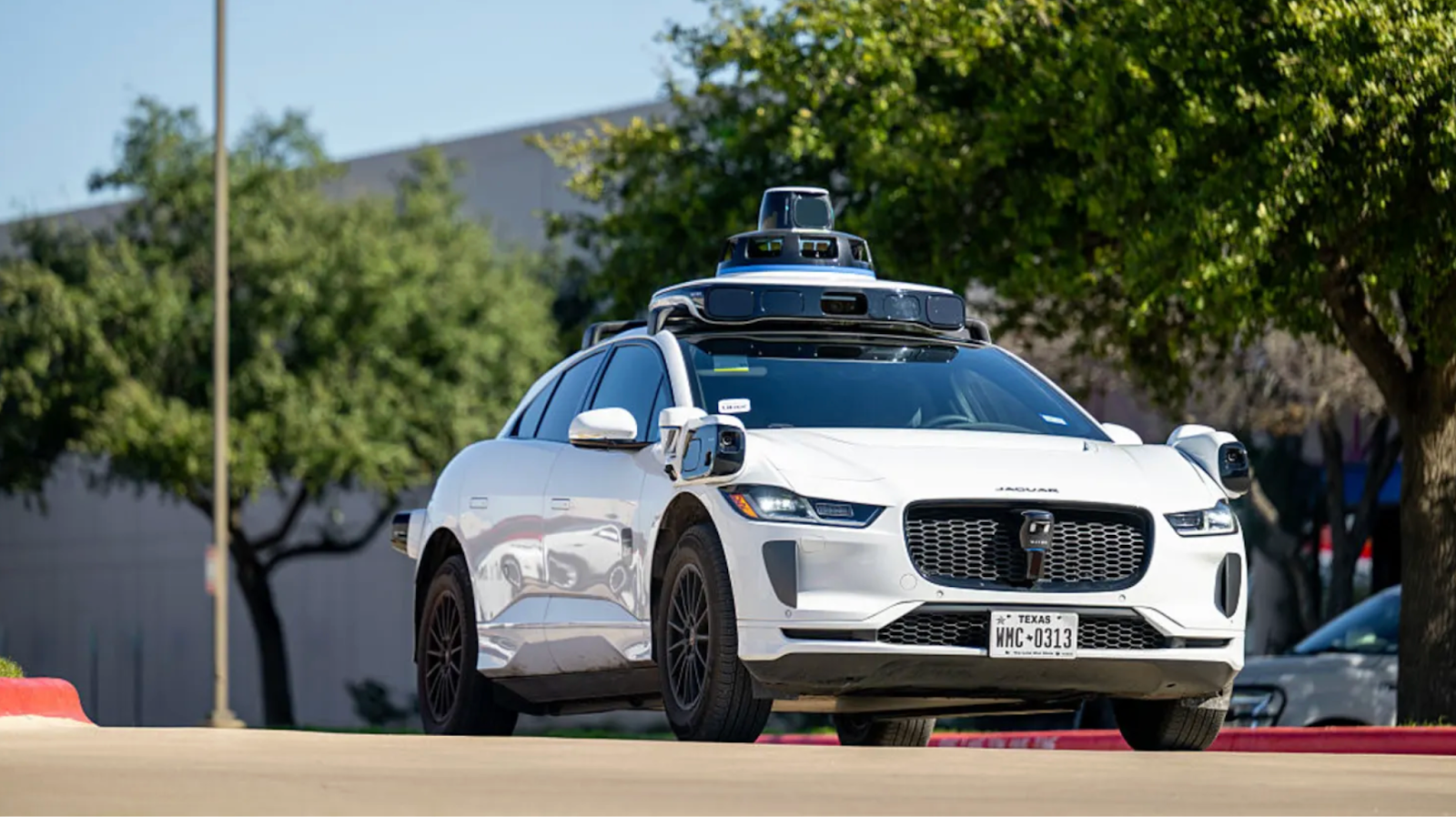
Waymo announces $16 billion funding round. This round values the company at $126 billion — more than double its 2024 valuation of $45 billion, and brings their total external funding to $27.1 billion. Alphabet led the raise once again, with a $13 billion contribution, according to exclusive reporting by Bloomberg (link), joined by returning investors like Andreessen Horowitz, Fidelity, Perry Creek, Silver Lake, Tiger Global, and T. Rowe Price. The round also brought in some new names, including Dragoneer Investment Group, DST Global, Sequoia Capital, Kleiner Perkins, and Alphabet’s own venture arm, GV.
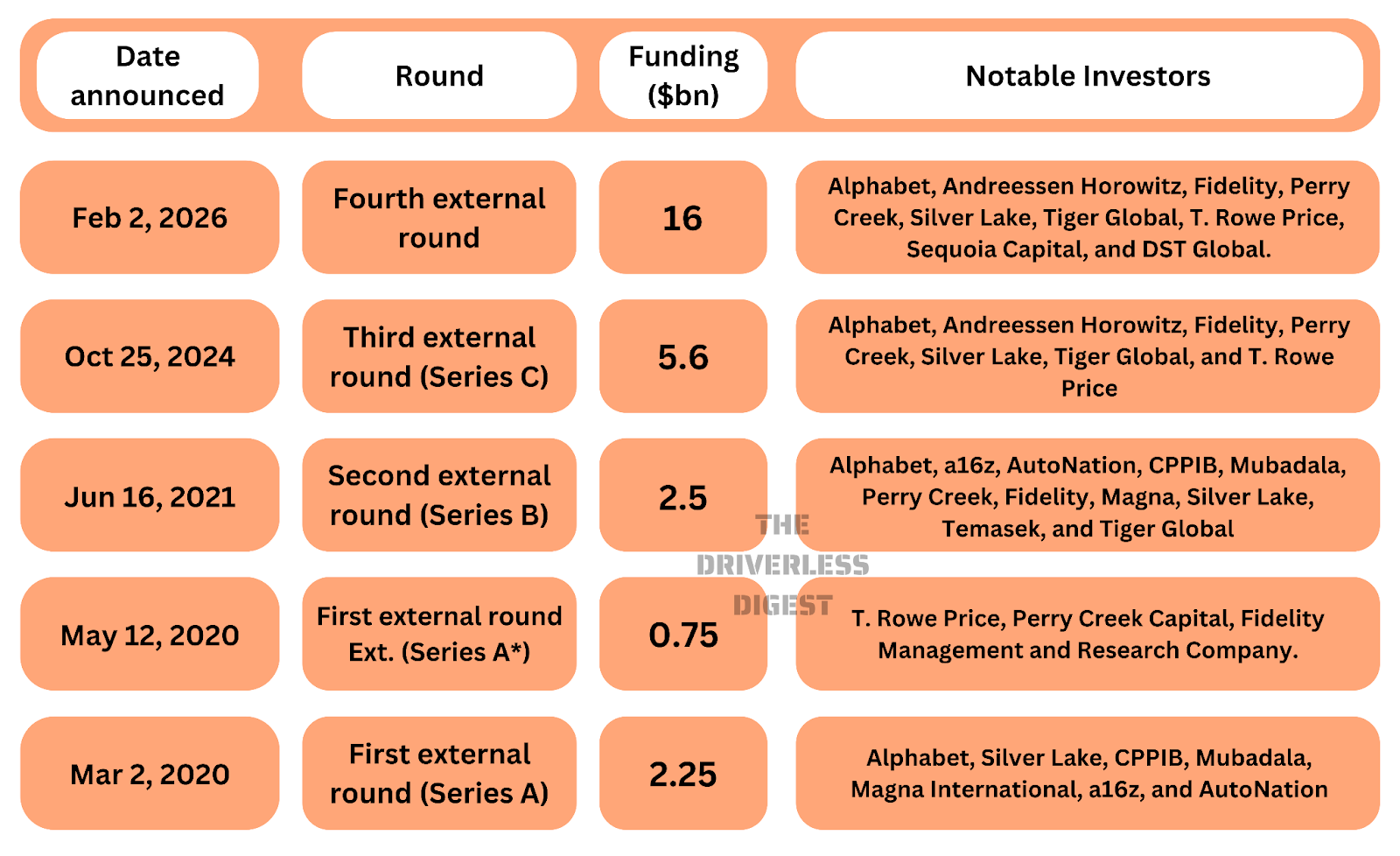
Related: a16z GP David George on 20VC: “We were the only VC fund that invested in Waymo in early 2020 (link).
Other Stuff
Uber Q4 2025 Earnings Call Transcript (link). Uber reported strong momentum across the business. Gross bookings were up 22% year over year, marking the fifth straight year of annual growth above 20%. Monthly Active Platform Consumers topped 202 million, with growth accelerating from 14% at the start of the year to 18% by the end of 2025.
Uber dedicated a significant portion of the call to AVs though. CEO Dara Khosrowshahi said AV trips per vehicle per day are roughly 30 percent higher on Uber’s platform compared to standalone AV deployments, and that Uber expects AV operations to be live in 15 cities by year end. He also pushed back on the idea that AV growth will be zero sum, arguing instead that AVs add supply and help expand the overall ridesharing market.
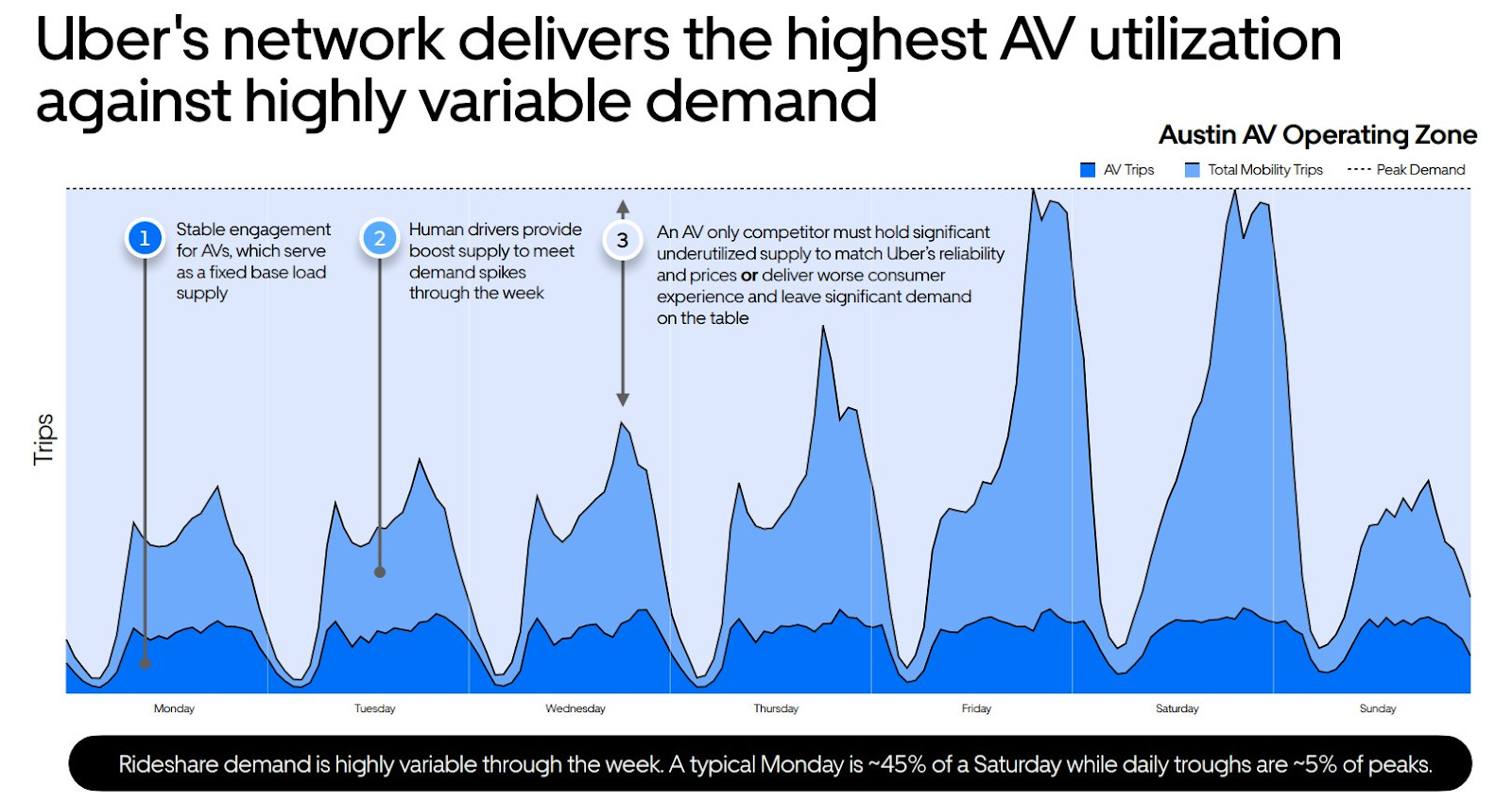
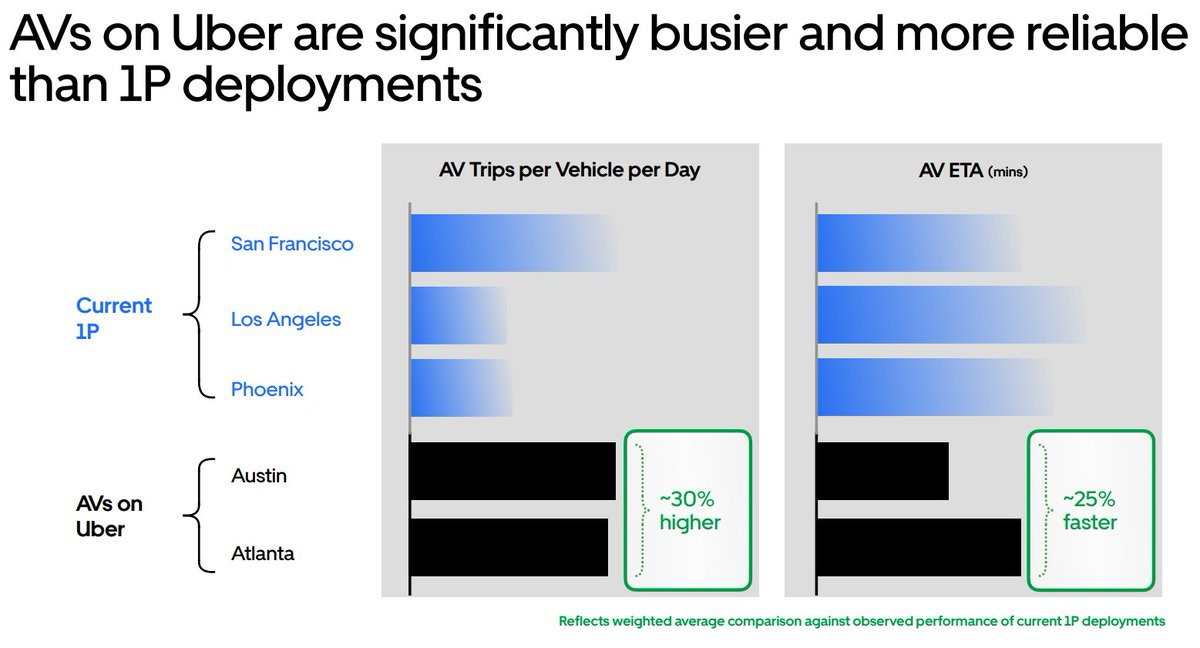
Uber’s AV argument makes sense. Rideshare demand is highly variable, which makes AVs a good fit for base load while human drivers handle peaks. But their first party benchmarks appear to be Uber’s own assumptions about Waymo utilization, rather than disclosed data. While the AVs on Uber’s platform reflect real performance and show about 30 percent higher utilization. I don’t think the conclusion is wrong, but the 1P numbers are highly sensitive to how those assumptions are set, and Uber did not share any methodology.
Related: ‘UBER CEO Dara Khosrowshahi used the prepared remarks in today’s earnings call to handle some misconceptions on Autonomous Vehicles’ (link).
Waymo Robotaxis Can Finally Go to SFO, But Don’t Try It If You’re in a Hurry (link). I guess Waymo has to start somewhere with SFO but this seems like a bad product experience. I don’t think Waymo should be encouraging folks to take airport rides to/from SFO just yet.
Interesting Hacker News comment that Waymo fares basically pull the money out of the local city (link). It’s a tough critique, but I think it’s a fair one. With Uber and Lyft, drivers take home roughly 60 to 70 percent of each fare, and that money flows back into the local economy quickly. Waymo has argued that they induce additional demand, which may be true and would increase local operations spending. But much of that spend mirrors what Uber and Lyft drivers already spend themselves, on items like vehicle maintenance, cleaning, repairs, charging, and other local services, just centralized through a fleet instead of individuals. To the extent those costs are comparable, it’s largely a wash1. The bigger difference is that a meaningful share of Waymo’s revenue ultimately flows back to Mountain View rather than staying in the city where the ride occurred. I don’t think there’s a clean solution here, but it does feel like a real downside of the technology that’s worth acknowledging.
Robotaxis are in a literal land grab moment (link). Interesting interview with Brett Hauser, CEO of Voltera. Vehicles may be the near-term bottleneck for AV growth, but over the next few years charging infrastructure looks like the real constraint.
Why Waymo’s London Launch Matters (link).
As a Londoner, I can tell you firsthand: this city is very different from its American cousins. It is not based on a grid. Instead, it is a culmination of about 2,000 years of haphazard building and rebuilding, with roads that can be winding and narrow. Jaywalking is legal here, and cycling is far more common. It has a much greater population density than many of the cities where Waymo currently operates, meaning your typical road is not just narrower, but busier too.
Uber plans to launch robotaxi services in Hong Kong, Madrid, Houston, and Zurich (link, no paywall), underscoring its push to make autonomous vehicles a core growth driver. Uber aims to operate driverless vehicles in more than 10 markets globally by the end of 2026, working with partners like Baidu and WeRide while continuing to compete with Waymo across several cities.
Waymo begins testing in Sacramento and Boston (link).

Dubai to launch Glydways network of self-driving pods, like train in cycle lane at cost of Metro (link).
‘This is just one story (of many) about how we tried, failed, and learned how to improve Zipline’s drone delivery system’ (link).
Senators grill Waymo and Tesla over robotaxi safety, liability, and China (link). Executives from both companies testified before the U.S. Senate Committee on Commerce, Science, and Transportation, with questions ranging from Waymo’s decision to use a Chinese made vehicle for its next generation robotaxi to broader concerns around safety and oversight. Separately, senators pointed to recent Waymo incidents, including vehicles driving past stopped school buses and a collision involving a child.
Lawmakers also raised concerns about Waymo’s remote safety operators, with an executive confirming that some are based abroad, including in the Philippines (link). It’s important to note that these operators are not driving the vehicles though. They step in only during edge cases to provide guidance, such as when a vehicle is stuck or needs help interpreting a situation. According to Waymo, the Waymo Driver remains in control of the vehicle at all times and does not rely solely on input from fleet response agents when determining the safest course of action.

New Hyundai Waymo in the wild (link).
‘At Kodiak, we’re building one AI Driver. It’s capable of driving on busy surface streets, highways, industrial roads, and off-road. It can drive small F-150s like in this video, huge tractor-trailers, and even various military vehicles’ (link).
California’s Teamsters call for Waymo ban, saying driverless cars threaten safety and jobs (link, no paywall).
An Uber-Lucid-Nuro Robotaxi testing in the cul-de-sac (link).
What else we're reading/listening to
The Compound and Friends podcast with Josh Brown and Michael Batnick featured Mark Mulhern discussing autonomous taxis and the opportunity in Uber (link). Uber’s relationship with Waymo has become a major driver of investor sentiment. If Waymo were to pull cars from Austin or Atlanta, Uber’s stock would likely take a hit, while a new Waymo launch on Uber would likely be a clear positive. I agree with the hosts though, over a multi year horizon, Uber looks like a good buy, especially if it continues to establish itself as the default demand layer in a fragmented AV market.
Autonomous System Safety by Phil Koopman: Is a Robotaxi Crash Really “Unavoidable”? (link).
AV companies are ignoring rural America. That’s a shame (link).
SF Urban Autonomy Summit 2026: Highlights and Takeaways (link).
AV behaving badly
Confused Waymo driving into oncoming traffic (link).
Announcements/Partnerships/Fundraising
Bedrock, an A.I. Start-Up for Construction, Raises $270 Million (link, no paywall).
WeRide and Uber to Deploy 1,200 Robotaxis in the Middle East (link).
Mercedes-Benz Unveils New S-Class Built on NVIDIA DRIVE AV, Which Enables an L4-Ready Architecture (link).
Uber appoints new CFO as its AV plans accelerate (link).
Uber is promoting Balaji Krishnamurthy, its VP of strategic finance and investor relations, to be its CFO. Krishnamurthy has been at Uber for over six years, spending most of his tenure in the company in its investor relations division. He often posts about the company’s autonomous ride-hailing efforts, and has a board seat at AV company Waabi — so the appointment may be a signal of the company’s plans to expand its driverless investments and operations.
Neat Jobs
Multiple engineering roles at Uber AV labs (link) via Praveen Neppalli.
Technical Lead Manager, Evaluation & Benchmarking at Waabi (link) via David Lukas.
Chief of Staff to CFO at Uber Freight (link) via Rebecca Tinucci.
Sr Manager, Deployment Operations at Skydio (link) via John Akalaonu.
Business Operations Principal at Waymo (link) via Sarah Basham.
Here’s a full list of the jobs we’ve featured (link).
Job Moves
Benjamin Chia: Deputy Manager (Autonomous Vehicles) at Singapore LTA ➡ Product Operations Technology Manager (Autonomous Vehicles) at Grab (link).
Jacob Schupbach: Social Media via US Tech Solutions ➡ full-time Social Media at Waymo (link).
Lauren Wilson: Senior State Policy and Government Affairs Manager at Zoox, May 2025 - Jan 2026 (link).
David Quinalty: Head of Federal Policy & Government Affairs at Waymo, Sept 2017 - Jan 2026 (link).
Cool Rides
‘We love a Big Game car wrap’ (link).
‘Being chauffeured by the Zoox self-driving cars made something click for me’ (link).
‘Over the last two days, I’ve taken 6 rides and spent 97 minutes in a Waymo and I’m genuinely blown away’ (link).
Shout-outs
Big thanks to TDD readers Drew and Semilore for referring new subscribers. If there’s someone you think would enjoy TDD, feel free to forward this email or use the referral button below, and we’ll make sure to shout out your company.
Until next week :)
-Harry
Insurance is one area where Waymo likely operates under a centralized or national policy, while many Uber and Lyft drivers purchase insurance through local agents or regional providers, which can further localize spending.