

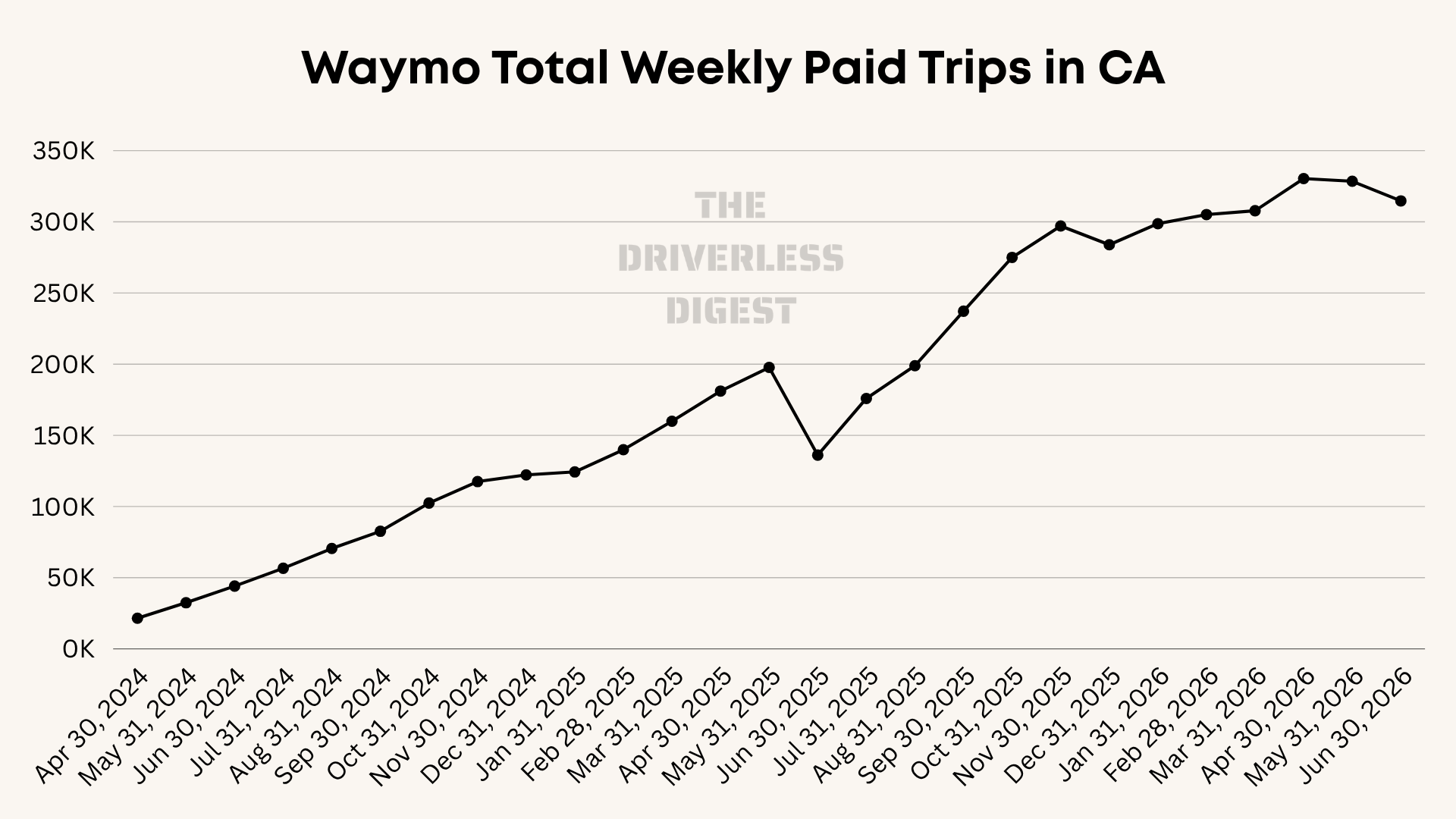
The latest data from the California Public Utilities Commission (CPUC), covering the second quarter of 2026, shows Waymo doing approximately 315,000 paid trips per week in California in June. That is still a huge number by any measure, but the direction of travel is now harder to ignore.
This is the third time we have looked at the question of whether Waymo’s growth in California is flattening. The first analysis showed a deceleration in the pace of growth through the first quarter of 2026. A follow up analysis argued that the underlying growth curve was indeed flattening, but that the picture was more complicated than simply saying Waymo had run out of demand.
The latest data adds another wrinkle.
First though, it is important to note that there is little doubt that Waymo is the dominant player in the U.S. robotaxi market, even though the industry remains in its early stages. The company currently operates in 11 U.S. cities and is delivering around 500,000 paid robotaxi rides per week.
This makes what is happening in California particularly interesting. Waymo is still growing rapidly overall, but its home market is showing signs that the growth strategy may be changing.
California Trips Are Now Falling
Waymo’s California paid weekly trip count grew in April to 330,400 and then went backwards to 328,500 in May and 314,700 in June.
There is an important caveat, however. Waymo paused freeway operations across the United States on May 21 while it worked on software improvements around construction zones and flooded roadways. Freeway service had become an increasingly important part of Waymo’s California operation, particularly in the Bay Area, where it allowed the company to connect parts of the Peninsula and cut journey times substantially, as well as in Los Angeles, where freeways are especially important given the city’s size and sprawl.
The freeway pause therefore overlaps with the period in which the California trip numbers started moving lower. So this may be one potential cause for the dip in paid rides.
The latest data also gives us another useful clue.
Average miles per paid trip fell slightly from 4.0 miles in May to 3.9 miles in June. This is only a small change, but it is notable because the longer term trend since July 2024 has been upwards. The freeway pause appears to have played a role in the June decline in trip length as well.
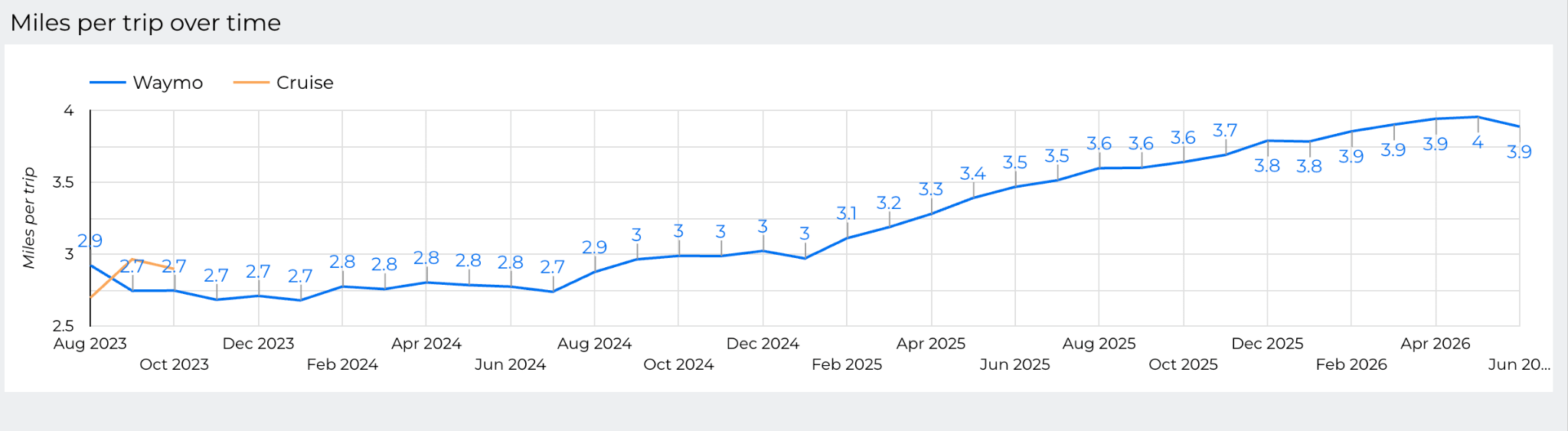
So we have fewer trips and slightly shorter trips in June. But the longer term picture remains one of passengers taking longer journeys than they were previously.
This Is Still A Slowdown
Even with that caveat, I think it would be wrong to dismiss the latest numbers.
In our previous analysis, the argument was that Waymo’s California business appeared to be following a fairly typical maturation curve. Growth accelerated rapidly as the service expanded, then began to flatten as Waymo became more established. The latest data does not prove that, but it does make the question harder to ignore.
There is also a more important point hiding underneath the headline trip numbers. Waymo does not necessarily need California to keep growing at the same rate. In fact, I am increasingly convinced that California may not be the market Waymo is most focused on maximising right now.
Waymo Has Bigger Ambitions
Waymo has been expanding aggressively outside California, with operations now stretching across a growing number of U.S. cities.
The company has been preparing for international expansion, and today announced that Munich will be its first mainland European market. It has also introduced its next generation robotaxi, the Ojai.
If Waymo already has a substantial presence in San Francisco and Los Angeles, adding another few percentage points of market share in those markets may be less valuable than proving it can reproduce the same playbook in a dozen other cities.
We made a similar point recently when looking at Uber’s claim that it is gaining market share from Waymo in San Francisco.
Waymo has already demonstrated that it can enter a mature rideshare market and take meaningful volume. The next question is whether it can do that everywhere.
This makes fleet allocation an important part of the story. Every vehicle deployed in a new market is a vehicle that cannot be used to squeeze more trips out of an existing market. And Waymo is now trying to do both.
The Next Quarter Will Be Much More Interesting
The June number of roughly 315,000 weekly paid trips should therefore not be treated as evidence that Waymo’s California business is collapsing. It is not. Three hundred and fifteen thousand weekly paid trips is still an enormous operation, and it represents years of growth from the relatively small service Waymo was running in California just a few years ago.
The freeway pause gives Waymo a perfectly plausible explanation for at least some of the recent decline. And because freeway service resumed gradually, we should get a much cleaner read on the underlying demand in the next set of data.
The average trip length will be worth watching too. If weekly trips rebound and average miles per trip return to their previous level or move higher, the May and June declines will look more like an operational blip than a demand problem.
If trips stay flat or keep falling, it will be harder to argue that Waymo’s California growth is anything other than a slowdown.
We know Waymo has been expanding aggressively beyond California, building a growing network of robotaxi services across Texas, Arizona, Florida, Georgia and Tennessee, with further launches planned in cities including Denver, Las Vegas and Tampa. The bigger question then may be whether Waymo will continue growing by taking its playbook into new markets, or will it go back to adding vehicles and growing market share in California.
Either way, the next CPUC release should tell us a lot.
Is it possible to know the number of vehicles deployed, and thus miles per vehicle? In other words, is the flattening the result of fleet redeployment or something else?
Isn't the drop in weekly *paid* trips just due to Ojai being free (up until very recently)?
The stats will jump up again now that the Ojai trips are paid.